
- Hypermobile hip exercises we use, and why clamshells aren’t one of them - 17 October 2026
- Is Fibromyalgia a Disability in the UK, and Can You Claim PIP? - 14 October 2026
- Fibromyalgia and Central Sensitisation, What Is It in Plain English? - 8 October 2026
This article is part of our comprehensive guide to exercise and rehabilitation for hypermobility.
Your hip clunks when you roll over. It aches somewhere deep at the front after a long sit, and it gives a little when you step off a kerb. Somebody has probably handed you a photocopied sheet of clamshells, the one exercise I hate more than anything else out there.
Below are some of my favourite exercises for the hip, along with why they are my favourite, and why I hate clam shells so much. I am also fairly certain you didn’t type “hip exercises for hypermobility” into Google, only to be met with a wall of text. So I’ll give you the exercises first, explain after, and for those of you who are really wanting to get deeper into this…..I’ll show you (text and video) why you should be starting at the foot first, if you really want to build some hips that will survive daily life!
These are the exercises I love the most, and the ones we put in front of hypermobile hips the most.
Glute med fire ups, where we start all the time
This one trains the hip in the position the hip likely keeps letting you down in: standing on one leg, with the other half of your pelvis hanging off it, while you’re walking down the street.
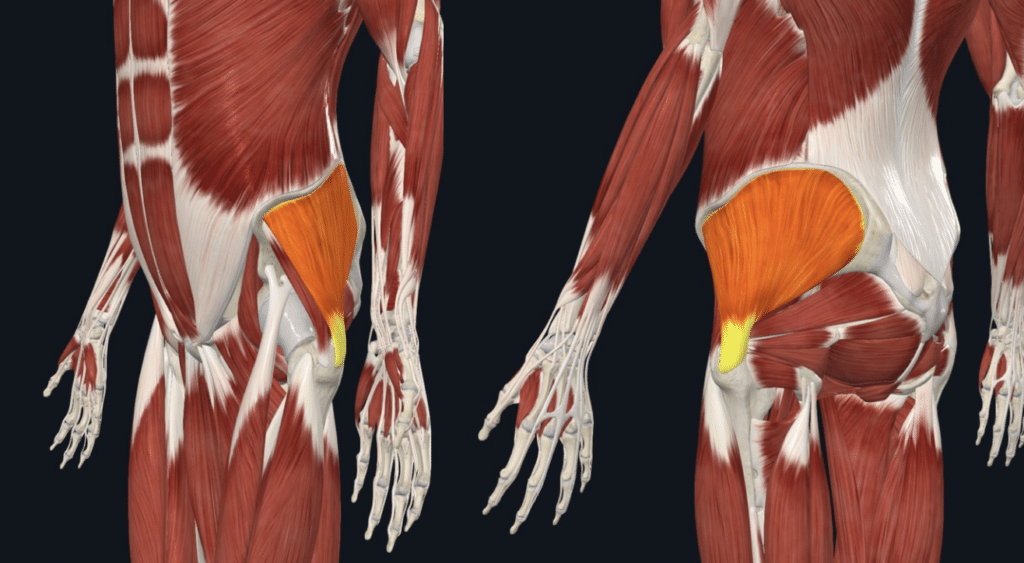
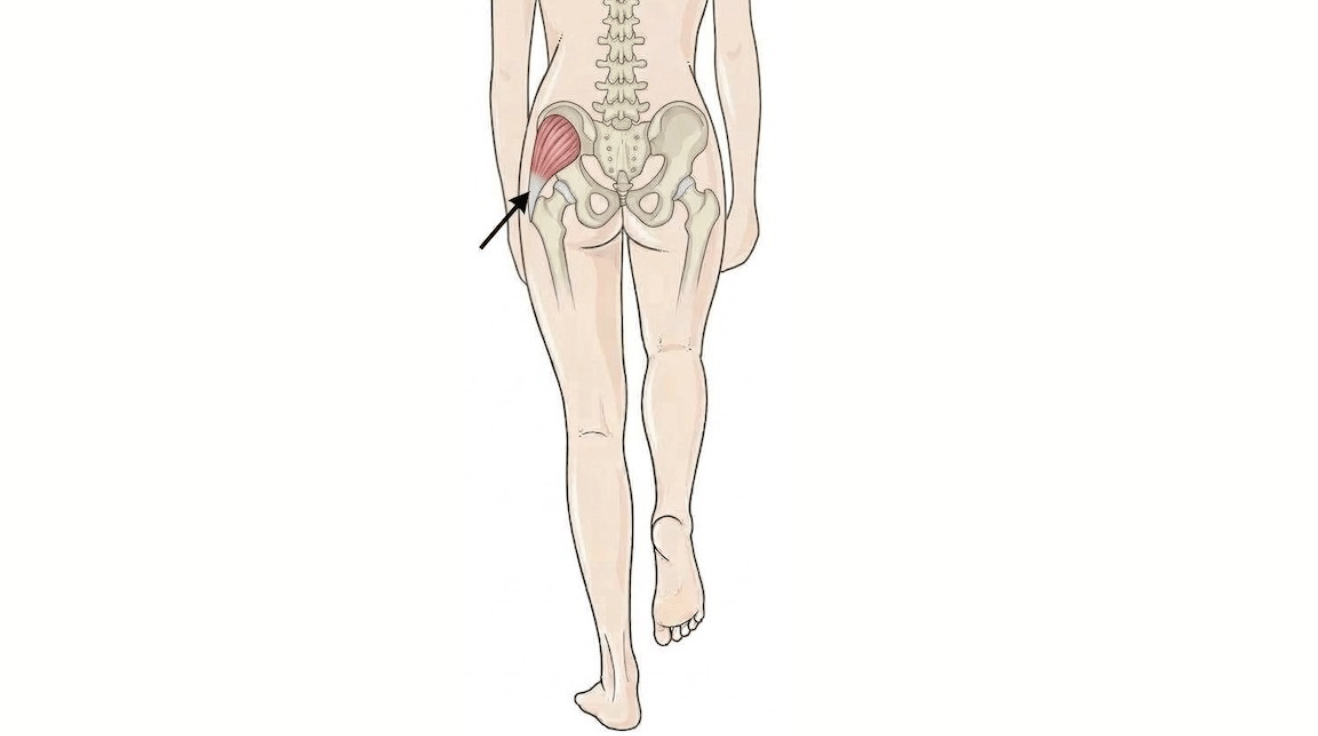
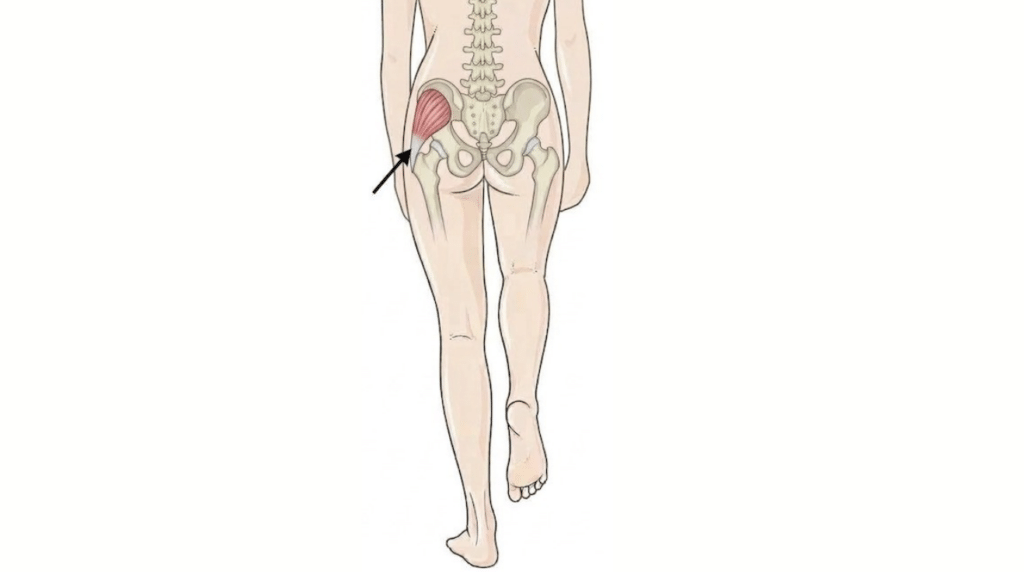
Every step you take has a moment where only one foot is on the floor, and in that moment the other half of your pelvis has nothing underneath it at all. The only thing stopping it dropping is the abductor group on the side that’s loaded, pulling down on the rim of the pelvis it’s attached to and levering the opposite side up. When that muscle can’t manage it, the free hip visibly drops away as the foot leaves the floor, and that drop has a name, the Trendelenburg sign. It’s exactly what somebody is watching for when they ask you to stand on one leg. On two feet the whole thing is invisible, because the other leg is taking its share.
So the job here is to hold the opposite half of your pelvis level while you balance, which is a different instruction from balancing and comes with a completely different feeling attached to it.
Why one leg, and why it’s the other hip that matters
The pelvis is held level by the hip, the hip is standing on a knee, and the knee is standing on a foot. Take any link out and the one above it ends up covering, which is why the foot work further down matters a good deal more than it sounds like it should do. It’s also one of the biggest issues we find, that people with hypermobility just can’t connect to the hip, or just feel it elsewhere….or not at all.
Pooling twenty studies that recorded electrical activity in gluteus medius across thirty three rehab exercises, all of it in people without injuries, standing on one leg while the other leg moves came out in the high and very high bands, while the prone, four point and bridging exercises sat down in the low and moderate ones [1]. That’s electrical activity in a single session rather than anything anybody got stronger at, though it matches what the exercise feels like and it matches what your hip is actually asked to do all day when you’re walking about.
Why we don’t start with clamshells
You’ve almost certainly been given clams. I honestly can count on one hand the number of clients over the years who hadn’t been given them(on one hand). Side lying, knees bent, lift the top knee, keep the feet together, in a V shape, three sets of fifteen, six week block, stick figure on a sheet of A4……fantastic, get out the office please and go home.
I will predict, nobody probably bothered explaining what they’re for. You did them, not much happened, and you came away concluding either that you’d done them wrong or that exercise doesn’t work on you. Both of those conclusions are doing you damage matey.
You get what you train, in the position you train it. A clam is side lying and unloaded, with the floor holding your pelvis up for you. The problem you’re trying to fix happens standing, on one leg, with your whole bodyweight going through a pelvis that nothing is holding level, gravity to argue with and a movement pattern to remember on top. One doesn’t reliably turn into the other. It’s a little like wanting to get really good at the piano, but you keep practising on the guitar…..yes it’s music, but one doesn’t transfer very well to the other.
Pooling 106 studies of proprioception training, training aimed at the thing being measured improved it by somewhere between roughly 29% and 43% on average, training that wasn’t aimed at it managed about half that, and no training at all shifted it a few per cent [2]. The gains were largest in people with musculoskeletal conditions rather than in healthy volunteers, and much the same wherever on the body the training was pointed at [2]. The authors are careful though, that most of the studies were small, and that a test you have now sat ten times is a test you get better at regardless [2]. Even with all of that, aiming the training at the thing you actually want is the part doing the work.
The argument you’ll meet online is a different one though…. and it’s weaker.
It runs thus: clams produce low gluteus medius activation on EMG, therefore clams are useless. There is a measurement behind it. Fine wire electrodes went into ten healthy young university students, with seven left per muscle segment once the artefact was thrown out, and in that single lab session the side lying clam came out in the low band for the front part of gluteus medius while the single leg squat came out in the high one [3]. Ten students, one session, nobody injured and nothing followed up over time, so it tells you how loudly a muscle fired on the day, rather than what anyone got stronger at. Interesting, and not the argument I’d hang this on.
The clam deserves better than that, mind. It’s a low load exercise done lying down, and low load exercises done lying down have a place. If you can’t yet stand on one leg without the hip screaming, if you’re mid flare, if the joint is too irritable to load, then the floor is the right place to be (perhaps you’re in a POTS flare) and there’s nothing wrong with starting there. My problem is the clam as a destination.
So get off the floor and get loading when you can, otherwise you’ll still be doing clams in ten years (I’ve seen this story play out so much). The nearest thing to a test of that in our own population was run on shoulders rather than hips. A hundred adults with hypermobility spectrum disorder and shoulder pain, four in five of them women, were randomised to sixteen weeks of heavier shoulder loading or to a lighter mid range programme, and the heavier group came out ahead on self reported shoulder function by less than the researchers had decided in advance would count as meaningful [4]. Shoulders, and a modest result, so take it as a nudge in the right direction, rather than a proof. Worth noticing that loading hypermobile people harder for four months did them no harm.

The hip hinge, and the pattern most people have lost
In a squat your knees travel forwards and you drop down between your feet. In a hinge your hips travel backwards and your chest comes down towards the floor, while your shins stay close to vertical and your knees stay soft and more or less where they started.
The pattern that goes missing
Here’s what losing the hinge looks like when somebody measures it. Sixty three adults, roughly half of them with long standing back pain, bent forwards with movement sensors on their backs. The group in pain used less of their lumbar spine to get there and more of their pelvis, so the bend was arriving from a slightly different place [5]. The same study found no difference at all in the curve of their lower backs standing [5], which is worth holding onto if anybody has ever told you your posture is the problem. All of it measured in a back pain group rather than a hypermobile one.
On hips specifically, eleven adults with hEDS were set against eleven matched controls and came out with roughly 40% less hip extensor strength on a dynamometer, with three of the eleven unable to complete the hip strength testing at all [6]. Eleven people, in a study the authors themselves describe as underpowered. Hold it loosely, and notice that the muscle group concerned is exactly the one the hinge trains.
I personally like it because it lets you feel like you have uncoupled your ribs from your pelvis. Try it and see what I mean.
Form closure, force closure, and what laxer ligaments do to the sum
Two words we need before we go further, to help explain your SI joints.
Form closure: This is the stability you get for free from the shape of the thing….in this case your pelvis. Interlocking surfaces, a snug fit, strong ligaments holding it together. Nothing has to dial up or down for form closure to work, it’s structural.
Force closure: This is the stability you generate by squeezing a joint together with muscle. It costs energy, it has to be timed, and it’s the thing you can train.
Six healthy young women had the stiffness of their sacroiliac joint recorded while they contracted one muscle at a time, and glute max, the hamstrings and the long muscles running up the back of the spine each cut how freely the joint moved by roughly half [7]. Six women, none of them hypermobile, and it’s glute max rather than glute med, which is part of why it belongs here with the hinge rather than with the exercise above it.
The step from there to you is mine, rather than the paper’s. If your ligaments are laxer, you have less form closure to begin with, so the force closure half has to carry proportionally more of the job. Nobody has measured that in a hypermobile pelvis (I know big surprise). It is, though, why I’d rather spend your time on a hinge than on anything passive.
Moving as one piece
When you walk, your ribcage and your pelvis rotate against each other. Your shoulders go one way as your hips go the other, and the faster you walk, the more pronounced that counter rotation gets.
Pool the gait research in persistent low back pain and that counter rotation is reduced, with the trunk and the pelvis moving more in phase, more like a single unit [8]. The range each segment turns through comes out the same as anybody else’s, and what differs is the timing between them [8]. So it’s a description of how somebody walks rather than a description of a locked spine, and those two are worth keeping apart.
It isn’t everybody, though. The narrative review of this work is blunt that the altered coordination turns up in some people with back pain and not others, and puts that down to how varied motor control changes are in back pain generally [9]. The same look can also be produced by bigger pelvic rotations, by arm swing and by how long your steps are, so it doesn’t prove a stiff trunk either [9]. All of it measured in low back pain, so carry it as a pattern somebody might show rather than as a thing you have.
I bring it up because it’s the other half of why I like the hinge. A hinge is practice at letting your hips travel a long way while your trunk stays exactly where it is.
Locking the arch, so we work the hip
If you want to kick the arse out of this, this is the bit that does it, and it’s the bit where most people feel the hip start working for the first time.
Everything above is done standing on one leg, and the thing you’re standing on is a foot. If that foot is rolling about underneath you, the leg above it rotates in to follow, and the work you were trying to put into the hip gets spent somewhere else entirely. A foot rolling in takes the shin round with it and the thigh follows, so a hip can be doing everything it’s asked and still lose the argument to the floor. Nobody has put a number on how much of your effort leaks away that way in a hypermobile leg specifically, so judge this one on whether the exercise feels different underneath you. It will.
So, before you go gung ho into a much harder version of the glute fire up, you need to actually be able to connect to and control the arch of your foot. There are many of you who are going to watch this video, and be incredibly humbled, and realise actually “I should focus on this a bit before getting into the hip work”. That is a good call. In the video I’m kneeling down as it’s easier to demo and point things out to you, but feel free to sit in a chair to practice, just make sure your ankles are directly underneath your knees.
If you were humbled, feel free to check out our dedicated hypermobile arch course.
Glute med fire ups with the arch locked high
Now put the two together, and this is the exercise I’d actually like you to end up doing.
With the arch locked, your shin can’t rotate in and your knee can’t fall inwards, so the foot has run out of ways to help you cheat, and the only thing left that can hold your pelvis up is your hip (just keep the knees soft as well). People describe this as a completely different exercise from the version they’d been doing for weeks, usually with some swearing thrown in.
Eversion, for ankles that keep rolling
Last one, and the smallest. Ankles mostly fail in one direction: the foot rolls outwards and under you, usually off a kerb, usually when you’re tired and looking at something else. The muscles that stop that live on the outside of your shin and run down behind the bony lump on the outside of your ankle, and their job is to pull the sole of your foot outwards. That’s eversion.
It’s in a hip article because every exercise above it is performed on one foot, and an ankle that gives out under load means the hip above it never gets a fair go.
Where to start
Four exercises is too many to begin with, so don’t.
First two weeks: the glute med fire ups and the hip hinge, both of them, most days. Low volume, high attention. You’re learning what the standing hip feels like when it’s working, and what your back feels like when it’s taken over.
Then: add the three points of contact and the arch loading pattern. Do them barefoot while the kettle boils, because an exercise that needs a slot in the diary is an exercise you’ll stop doing, and what we want is something that survives daily life.
Then: put them together. Glute med fire ups with the arch locked high, which is the one that earns the time.
Alongside, whenever: the eversion work. It costs ninety seconds and a band.
Taping comes up a lot for hips and there’s a separate piece on KT tape and the pretty bad evidence behind it. Worth knowing about, and no substitute for any of the above.
What I’d want you to take from all of this is that your hip is a joint being asked to do a difficult job, with less structural help than most people get, standing on one leg, several thousand times a day. Train it in that position and it gets better at it. It genuinely does.
Adam
References
[1] Ebert, J.R., Edwards, P.K., Fick, D.P. and Janes, G.C. (2017) ‘A Systematic Review of Rehabilitation Exercises to Progressively Load the Gluteus Medius’, Journal of Sport Rehabilitation. https://doi.org/10.1123/jsr.2016-0088
[2] Seo, H.G., Yun, S.J., Farrens, A.J., Johnson, C.A. and Reinkensmeyer, D.J. (2023) ‘A Systematic Review of the Learning Dynamics of Proprioception Training: Specificity, Acquisition, Retention, and Transfer’, Neurorehabilitation and Neural Repair. https://doi.org/10.1177/15459683231207354
[3] Moore, D., Pizzari, T., McClelland, J. and Semciw, A.I. (2019) ‘Rehabilitation Exercises for the Gluteus Medius Muscle Segments: An Electromyography Study’, Journal of Sport Rehabilitation. https://doi.org/10.1123/jsr.2018-0340
Read More[4] Liaghat, B., Skou, S.T., Søndergaard, J., Boyle, E., Søgaard, K. and Juul-Kristensen, B. (2022) ‘Short-term effectiveness of high-load compared with low-load strengthening exercise on self-reported function in patients with hypermobile shoulders: a randomised controlled trial’, British Journal of Sports Medicine. https://doi.org/10.1136/bjsports-2021-105223
[5] Laird, R.A., Kent, P. and Keating, J.L. (2016) ‘How consistent are lordosis, range of movement and lumbo-pelvic rhythm in people with and without back pain?’, BMC Musculoskeletal Disorders. https://doi.org/10.1186/s12891-016-1250-1
[6] Ball, L.N., Jacobs, M.V., McLouth, C.J., Clasey, J., Francomano, C., Sheppard, M.B. et al. (2024) ‘Assessment of gait mechanics and muscle strength in hypermobile Ehlers Danlos Syndrome’, Clinical Biomechanics. https://doi.org/10.1016/j.clinbiomech.2024.106210
[7] van Wingerden, J.P., Vleeming, A., Buyruk, H.M. and Raissadat, K. (2004) ‘Stabilization of the sacroiliac joint in vivo: verification of muscular contribution to force closure of the pelvis’, European Spine Journal. https://doi.org/10.1007/s00586-003-0575-2
[8] Smith, J.A., Stabbert, H., Bagwell, J.J., Teng, H.L., Wade, V. and Lee, S.P. (2022) ‘Do people with low back pain walk differently? A systematic review and meta-analysis’, Journal of Sport and Health Science. https://doi.org/10.1016/j.jshs.2022.02.001
[9] van Dieën, J., Prins, M., Bruijn, S., Wu, W., Liang, B., Lamoth, C. et al. (2021) ‘Coordination of Axial Trunk Rotations During Gait in Low Back Pain. A Narrative Review’, Journal of Human Kinetics. https://doi.org/10.2478/hukin-2020-0085