

This article is part of our comprehensive guide to hypermobility and Ehlers-Danlos syndrome.
The wrist is the joint people come to us about last, well after the shoulders, the hips and the knees, and usually because typing has started to hurt or bearing weight through them has become troublesome.
Most of the advice aimed at them is some version of the same old strengthen your grip, that you’ve likely heard a million times before.
What a hypermobile wrist is, and how it differs from a typical one
Your wrist isn’t one joint, it’s made of many small bones and ligaments, and there’s not much in the way to actually strengthen.
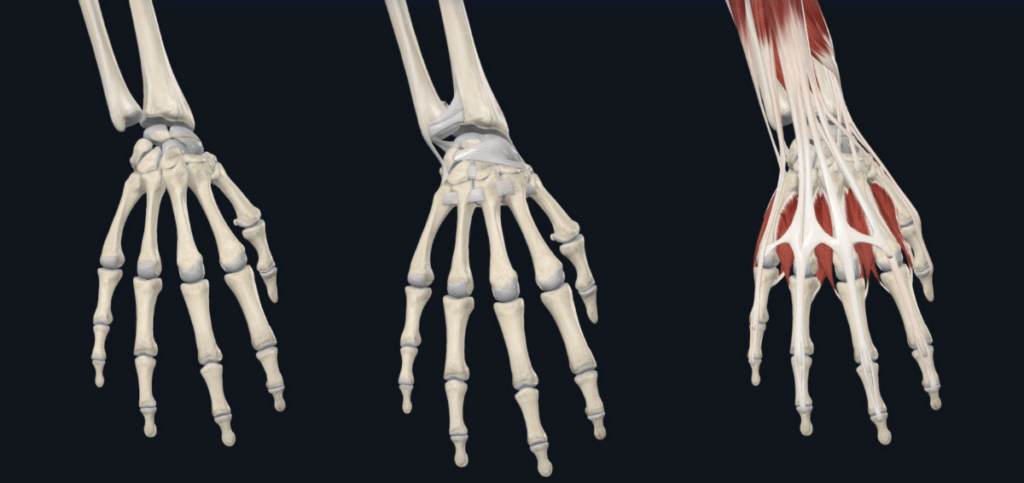
You have the radius and the ulna (the two bones of your forearm) and below them the eight small carpal bones sitting in two rows of four. Then three separate joints do the work between them. The radiocarpal joint, where the forearm meets the first row of carpal bones, does a lot of the bending forwards and back. The midcarpal joint, between the two rows, does a good share of that bending as well. And the distal radioulnar joint, where the radius and the ulna meet each other down at the bottom, is the one that turns a key in a lock.
Why hypermobile wrists hurt
Extra range isn’t painful on its own. What hurts is everything the rest of the system has to do to cover for it.
A joint is held together two ways. There’s passive restraint, which is the ligaments, the capsule and the shape of the bones, and it’s instant, free and permanently switched on. In a wrist where the passive stop turns up late and soft, more of the job falls to the muscles. Muscles are slower and muscles get tired. That’s most of why a hypermobile wrist is fine for the first twenty minutes of something, and then distinctly not fine by the end of it.
Holding the hand loaded at the end of its range raises the risk of pain, pins and needles, and subluxation or dislocation in hypermobile Ehlers-Danlos syndrome and hypermobility spectrum disorder [1]. A subluxation, since the word gets used at people without ever being explained to them, is a joint surface shifting further than it should and then going back by itself. A dislocation stays out until something puts it back in.
Picture the position that first bit describes. You’re at a laptop, the heel of your hand on the desk edge, wrist bent back over it, forearm resting its weight on top. The joint is at the end of what it can do, under load, for a few hours, while you type away.
Your wrists have nerve endings, whose whole job is to report exactly that. Nociceptors are high threshold endings that fire when something might be about to do damage (actual or potential): too much stretch, too much pressure, too much load, or held for too long past your capacity.
Across hEDS and HSD, pain is common, and linked to subluxations, dislocations, impaired proprioception and chronic overload of unstable joints [2]. At the wrist specifically, the pain is often reported as coming from subluxations [3]. And there’s a named version of it: Midcarpal instability. It follows ligamentous injury or laxity, and when the unstable joint is the one between the lunate and the capitate, the capitate can shift forwards or backwards, which causes pain and grip weakness [4].
Proprioceptive deficits and impaired motor control sit at the centre of symptomatic hypermobility, which gives you a plausible route from lax ligaments to pain during loading and repeated activity [5].
The signal problem
Proprioception is your sense of where your body is without looking at it. It comes from receptors in the muscles, in the tendons, in the joint capsule and ligaments, and in the skin, all reporting to your brain. Your brain then takes that stream, works out where the joint is, and predicts where it’s about to be.
Lax tissue degrades that stream before it ever reaches the brain. A receptor sitting inside a ligament reports how much that ligament is being stretched. If the ligament deforms more for the same amount of joint movement, the relationship between the stretch and the actual position gets looser. The information still arrives. But it arrives noisier and less precise, and a noisier read makes a worse prediction. A worse prediction means the correction arrives late, and a late correction at a joint already sitting at the end of its range is how you get caught out.
Which is a measurement problem happening at the joint itself, and it’s why being told to concentrate on your form has most likely got you nowhere. You can’t concentrate your way to better information.
It isn’t all mechanical
Pain in hEDS rarely has one source. Some of it comes from the tissue itself, and some of it comes from the nervous system turning its own volume up [6].
That second part gets used against people, so here’s the plain version. When something hurts for long enough, the system carrying the signal turns its own gain up. The nerve endings get easier to set off. The spinal cord passes more of what arrives through to the brain, and it passes it through for longer. What you notice is ordinary pressure starting to get reported as worth knowing about, the sore area spreading wider than whatever is actually irritating it, and a flare taking longer to settle than the tissue needs. That’s sensitisation. None of it means the pain is imaginary and none of it means your wrist is fine. A volume knob has moved, and volume knobs move both ways.
Small fibre neuropathy is frequent in pain centre cohorts, and neuropathic pain features are common, so median nerve compression is only one possible contributor to hand symptoms [7]. The small fibres are the thin, barely insulated ones that carry temperature and much of the threat reporting, as opposed to the thick fast ones that carry position and touch. Hang on to that, because it’s the reason a normal nerve test isn’t the end of the conversation, and we’ll come back to it.
The little finger side
The little finger side of the wrist is where the two bones of your forearm meet, and unlike most joints, they aren’t held together by their shape. There’s very little bone locking them in place, so the job falls to soft tissue [8]. The main bit of soft tissue doing it is the TFCC, a small cushion of cartilage with a sling of ligaments round it [9]. It’s what keeps those two bones together while you turn your hand, think turning a key in a lock. And soft tissue is exactly the thing that’s laxer in you.
Pain on this side tends to come with clicking, weakness, a weaker grip and pain when you turn the forearm [10]. If turning a doorknob or wringing out a cloth is what sets you off, that’s the pattern.
It isn’t the only thing that hurts there, though. An irritated tendon, a slightly long ulna knocking into the wrist bones, and wear in the joint can all sit in exactly the same spot [10].
And a wrist that moves a long way isn’t automatically an unstable one. The hand literature now argues the two have to be told apart [11]. Whether yours is unstable is about what it does, not how far it goes.

Wrist braces and supports
A brace does two things: It stops a joint reaching a range you can’t control, and it puts something on your skin that your nervous system can feel a bit better. Everything else written on the box is pretty much just marketing.
Which is why the answer to which brace to use, is a question about the task rather than the brand.
Work out what you’re doing when it hurts, work out whether the problem is range, rotation, grip or the thumb, and then take the least restrictive thing that covers that problem.
There’s one direct comparison in hypermobility for this exact thing, and people rarely talk about it. Put head to head, wrist stabilising exercise and a hand orthosis came out with no significant difference after twelve weeks. That’s on pain, pins and needles, hand function, grip strength, ability to do activities, and quality of life [1]. A brace is a thing you buy once and put on. Exercise is work, delivered over weeks or months, which is a considerably harder sell than a strap. Both landed in the same place after three months though, so if bracing is what you can manage this month, bracing is a perfectly reasonable thing to be doing.
Surveys do report that many people find splints or braces helpful for pain control, and that’s uncontrolled self reported data rather than a comparison [12], so take it as a reason to try, rather than solid evidence.
Now, the costs are real and they’re fairly specific. Some braces clearly trade stability for reduced function or comfort [13], and the ten orthoses compared in that work were tested on healthy women rather than anybody hypermobile (there really aren’t many studies in this area). And the children’s work is blunter still. In a small study built around handwriting, most students didn’t get significant pain relief and 75% reported pain from the brace itself [14]. A neoprene wrist and hand splint slowed handwriting down, didn’t reduce pain in children with joint hypermobility syndrome, and several of them had their pain improve after the splint came off [15].
What each one is actually for
Compression sleeve. It doesn’t stop your wrist going anywhere, and that’s the point of it. What it does is put even, constant pressure on the skin. Essentially handing your nervous system a steady stream of information about a joint it was already struggling to get pinpointed data from. Compression garments have prospective cohort and randomised data showing reduced pain, improved balance or proprioceptive measures, and fewer sprains or subluxations at the whole joint level. But, a caveat, and a bloody big one at that, none of those studies were wrist specific [16]. So the evidence is borrowed from the rest of the body. It’s also the cheapest thing on this list, it takes nothing away from you, and you can type in it, which makes it the sensible first thing to try.
Elastic wrap or strap. You set the tension yourself, you decide how much of the end of range it takes away, and you can change your mind for the next job. This is the one for the twenty minutes of chopping, mixing, sanding or carrying that reliably hurts…… and then off it comes. A wrap you tighten for a specific task, is doing something quite different from a brace you wear all day.
Rigid night splint. This holds the wrist near neutral while you’re asleep, and the whole point of it is the hours you aren’t awake and conscious. It’s aimed at night time median nerve symptoms, for the crowding reason we’ll get to in the carpal tunnel section further down. It isn’t a daytime brace, and wearing it as one will cost you more function than it actually buys you.
Thumb support. The thumb column is where a lot of pinch and grip load actually enters the hand, and a thumb that collapses makes the wrist brace against it. Take the thumb out of the equation and you can settle a wrist that was never the original problem. Finger orthoses improved hand function in small repeated measures studies, which suggests supports further down the hand can help with selected tasks even where the wrist brace picture is mixed [17].
Actually, this is a fairly big one for handwriting as well. There has been many a client over the years who struggled with writing. And we have found a lot of the time, it was because of issues with the thumb dropping and straining that first CMC joint. What we find actually helps a lot of people, is using KT tape to help guide the thumb into the right position, without restricting it too much. I have put a video below on it, in hope it helps a lot of you struggling with the same thing.
Ulnar side support. These are the narrow bands that sit across the distal radioulnar joint instead of immobilising the whole wrist, and they’re aimed at the little finger side specifically. An external wrist band brace reduced distal radioulnar joint translation towards near normal levels after the TFCC had been detached, and that was measured on cadaver wrists, rather than on anybody who could tell you whether or not it felt better [18]. A mechanical measurement isn’t a comfort measurement, though it does mean the design does the thing it says on the packet (which is not something I say a lot). If your pain is on the little finger side and worse on rotation, that’s what to look at before a full wrist brace.
On KT tape, the authors of one major hypermobility review, classify kinesiotaping as anecdotal and under studied [19], and we’ve written about it separately (extensively). We do like it, we are very clear on the evidence around it not being great or the results it yielded in studies. It’s used massively in the hypermobile community, it’s far too thin to actually do any physical supporting, so the most likely explanation for those who it does appear to work for, is that it’s probably a sensory thing: a big giant tactile cue.
Building wrist control
The brace buys you the task. What changes the wrist with the brace off is an order of operations, and the order matters a good deal more than any single exercise within it.
Wrist advice for hypermobility goes straight for grip, usually in the form of being handed a squeezy ball. Grip matters, though grip comes last. A stronger muscle attached to a joint your brain can’t locate accurately just gives you a faster route to the end of your range. What you train is the information first, then the response to it, and only then…… the load.
Therapeutic exercise and motor control training tend to improve pain, proprioception, and function in hEDS and HSD, while the evidence for adaptive equipment such as splints or braces is weaker and much more limited [20]. Outside hypermobility, personalised exercise based physiotherapy improved pain and function in a carpal instability group who didn’t have EDS [21], which is encouraging rather than conclusive, because they aren’t us. And a programme combining an orthosis with progressive strengthening and proprioception training reported large gains in pain, grip, range of motion, function and stability at the distal radioulnar joint. That was a small quasi experimental study with no control group [22]. Read the design before you read the result on that last one.
The order that works
Clarity first. Anything that gives the wrist a lot of information without asking much of it. Pressing the flat of your hand into different surfaces and noticing what’s different about them. Moving slowly to the edge of the comfortable range and back, eyes open and then shut, trying to stop in the same place twice. Resting the forearm on a table and moving only the hand, so the shoulder can’t quietly do it for you. It feels pointless, and it’s the part that makes everything after it work.
Then control, which means holding still. Isometric work in the middle of the range, where you push against something immovable and nothing visible happens. Press the back of the hand gently up into the underside of a table and hold it. Press the palm down into the tabletop and hold. Push the little finger side into a wall. Do it at several wrist angles, because control at thirty degrees tells you nothing whatsoever about control at seventy.
Then load, and bring the forearm into it. Rotation under resistance is the piece everybody skips, and it’s the one the distal radioulnar joint needs. Hold something weighted at one end, a hammer held down the handle is ideal, and turn the palm slowly up and slowly down with your elbow tucked in. Then weight through the hand, building towards a flat palm instead of starting there. A fist on the floor keeps the wrist straight. A wedge, or a rolled towel under the heel of the hand, cuts how much extension you have to tolerate. Hands on a wall is less than hands on a worktop, which is less than hands on the floor.
Then vary it. This is the bit that turns a drill into a skill. The same movement at a different speed, on a different surface, with a different hand position, with your eyes shut, while holding a conversation. Control that only exists in one tidy version of a movement is a horse with blinders on, and your wrist doesn’t meet tidy versions of movements during the day. Build out those wrist schema. More on motor learning here by the way.
Then build a ladder for the thing you actually care about. If it’s drawing, the ladder is minutes of drawing. If it’s a press up, the ladder goes wall, worktop, bench, floor, and it moves up when the current rung has got boring and easy, rather than when the calendar says so. Change one thing at a time, more time or more load or less support, never two at once, because when it flares you want to know which one did it.
In practice that’s a short, regular, and faintly dull set of positions that gets harder in one dimension at a time, done most days, for longer than you’d like. I know it’s not a crazy, sexy moment with a catchy name, but that’s rehab for you.
A thing we do in the gym, and it’s ours
Nothing in this part is cited, and that’s on purpose. Everything else on this page sits on the papers at the bottom of it. This sits on our studio floor and nothing else, so read it as what it is: something we do, that we think is worth a go, with no paper underneath it, that we’re pointing you at.
The problem that it’s for turns up the moment somebody puts weight through a flat hand. A press up, a cat cow, pushing up off the floor, the position a Pilates or yoga class tends to start in. What stops them often isn’t pain. It’s a nip, or a catch, or a sense that something is in the way, and the words people reach for are stuck, jammed, pinched or gritty. It’s also the sort of thing that gets looked at and called fine, which it is, in the sense the word fine is usually meant.
What we do about it is fairly small, and it really does look like nothing at all. Take hold of the forearm just below the wrist joint, hold it steady there, and move the hand itself in slow circles (keeping the fingers bladed). Gently, a few seconds each way. It isn’t a stretch and there’s nothing to push into. Then go back to whatever you were trying to put weight through, and see whether the sensation has changed.
Watching it is quicker than reading a description of it though, so I have put a video below. A couple of minutes, and there’s an ankle version on the end of the same video because people kept asking for one.
Our hypothesis about why it does anything is that it settles the small bones of the wrist into a position they load better from. Hypothesis is the right word and we’d rather use it than a better sounding one. We haven’t shown that’s what happens, and you don’t have to believe the explanation to try the thing.
What people tell us afterwards is that the nip isn’t there when they go back to the same position or it feels like their bones have popped back into place. Sometimes it still is. If that’s you, that’s told you something rather than nothing, and the section above this one is the part that actually changes a wrist. This is a way of getting a session started, not a treatment, and none of it wants forcing.
Typing, phones, sleeping and carrying
None of this replaces the sections above. It’s how you stop spending the tolerance you’re actually building, which is a different job and a far, far easier one.
The useful move in hypermobility spectrum disorders, is broad activity modification, temporarily keeping off the loading that provokes it, adjusting work or sport, and education, rather than any particular ergonomic prescription [23].
Typing. The problem is rarely the typing. It’s the position your hand gets parked in between bursts of typing. The heel of the hand lands on the desk edge, the wrist bends back over it, and the forearm leans its weight through that one point for hours at a stretch. Get the forearm supported along its length instead of balanced on a single spot, which usually means raising the chair or lowering the desk until your forearm sits roughly level and can rest on the surface. Pull the keyboard back towards you so the hand isn’t reaching for it. If you use a wrist rest, use it between bursts and not as a pivot to type over, because a rest you lean on while your fingers work is just a more comfortable version of the same problem.
Laptops. A laptop bolts the screen to the keyboard, so either your neck loses the fight or your wrists do. A separate keyboard and a stand for the laptop solves both at once and it’s the change we’d make first, for the money. If you can’t carry a keyboard about with you, at least move often enough that nothing holds still for an hour.
Phones. The usual grip rests the bottom of the phone on the little finger while the thumb reaches diagonally across a screen that’s too big for it, which loads the ulnar side and the thumb base at the same time. Those being the two places you’re already sore. Hold it in the palm with both hands, or rest it on something, and scroll with the hand that isn’t holding it.
Writing, drawing and crafts. Fine work means a sustained grip, and a sustained grip in a hypermobile hand usually means over gripping, because squeezing harder is how you compensate for a joint you can’t feel precisely. A thicker barrel on a pen or a tool needs less squeeze to control, which is why the fat grips sold for arthritis work rather well here. Breaks taken before it hurts instead of after are the harder habit, and they’re the one worth building.
Sleeping. You can’t steer your position, so make the available positions better ones. Keep the hand out from under the pillow and out from under your own head, because both of those park the wrist at the end of its range under body weight for hours. A loose splint is a reasonable way to force the issue if curling is your pattern.
Carrying. The further a weight sits from your body, the harder every joint in the chain has to work to hold it, and your wrist is at the far end of that chain. Carry bags in the crook of your elbow or on your shoulder instead of hanging them off your fingers. Use a rucksack. Use a trolley for the shopping. Split one heavy bag into two lighter ones, so you aren’t hanging a load off one hand with your wrist bent sideways to keep it clear of your leg.
Clicking, clunking and subluxation
Noise on its own isn’t evidence that anything is wrong (you should have heard my Granny’s knees, and she was a machine), and the evidence for that is much better than you’d expect.
Snapping of the extensor carpi ulnaris tendon turned up in 6.6% of people with no wrist symptoms at all, and ultrasound confirmed actual subluxation or dislocation of that tendon in 2.9% of them, so clicking alone doesn’t prove causality [24]. Those figures belong to an asymptomatic group (no symptoms), which is the entire reason they’re useful in the first place.
The snap itself is the tendon slipping out of its groove and back in again, as you turn the palm up or bend the wrist and lean it towards the little finger. And the pain tends to come when friction and tendinopathy develop, rather than from every audible snap [24]. Tendinopathy being the state a tendon ends up in once it’s been irritated for a while: thickened, sore to press, and generally grumpy about load. So, the noise and the problem are two separate things entirely, and you can have the first for years without ever getting the second.
The words people use are worth translating also, because they’re describing genuinely different things and they get flattened into “clicking” by the time they reach a clinician.
Crunchy, or like Rice Krispies under the skin, is crepitus: a fine, repeated, grinding sort of sensation you feel more than you hear, and it tends to come with movement rather than at one particular point in your range. A click or a pop is a single discrete noise at a specific point, usually reproducible if you do the same thing again and again. A clunk is bigger, lower, and considerably more alarming. It usually comes from the middle of the wrist as that first row of carpal bones changes position under load, which is the midcarpal joint from earlier and the one midcarpal instability is named after. If you roll your hand from thumb side to little finger side with weight on it and get a solid thud, that’s the one. Giving out or buckling is the wrist not holding the weight you’ve put through it, so the hand drops a few millimetres before you catch it. And “it came half out and went back” is a subluxation, which needs nobody to put it back, which is precisely why it gets waved off at appointments.
What actually tells you something, is what comes along with the noise. Clicking at the TFCC or the distal radioulnar joint that comes with pain, weakness or provocation on rotation, is repeatedly described as a symptom of instability or of something sitting alongside it [10]. So a wrist that clicks and otherwise behaves itself, with no pain, no swelling, no weakness and no giving way, is a wrist making a noise. A wrist that clicks and also gives way, or aches for two days afterwards, or has quietly lost grip, is telling you something, and that’s the one to take to somebody.
Hypermobility and carpal tunnel
The carpal tunnel is an actual tunnel.
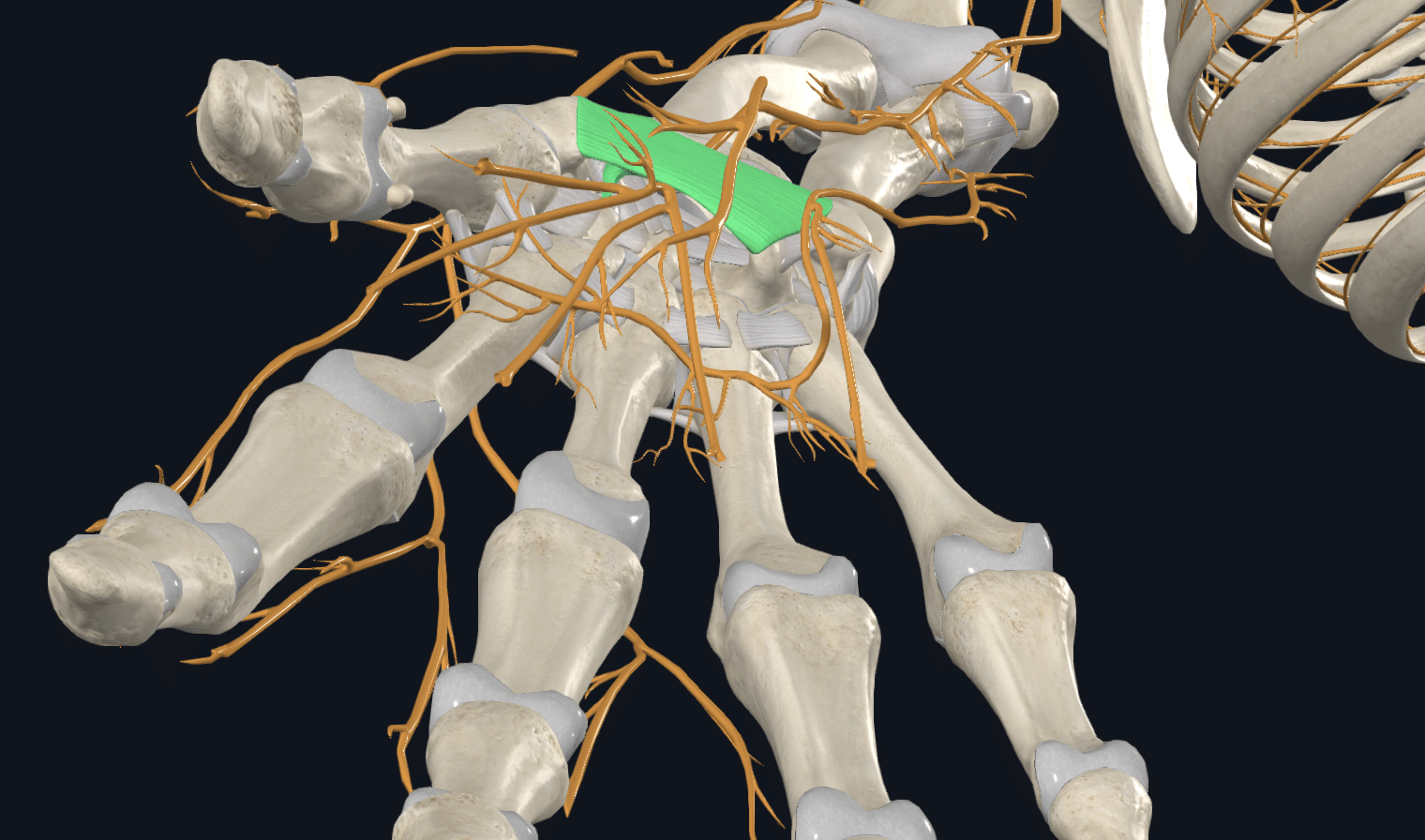
The carpal bones form an arch, and a thick band called the transverse carpal ligament roofs it over. Through that gap run nine tendons that bend your fingers and thumb, and the median nerve. The walls are bone and ligament, so the space can’t stretch to accommodate anything. Put more in there, or hold the wrist in a position that crowds what’s already in there, and the softest thing in the tunnel absorbs it. The softest thing in there is the nerve.
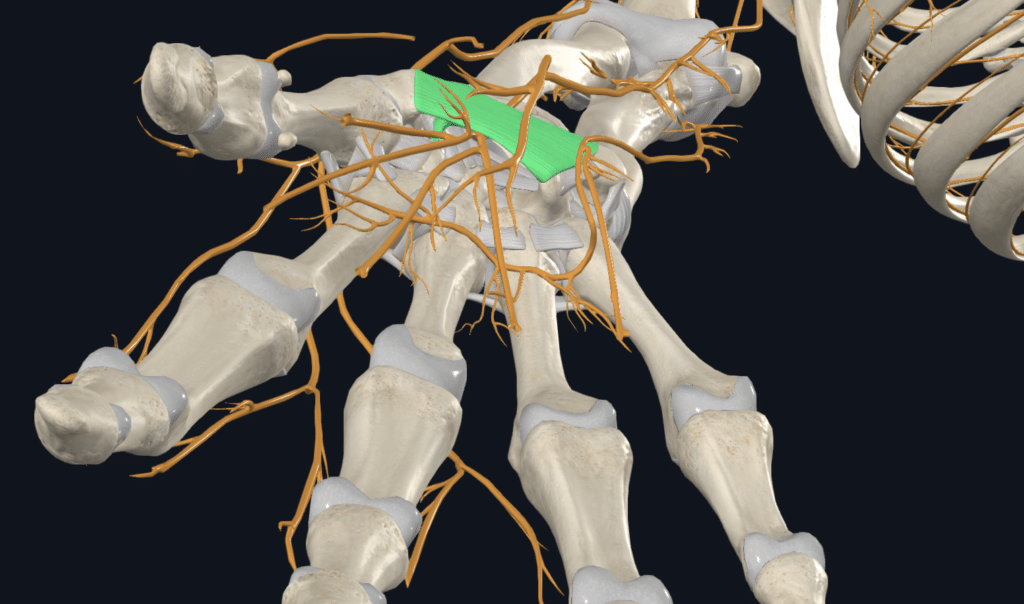
The median nerve supplies sensation to your thumb, index finger, middle finger and half your ring finger, and it drives some of the muscles at the base of the thumb. Which is why the classic picture is numbness and pins and needles in those fingers and not the little one.
In a controlled study using nerve conduction testing, benign joint hypermobility syndrome was markedly more common in people with carpal tunnel syndrome than in people without it, and carpal tunnel correlated positively with hypermobility [25]. In women who had carpal tunnel syndrome in both hands, the hypermobile group had worse symptom severity and worse functional capacity, plus more positive provocative tests [26]. Both of those are observational though, so what they establish is that the two turn up alongside each other and not that one drives the other.
It doesn’t follow that every hand symptom in hEDS or HSD is carpal tunnel, because neuropathic pain, small fibre neuropathy and instability related pain overlap clinically [7]. Standard nerve conduction studies measure the large, myelinated fibres, because those are the ones that conduct fast enough to be measured this way. Small fibre neuropathy is, by definition, a problem with the small ones, and the test isn’t built to actually see them. A normal nerve conduction study tells you the median nerve isn’t being squeezed hard enough to slow the big fibres down. It’s a specific answer to a very specific question.
Additionally, sleep tends to leave the wrist curled, either flexed under a pillow or bent back under your own bodyweight. Bend a wrist hard in either direction, and the contents of that tunnel get crowded together. Hold it there for seven hours, and the nerve gets a very long squeeze.
So, what to do with that?
Go into your appointment describing the pattern instead of sensation. Because thumb, index, middle and half the ring finger, worse at night, better after shaking the hand out, is a recognisable shape, and it’s the thing that gets acted on. If a nerve test has already come back normal and your hand still does what it does, say so and ask what else would fit, because that test answered one question and the rest of them are all still sitting there waiting. And if the night is where this hits hardest for you, the rigid night splint back in the braces section is aimed at exactly that: the seven hours you’re not conscious.
When to see someone
Some of this is worth getting looked at instead of trying to fight through the managing at home, and the list is shorter than the internet would have led you to believe.
Numbness or pins and needles, in a pattern that doesn’t shift when you move, particularly if it wakes you at night. Weakness you can see rather than weakness you suspect, so dropping things you had no intention of dropping, or the fleshy pad at the base of your thumb looking flatter on one side than the other. A wrist that locks or catches so you can’t finish a movement. A clunk that arrives with pain and with the wrist giving way under weight. Pain concentrated on the little finger side that gets worse with turning and hasn’t settled. Swelling that has turned up and stayed. Any of it starting after a fall onto an outstretched hand. And pain that’s stopped responding to whatever used to settle it.
Two things are worth knowing before you go: Distal radioulnar joint instability and TFCC tears are frequently missed, the diagnosis is primarily clinical, and imaging is there to confirm a suspicion rather than to replace an examination [27]. So the appointment that helps you is the one where somebody puts their hands on your wrist and provokes the thing, and also a scan you were sent for without an examination isn’t a shortcut to the answer…….just putting that out there.
And if something does get found, that isn’t the same as being sent for surgery. For a stable TFCC tear without instability at the distal radioulnar joint, non surgical treatment is moderately successful and is repeatedly recommended as first line for at least six months [28]. Six months sounds like a long wait. It’s also permission to get on with the work instead of just sitting on a list.
Ask for somebody who’s seen hypermobile hands before. Physical therapy tailored to EDS gets rated as more helpful than standard physical therapy, and sometimes as equal to or better than surgery on perceived benefit [29]. When you get there, describe what your wrist does, rather than how far it bends. “It gives way when I take weight through it” and “it clunks and then aches for two days” will get you a great deal further than saying you’re quite hypermobile, which is a sentence that’s been getting people dismissed for decades, unfortunately.
And bring the task with you. If it’s one specific movement at work that sets it off, do that movement in front of them.
Adam

References
[1] Susanne, L. and Lisbeth, C. (2024) ‘Wrist Stabilising Exercise Versus Hand Orthotic Intervention for Persons with Hypermobility: A Randomised Clinical Trial’, Clinical Rehabilitation. https://doi.org/10.1177/02692155241293265
[2] Voermans, N.C., Knoop, H., Bleijenberg, G. and van Engelen, B.G. (2010) ‘Pain in Ehlers-Danlos Syndrome Is Common, Severe, and Associated with Functional Impairment’, Journal of Pain and Symptom Management. https://doi.org/10.1016/j.jpainsymman.2009.12.026
[3] Krijgh, D.D., Harley, O.J., Hovius, S.E., Coert, J.H. and Walbeehm, E.T. (2014) ‘Surgical Technique: Hemi-Extensor Carpi Radialis Brevis Tenodesis for Stabilizing the Midcarpal Joint in Ehlers-Danlos Syndrome’, The Journal of Hand Surgery. https://doi.org/10.1016/j.jhsa.2014.07.031
Read More[4] Muneer, M., Bouri, F., Van Royen, K., Badran, S., Quintero, J.I. and Ozyurekoglu, T. (2025) ‘Soft Tissue Stabilization of Midcarpal Instability in Ehlers-Danlos Patients Using a Cadaveric Tendon Graft’, Plastic and Reconstructive Surgery – Global Open. https://doi.org/10.1097/gox.0000000000006963
[5] Keer, R. and Simmonds, J. (2011) ‘Joint protection and physical rehabilitation of the adult with hypermobility syndrome’, Current Opinion in Rheumatology. https://doi.org/10.1097/bor.0b013e328342d3af
[6] Chopra, P., Tinkle, B., Hamonet, C., Brock, I., Gompel, A., Bulbena, A. et al. (2017) ‘Pain management in the Ehlers-Danlos syndromes’, American Journal of Medical Genetics Part C: Seminars in Medical Genetics. https://doi.org/10.1002/ajmg.c.31554
[7] Fernandez, A., Aubry‐Rozier, B., Vautey, M., Berna, C. and Suter, M.R. (2022) ‘Small fiber neuropathy in hypermobile Ehlers Danlos syndrome/hypermobility spectrum disorder’, Journal of Internal Medicine. https://doi.org/10.1111/joim.13539
[8] Flores, D.V., Umpire, D.F., Rakhra, K.S., Jibri, Z. and Belmar, G.A.S. (2023) ‘Distal Radioulnar Joint: Normal Anatomy, Imaging of Common Disorders, and Injury Classification’, RadioGraphics. https://doi.org/10.1148/rg.220109
[9] Palmer, A.K. and Werner, F.W. (1981) ‘The triangular fibrocartilage complex of the wrist: Anatomy and function’, The Journal of Hand Surgery. https://doi.org/10.1016/s0363-5023(81)80170-0
[10] Jawed, A., Ansari, M.T. and Gupta, V. (2020) ‘TFCC injuries: How we treat?’, Journal of Clinical Orthopaedics and Trauma. https://doi.org/10.1016/j.jcot.2020.06.001
[11] Thalhammer, G. and Tünnerhoff, H. (2024) ‘Editorial Commentary: Symptomatic Recurrent Instability of the Distal Radioulnar Joint After Triangular Fibrocartilage Complex Repair in Patients With Ulnar‐Sided Wrist Pain May Be Related to Generalized Laxity’, Arthroscopy. https://doi.org/10.1016/j.arthro.2024.12.002
[12] Arthur, K., Caldwell, K., Forehand, S. and Davis, K. (2015) ‘Pain control methods in use and perceived effectiveness by patients with Ehlers-Danlos syndrome: a descriptive study’, Disability and Rehabilitation. https://doi.org/10.3109/09638288.2015.1092175
[13] Aranceta-Garza, A. and Ross, K. (2021) ‘A Comparative Study of Efficacy and Functionality of Ten Commercially Available Wrist-Hand Orthoses in Healthy Females: Wrist Range of Motion and Grip Strength Analysis’, Frontiers in Rehabilitation Sciences. https://doi.org/10.3389/fresc.2021.687554
[14] Feldman, E.C.H., Hivick, D.P., Slepian, P.M., Tran, S.T., Chopra, P. and Greenley, R.N. (2020) ‘Pain Symptomatology and Management in Pediatric Ehlers-Danlos Syndrome: A Review’, Children. https://doi.org/10.3390/children7090146
[15] Frohlich, L., Wesley, A., Wallen, M. and Bundy, A. (2011) ‘Effects of Neoprene Wrist/Hand Splints on Handwriting for Students with Joint Hypermobility Syndrome: A Single System Design Study’, Physical & Occupational Therapy In Pediatrics. https://doi.org/10.3109/01942638.2011.622035
[16] Benistan, K., Pontier, B., Leblond, C., Flageul, O., Le Guicher, G., Enjalbert, M. et al. (2023) ‘The Effectiveness of Compression Garments for Reducing Pain in Non-Vascular Ehlers-Danlos Syndromes: A Prospective Observational Cohort Study’, Healthcare. https://doi.org/10.3390/healthcare11131862
[17] Jensen, A.M., Andersen, J.Q., Quisth, L. and Ramstrand, N. (2020) ‘Finger orthoses for management of joint hypermobility disorders: Relative effects on hand function and cognitive load’, Prosthetics & Orthotics International. https://doi.org/10.1177/0309364620956866
[18] Shin, S.H., Park, T., Hong, E., Kwak, D.S. and Chung, Y.G. (2022) ‘Stabilization of the Distal Radioulnar Joint with or without Triangular Fibrocartilage Complex Tear by an External Wrist Band Brace: A Cadaveric Study’, Healthcare. https://doi.org/10.3390/healthcare10050828
[19] Gensemer, C., Burks, R., Kautz, S., Judge, D.P., Lavallee, M. and Norris, R.A. (2020) ‘Hypermobile Ehlers‐Danlos syndromes: Complex phenotypes, challenging diagnoses, and poorly understood causes’, Developmental Dynamics. https://doi.org/10.1002/dvdy.220
[20] Garreth Brittain, M., Flanagan, S., Foreman, L. and Teran-Wodzinski, P. (2023) ‘Physical therapy interventions in generalized hypermobility spectrum disorder and hypermobile Ehlers-Danlos syndrome: a scoping review’, Disability and Rehabilitation. https://doi.org/10.1080/09638288.2023.2216028
[21] Cheuquelaf-Galaz, C., Antúnez-Riveros, M.A., Lastra-Millán, A., Canals, A., Aguilera-Godoy, A. and Núñez-Cortés, R. (2024) ‘Exercise-based intervention as a nonsurgical treatment for patients with carpal instability: A case series’, Journal of Hand Therapy. https://doi.org/10.1016/j.jht.2023.08.010
[22] Tse, Y.L.F., Chau, W.W. and Wong, C.W.Y. (2023) ‘A structured non-operative treatment program for traumatic triangular fibrocartilage complex tear: A quasi-experimental study’, Hand Surgery and Rehabilitation. https://doi.org/10.1016/j.hansur.2023.07.009
[23] Atwell, K., Michael, W., Dubey, J., James, S., Martonffy, A., Anderson, S. et al. (2021) ‘Diagnosis and Management of Hypermobility Spectrum Disorders in Primary Care’, The Journal of the American Board of Family Medicine. https://doi.org/10.3122/jabfm.2021.04.200374
[24] Erpala, F. and Ozturk, T. (2021) ‘“Snapping” of the extensor carpi ulnaris tendon in asymptomatic population’, BMC Musculoskeletal Disorders. https://doi.org/10.1186/s12891-021-04271-z
[25] Aktas, I., Ofluoglu, D. and Albay, T. (2008) ‘The relationship between benign joint hypermobility syndrome and carpal tunnel syndrome’, Clinical Rheumatology. https://doi.org/10.1007/s10067-008-0909-x
[26] Satis, S. and Tuna, M. (2022) ‘Effects of Benign Joint Hypermobility Syndrome on the Clinical Characteristics of Carpal Tunnel Syndrome in Females’, Journal of Clinical Neurology. https://doi.org/10.3988/jcn.2022.18.2.223
[27] Mirghasemi, A.R., Lee, D.J., Rahimi, N., Rashidinia, S. and Elfar, J.C. (2015) ‘Distal Radioulnar Joint Instability’, Geriatric Orthopaedic Surgery & Rehabilitation. https://doi.org/10.1177/2151458515584050
[28] Lee, J.K., Hwang, J.Y., Lee, S.Y. and Kwon, B.C. (2018) ‘What is the Natural History of the Triangular Fibrocartilage Complex Tear Without Distal Radioulnar Joint Instability?’, Clinical Orthopaedics & Related Research. https://doi.org/10.1097/corr.0000000000000533
[29] Wilson, F.C., Bruno, K.A., Fairweather, D., Carroll, M.G., Darakjian, A.A., Gajarawala, S. et al. (2025) ‘Treatment Modalities, Pain Response, and Referrals for Hypermobile Ehlers-Danlos Syndrome and Hypermobility Spectrum Disorders: A Retrospective Study’, Mayo Clinic Proceedings: Innovations, Quality & Outcomes. https://doi.org/10.1016/j.mayocpiqo.2025.100672