

- Teeth, Gums and Jaw Pain in hEDS, and How to Get Through a Dental Appointment - 28 September 2026
- Why ADHD and Hypermobility Keep Turning Up Together - 16 September 2026
- Hypermobility and Early Development: Milestones, Motor Delay, and Predictions - 12 September 2026
This article is part of our comprehensive guide to hypermobility and Ehlers-Danlos syndrome.
Plenty of people with hEDS turn up at the dentist braced for bad news about their teeth, because the crumbling teeth story is everywhere online and it’s a frightening one at that. The teeth themselves come out looking far more ordinary though once you look at the research. It’s a jaw behaving differently that seems to be the issue, well at least for most. And having your jaw held wide open for an hour by somebody else’s hands, is actually problem you can plan around by having a little word with your dentist before hand.
So, what needs planning isn’t your teeth, it’s the appointment, and most of that can happen before the dentist even picks up their tools.
The Jaw Is the Bit That Behaves Differently
If your jaw clicks, aches by the end of a meal, or sticks somewhere it shouldn’t (your dentist will file all of that under TMD, temporomandibular disorder), then you’ve hit the most consistent finding in this whole area. When 26 adults with hEDS were examined alongside controls, using the standard criteria a clinician would work from, more of the hEDS group had muscle pain, pain spreading out from those muscles, joint pain, headaches coming from the jaw, and the small cushion inside the joint sitting out of place, and wear in the joint itself [1].
How wide people could actually open their mouths also came out smaller in the hEDS group, which points to factors like pain and joints that aren’t working as well as they should do. [1].
Likewise, women with hEDS were asked to describe their own jaws, and 98 per cent of them reported issues: pain, clicking, muscles that tire, a grinding noise as they opened [2]. They were describing themselves rather than being examined though, and just under half of them said the jaw had actually come out of place at some point [2].
Jaw trouble is actually common in the general population too, estimated at 31.1 per cent of adults and older people, and the cushion slipping out of place is the common joint diagnosis that comes with it [3]. That matters for how you read the hEDS numbers, and it also matters in the dentist chair, because a dentist hearing about jaw pain has no particular reason to start thinking about connective tissue. That part falls to you unfortunately.
Where the Crumbling Teeth Story Comes From
Crumbling is the word people use a lot online, and they do use it a lot: teeth chipping, breaking, feeling somehow softer than everybody else’s. But, when teeth were actually examined and compared, decay, tooth fractures, enamel defects, unusual crown or root shapes, calcification inside the tooth and problems with the lining of the mouth, didn’t come out higher in hEDS than in controls [4]. Those claims mostly trace back to case reports and to what people remember about their own teeth, so take it with a pinch of salt (we do need more research in this area) [4].
Brittle teeth does turn up when a large group at an hEDS and HSD clinic were asked what symptoms they had, but that’s a self reported aswell [5].
Now, If you’ve got a high palate, a narrow one, or teeth that came in crowded, those turn up repeatedly in descriptions of hEDS, and in the diagnostic picture around it.[6].
Gum Disease Belongs to a Different Subtype
Early, severe gum disease with teeth lost young isn’t part of the usual hEDS picture, and reviews put that pattern with periodontal EDS (separate and much rarer subtype) [7]. It’s worth knowing though, because much of what gets written online about gum recession and teeth problems ,fits periodontal EDS better than it fits hEDS [8]. If you’ve read one of those and recognised yourself in it, that’s the thing to take to your clinician, because it’s a different diagnosis.

Most of This Won’t Come Up Unless You Raise It
A dry mouth is the thing most people have lived with for years without ever connecting it to anything (usually filed under not drinking enough water). When adults with hEDS were compared with controls, these came out differently:
– dry mouth, more often
– local anaesthetic not doing its job properly
– complications after having a tooth out
– more left on the teeth when they were scored for cleanliness
– a slightly greater gap between the neck of the tooth and the bone holding it in [9].
All of it is worth handing over at the start of an appointment, because most of it changes how the work gets planned.
Across EDS, the tissue inside the mouth is described as fragile, easily bruised and slower to heal after an extraction or gum work. [10].
Most people who’ve raised anaesthetic with a dentist have been told it was nerves (and there’s a fair chance you’ve been told exactly that). At 5 minutes after a lidocaine injection under the skin, people with EDS were no different from controls [11]. What separated them was how long it lasted, with fewer of them still adequately numb at 15 minutes and again at 30 minutes, which looks like the numbing running out early, its opposed to just not working [11].
An Hour with an open mouth
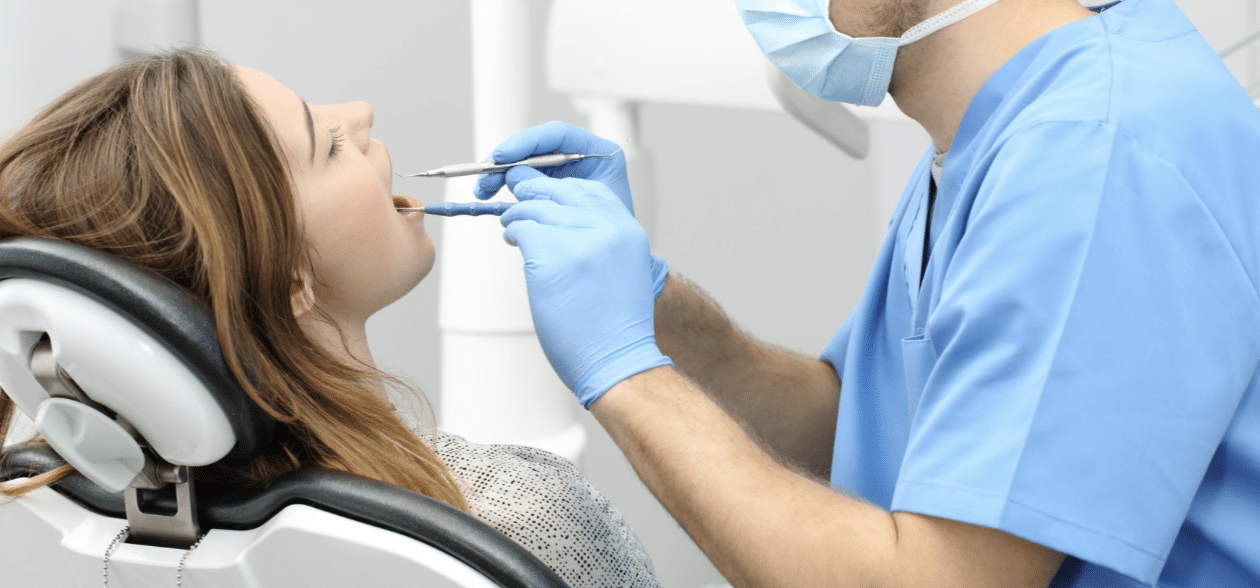
Dental work holds your jaw near the end of its range, with somebody else’s hands and instruments keeping it there for as long as the work takes(which in some cases can be a while), and if you put a shoulder in that position for an hour nobody would be surprised is it caused some real issues.
Among people with classical or hypermobile EDS, about half said the jaw had dislocated at some point [12]. A jaw disorder was written down in the notes of 46.3 per cent of them, which suggests a fair bit of this is going unrecorded [12]. Sudden dislocation of the jaw joint can follow a long stretch of being held open during dental work [13]. Prolonged opening, the jaw sliding as it opens, a previous dislocation and lax ligaments all get named as risk factors during dental and other procedures [14].
A bite block is a prop that holds your mouth open so your muscles don’t have to, and most people haven’t even heard of one. In people with pain in their chewing muscles, sitting through 120 minute dental visit, a block adjusted to the individual kept pain from escalating during the treatment better than a standard one did, and being forced to hold maximum opening was named as what provoked the symptoms in the first place [15].
That work wasn’t done in people with hEDS though, so it isn’t evidence that shorter sessions or a bite block do anything specific for you, but reading across, theres a good chance it may[10].
What we do know, however, is that there a few things likely to help:
– flagging a hypermobile jaw before treatment
– keeping long stretches of extreme opening to a minimum
– using something that takes the sustained load off the joint when a long procedure can’t be avoided [10].
Precautions of that kind are meant to be anticipated before treatment starts, particularly around the jaw dislocating and around tissue that bruises and tears easily [10].
The One Sentence to Say Before They Start
One sentence covers it: I have a hypermobile jaw, it’s come out of place before, and being held wide open for a long stretch is what tends to causes issues. Said at the start, it gives the dentist the chance to break the work into shorter blocks, and to use a prop.
Everything past that is a conversation between you and your own dentist, because how long is too long in a chair, how often to stop, and which prop suits your jaw are things the two of you need work out.
The mouth is a more manageable thing than the stories make it sound. Your teeth are in better shape than they get credit for, the early gum loss belongs to a different subtype, and the joint sitting just in front of your ear is the one with the evidence behind it, which makes it the one worth mentioning before somebody props it open and goes to town on it.
Adam

References
[1] Bech, K., Fogh, F.M., Lauridsen, E.F. and Sonnesen, L. (2022) ‘Temporomandibular disorders, bite force and osseous changes of the temporomandibular joints in patients with hypermobile Ehlers‐Danlos syndrome compared to a healthy control group’, Journal of Oral Rehabilitation. https://doi.org/10.1111/joor.13348
[2] Yekkalam, N., Novo, M., Tyrberg, M.J. and Sipilä, K. (2024) ‘Risk factors associated with symptoms of temporomandibular disorders among women with hypermobile Ehlers–Danlos syndrome: Questionnaire‐based study in Finland and Sweden’, Journal of Oral Rehabilitation. https://doi.org/10.1111/joor.13706
[3] Valesan, L.F., Da-Cas, C.D., Réus, J.C., Denardin, A.C.S., Garanhani, R.R., Bonotto, D. et al. (2021) ‘Prevalence of temporomandibular joint disorders: a systematic review and meta-analysis’, Clinical Oral Investigations. https://doi.org/10.1007/s00784-020-03710-w
Read More[4] Lepperdinger, U., Zschocke, J. and Kapferer‐Seebacher, I. (2021) ‘Oral manifestations of Ehlers‐Danlos syndromes’, American Journal of Medical Genetics Part C: Seminars in Medical Genetics. https://doi.org/10.1002/ajmg.c.31941
[5] Darakjian, A.A., Bhutani, M., Fairweather, D., Kocsis, S.C., Fliess, J.J., Khatib, S. et al. (2024) ‘Similarities and differences in self-reported symptoms and comorbidities between hypermobile Ehlers–Danlos syndrome and hypermobility spectrum disorders’, Rheumatology Advances in Practice. https://doi.org/10.1093/rap/rkae134
[6] Gensemer, C., Burks, R., Kautz, S., Judge, D.P., Lavallee, M. and Norris, R.A. (2020) ‘Hypermobile Ehlers‐Danlos syndromes: Complex phenotypes, challenging diagnoses, and poorly understood causes’, Developmental Dynamics. https://doi.org/10.1002/dvdy.220
[7] Kapferer-Seebacher, I., Schnabl, D., Zschocke, J. and Pope, F. (2020) ‘Dental Manifestations of Ehlers-Danlos Syndromes: A Systematic Review’, Acta Dermato Venereologica. https://doi.org/10.2340/00015555-3428
[8] Angwin, C., Zschocke, J., Kammin, T., Björck, E., Bowen, J., Brady, A.F. et al. (2023) ‘Non-oral manifestations in adults with a clinical and molecularly confirmed diagnosis of periodontal Ehlers-Danlos syndrome’, Frontiers in Genetics. https://doi.org/10.3389/fgene.2023.1136339
[9] Honoré, M.B., Lauridsen, E.F. and Sonnesen, L. (2019) ‘Oro‐dental characteristics in patients with hypermobile Ehlers‐Danlos Syndrome compared to a healthy control group’, Journal of Oral Rehabilitation. https://doi.org/10.1111/joor.12838
[10] De Coster, P.J., Martens, L.C. and De Paepe, A. (2005) ‘Oral health in prevalent types of Ehlers–Danlos syndromes’, Journal of Oral Pathology & Medicine. https://doi.org/10.1111/j.1600-0714.2004.00300.x
[11] Bourne, K.M., Thai, S., Lei, L.Y., Siddiqui, T., Black, B., Peltier, A. et al. (2026) ‘Patients with Ehlers-Danlos syndrome experience reduced effectiveness of lidocaine local anesthetic: a randomized cross-over clinical trial’, Regional Anesthesia & Pain Medicine. https://doi.org/10.1136/rapm-2025-107416
[12] Willich, L., Bohner, L., Köppe, J., Jackowski, J., Hanisch, M. and Oelerich, O. (2023) ‘Prevalence and quality of temporomandibular disorders, chronic pain and psychological distress in patients with classical and hypermobile Ehlers-Danlos syndrome: an exploratory study’, Orphanet Journal of Rare Diseases. https://doi.org/10.1186/s13023-023-02877-1
[13] Mitakides, J. and Tinkle, B.T. (2017) ‘Oral and mandibular manifestations in the Ehlers–Danlos syndromes’, American Journal of Medical Genetics Part C: Seminars in Medical Genetics. https://doi.org/10.1002/ajmg.c.31541
[14] Upadhyaya, A. and Brown, J. (2026) ‘Acute Temporomandibular Joint Dislocation Immediately Following Mandibular First Molar Extraction: A Case Report and Review of Clinical Management’, International Journal of Research and Innovation in Applied Science. https://doi.org/10.51584/ijrias.2026.11060279
[15] Nacharyan, D., Apresyan, S., Stepanov, A., Kopylov, M. and Moskovets, O. (2026) ‘CLINICAL EFFECTIVENESS OF THE USE OF AN INDIVIDUAL PROGRAMMABLE BITE BLOCK FOR THE PREVENTION OF EXACERBATION OF SYMPTOMS OF MUSCULAR-ARTICULAR DYSFUNCTION’, Actual problems in dentistry. https://doi.org/10.18481/2077-7566-2026-22-2-274-282