
- Water exercise and hydrotherapy for fibromyalgia - 2 November 2026
- Hypermobile hip exercises we use, and why clamshells aren’t one of them - 17 October 2026
- Is Fibromyalgia a Disability in the UK, and Can You Claim PIP? - 14 October 2026
This article is part of our comprehensive guide to living with fibromyalgia.
Warm water takes most of your weight off you, settles muscle, and presses in on you from every side, so its harder to wobble, which is why a session in a pool costs you less at the time, than the same session on dry land. You can feel it a minute you get in the pool. What gets misread all the time, is the bit afterwards, because if you put exercise in water against the same exercise on land, the pooled difference in pain comes out at under a point on a hundred point scale, and the range is wide enough to sit either side of zero [1]. That scale is the one you get handed at an appointment, 0 for no pain at one end and a 100 for the worst you can imagine at the other. So the pool isn’t a better treatment. It’s a better room, and for some people it’s the room where the exercise actually happens, rather than slowly falling off the band wagon, so thats something.
Two different things also get sold under the one word, which is most of the reason the advice you’ve read contradicts itself. Hydrotherapy in a clinic means prescribed movement in a heated pool, with a physio watching. Hydrotherapy on a spa website means sitting in hot water. Both do something don’t get me wrong, they just don’t do the same thing, and only one of them has a programme attached.
Is a pool worth getting into at all
Exercise carries a strong recommendation in the guidelines for fibromyalgia, and water is one way of many, of doing exercise [2]. So the first thing to settle is whether getting in beats staying out, which is a lower bar than the clinic pages aim at.
Against people who stayed inactive, aquatic exercise comes out around 6.6 points better for pain on that hundred point scale [1]. On a walking test it’s about 37 metres further [1], which is roughly a length and a half of an ordinary pool, and on a bad day that’s the difference between getting to the corner shop and turning back. The same review set itself a bar of 15% improvement before it would call a change big enough to matter in real life, and pain and function didn’t clear it, while stiffness and strength did [1]. So: a real effect, pointing the right way, smaller than the brochure.
Set it against the other kinds of exercise and it does well early on. Rank 15 of them and aquatic exercise comes out top for short term pain in women with fibromyalgia [3]. Push the follow up out further and the order starts shift: dance and mixed exercise coming out ahead of water on overall fibromyalgia impact [4].
Is water better than the same work on land
That’s the comparison that decides it, and it has been run several times. Deep water running, which means running in water too deep to stand up in with a float belt holding you at the surface, has been put up against walking and jogging on land, and both groups came down about 36 per cent on pain, with the water group improving faster on fibromyalgia impact and the emotional measures, which is actually nice to see for a change [5]. Swimming has been put up against walking, and the two came out level on pain and functional capacity at twelve weeks [6]. Pool the direct comparisons and there’s no clear difference in pain, overall function or stiffness at the end of treatment [1][7].
On strength, some of the evidence actually favours land [1]. Mechanically, that’s what you’d expect. Buoyancy is there to take load off you, and load is the thing muscle adapts to, so an hour in the pool is an hour in which your legs have been doing less of the work, and your legs have had less reason to get stronger. Water makes the movement available though, so if it makes a difference between doing something or not being able to do something, obviously it’s going to be on my list.
Does any of it hold once you stop
Forty women were put through matched aquatic and land programmes, sixty minutes, three times a week, for twelve weeks. 6 weeks after it finished, the water group’s pain sat at a median of 2.7 against 5.5 for the land group [8]. Their sleep scores came out better as well, and both groups held on to their walking improvement [8]. It was a small trial, and 6 weeks after a programme isn’t medium term follow up [8]. A 6 month comparison of land and water programmes pointed the other way, favouring the land group for holding on to fitness afterwards (which makes sense) [9].
The detraining studies are the useful ones, because they deliberately stop people exercising and then watch what happens. 16 weeks of aquatic training followed by 16 weeks of nothing put the symptom and fitness gains back to near where they started at [10]. In another warm water programme, pain fell by 29% while the training was running and returned close to baseline once it stopped, though the leg strength gains stayed [11].
Carrying on exercising goes with better results at follow up as well [12]. That sounds obvious and it matters anyway, because it means an improvement somebody recorded three months after a programme is usually telling you that person kept going, and not that the pool did something that lasts. So pick the version of this you can still be doing in three months, because that choice does more for you than any other really.
What the water is actually doing to you
Buoyancy is the obvious one. Chest deep water carries most of your body weight, so a step, a squat or a lunge works your joints a fraction of what it does on land [13]. If your problem is that everything hurts before it gets going, that’s the whole appeal really.
Hydrostatic pressure is the one nobody mentions. Water pushes inwards on everything under the surface, hardest at your feet and least near the top, and that squeeze does three jobs at once: it stops you wobbling, it feeds your skin and joints a constant stream of information about where your limbs are, and it pushes blood out of your legs towards the middle of you. At chest depth that shift is around 700 ml, which is enough to raise what your heart has to handle on each beat [14]. It’s a conversation to have with a doctor first if you’ve got heart failure [14]. Go deeper in and breathing rate and the top blood pressure number both come down, which is what you’d expect if the calming side of the nervous system had been nudged up a gear [15].
Then the warmth. Warm water floods the skin’s temperature and touch sensors with signal, and that traffic competes with the nociceptive input, the information the tissues send when something might be doing harm, damping it down on the way in before it ever becomes pain [8]. You already know this works, because you rub a shin after you bang it on the coffee table. In fibromyalgia the dial on that incoming traffic is turned up: repeated pokes stack up more than they should, and the body’s own ability to damp down one pain by applying another is measurably weaker than in people without it [16]. A warm pool is a very large, very even dose of exactly the input that competes with that.
So is it the water or the warmth
One trial put those two side by side at the same temperature: pool exercise against simply being immersed in warm water without exercising, both at 37 degrees, twelve weeks. Both groups improved, and exercise didn’t beat passive immersion on anything measured apart from depression at twenty four weeks [17].
That result doesn’t flatter the exercise. The way we’d read it is that inside twelve weeks a lot of how you feel is coming from the warmth, and what the exercise adds is the one thing a soak can’t touch, which is what your legs can actually do.
Passive heat on its own does something too: four weeks of hot water immersion brought average and worst pain scores down in people with fibromyalgia, although that was run at 40.5 degrees with core temperature, blood pressure and hydration monitored throughout, which is some distance from your bath [18]. So a hot bath is a good evening and worth having on a bad night. The exercise is the part worth building the week around, and that’s where we’d put the effort first.
How much, and how to tell when it’s too much
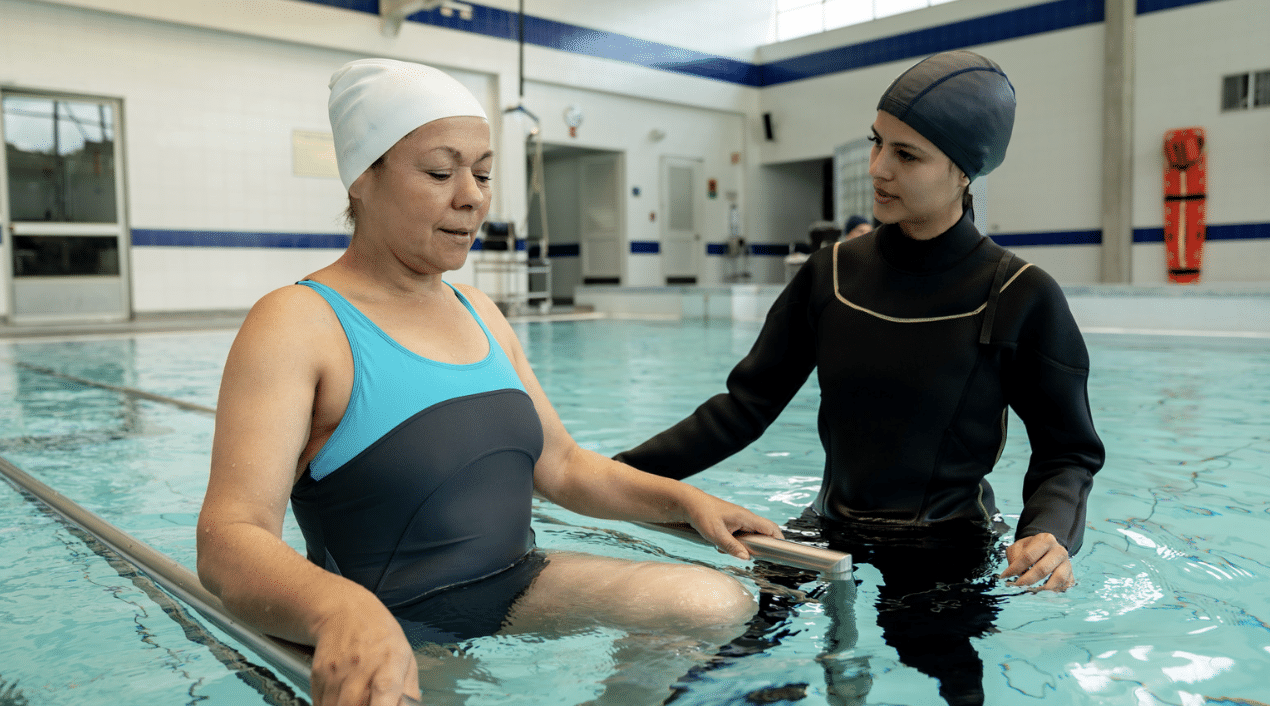
A hydrotherapy session is a class in chest deep water rather than lengths of front crawl. Some mobility work to loosen off at the start, then blocks of walking, marching or running on the spot with the water resisting you, then strengthening where the thing you push against is the water or a float, then a few minutes of drifting about at the end. Nothing to drop on your foot and nothing to fall off.
What the trials actually ran was 40 to 60 minute sessions, two or three times a week on alternate days [19]. The programmes themselves were usually six to sixteen weeks long [19]. Read “session” properly though, because that’s the whole class with the warm up and the cool down in it, rather than an hour of continuous effort [19]. Intensity was set by how hard the work feels rather than by speed or distance [19], starting around light and stepping up to somewhat hard once the movements are familiar [20].
Treat that as where supervised programmes finished up, not where you actually begin. The sensible entry point sits a long way below it, matched to what your symptoms are doing that week rather than to what the protocol says [21]. In a studio we’d rather somebody did fifteen minutes three times than sixty minutes once, and then nothing for a fortnight.
Why it feels fine in the pool and rough later on
Measure people straight after a warm water session and pain is down, by roughly 15% [22]. Measure over the following three days and the picture turns around. Across fibromyalgia and ME/CFS, the pain response to an exercise challenge is larger between eight and seventy two hours afterwards than it is immediately [23]. In fibromyalgia specifically, brief resistance work well short of maximum effort left local pain and fatigue running for up to three days, with no matching change in whole body pain [24].
That gap is the pool’s one real trap. Buoyancy has taken away the feedback you normally use to judge how much you’ve done, the warmth has turned the volume down on the way in, and the pull of a class does the rest, so a session can genuinely feel like nothing while you’re in it. You find out on Wednesday. Being told that water is gentle so it can’t hurt you is the part to ignore, because easy on the joints at the time and rough two days later are not in conflict at all.
No serious exercise related harms were reported across the aquatic trials [1], which is worth knowing and is a different measurement from how you feel on the sofa two days later. So judge a session by the two days after it rather than by how you feel climbing out, which means the first few go in deliberately short, so that you’ve got something to compare the next one against. And when pain or fatigue does come up substantially, drop the length or the effort rather than progressing through it on schedule [25].
When the pool isn’t warm, and when there isn’t one
30 to 34 degrees is the band the aquatic trials ran in [19][26]. A hospital hydrotherapy pool sits up at the top of that. A public leisure pool is cooler, and cold water with fibromyalgia is a miserable combination, because muscle tightens up in it and the warmth you came for isn’t there.
Cooler water still works, though. One aquatic against land programme that came out well ran at 30 degrees [27]. There’s also a sensible split for an ordinary pool: keep the cooler end of the range for the aerobic part of a session and something nearer 31.5 to 33 degrees for mobility, stretching and strengthening work [28]. If your local pool sits below the band the trials used, keep the session short, keep moving the whole time you’re in, and get out before you reach the standing around part. Go at the quiet times, keep moving between exercises rather than standing talking, get changed fast, and have something hot waiting. The trip there and back costs something too, and on a bad day it can cost more than the session does.
A class gives you a structure and a reason to turn up, and adherence to aquatic exercise appears to come out better than to land programmes, which has been put down to it hurting less and having other people in it [13]. An aqua aerobics class is set to a general population pace though, and that’s a different thing from hydrotherapy. The workaround is to do your own version in the same lane: smaller range, slower, and stopping when you’ve had enough rather than when the instructor has.
If there’s no pool at all
Land exercise held its own in the head to head trials, so a plan without a pool starts level. For aerobic work on land the proposed dose is twenty five to forty minutes, two or three times a week, starting at low intensity and building over six to twelve weeks [29].
In the UK, hydrotherapy arrives through a physiotherapist rather than through a booking page, so the thing to ask for at an appointment is a referral to a physio with access to a hydrotherapy pool. Say what you want it for while you’re there, because starting to move at all, getting stronger and getting your walking distance back are three different sessions.
Standing up out of hot water
Getting out is where people come unstuck. After whole body hot water immersion, blood pressure dropping on standing turned up in 77 to 94 per cent of people, more so with age [30]. Warm water has spent half an hour holding blood up out of your legs, and the second you stand in air it drops straight back down them, which is the grey, swimmy, grab for the handrail moment. So come up the steps slowly, sit on the side before you stand, and keep a drink with you.
The gain against doing nothing is real and modest rather than transformative [1], so getting in the water is worth it when the water is the thing that makes the exercise possible. If there’s a warm pool within reach and getting into it is what gets you moving, use it, and start a long way below what the trials ran. If all you can get to is a cool leisure pool, keep the session short and keep moving while you’re in it. If there’s no pool at all, nothing has been lost that can’t be rebuilt on dry land. And whatever room it happens in, when the exercise stops most of it goes with it [10], so the version worth picking is the one you’ll still be doing when the novelty has gone.
Adam

References
[1] Bidonde, J., Busch, A.J., Webber, S.C., Schachter, C.L., Danyliw, A., Overend, T.J. et al. (2014) ‘Aquatic exercise training for fibromyalgia’, Cochrane Database of Systematic Reviews. https://doi.org/10.1002/14651858.cd011336
[2] Macfarlane, G.J., Kronisch, C., Dean, L.E., Atzeni, F., Häuser, W., Fluß, E. et al. (2017) ‘EULAR revised recommendations for the management of fibromyalgia’, Annals of the Rheumatic Diseases. https://doi.org/10.1136/annrheumdis-2016-209724
[3] Rodríguez-Domínguez, Á.J., Rebollo-Salas, M., Chillón-Martínez, R., Rosales-Tristancho, A., Villa-del-Pino, I. and Jiménez-Rejano, J.J. (2025) ‘The most effective therapeutic exercises for pain intensity in women with fibromyalgia: A systematic review and network meta-analysis’, Brazilian Journal of Physical Therapy. https://doi.org/10.1016/j.bjpt.2025.101226
Read More[4] Rodríguez-Domínguez, Á.J., Jiménez-Rejano, J.J., Cardellat-González, M., Rosales-Tristancho, A., Arana-Rodríguez, A. and Rebollo-Salas, M. (2026) ‘Which exercise is most beneficial for treating women with fibromyalgia? A systematic review and network meta-analysis’, Musculoskeletal Science and Practice. https://doi.org/10.1016/j.msksp.2026.103515
[5] Assis, M.R., Silva, L.E., Alves, A.M.B., Pessanha, A.P., Valim, V., Feldman, D. et al. (2006) ‘A randomized controlled trial of deep water running: Clinical effectiveness of aquatic exercise to treat fibromyalgia’, Arthritis Care & Research. https://doi.org/10.1002/art.21693
[6] Fernandes, G., Jennings, F., Nery Cabral, M.V., Pirozzi Buosi, A.L. and Natour, J. (2016) ‘Swimming Improves Pain and Functional Capacity of Patients With Fibromyalgia: A Randomized Controlled Trial’, Archives of Physical Medicine and Rehabilitation. https://doi.org/10.1016/j.apmr.2016.01.026
[7] Correyero-León, M., Medrano-de-la-Fuente, R., Hernando-Garijo, I., Jiménez-Del-Barrio, S., Hernández-Lázaro, H., Ceballos-Laita, L. et al. (2024) ‘Effectiveness of aquatic training based on aerobic and strengthening exercises in patients with fibromyalgia: systematic review with meta-analysis’, EXPLORE. https://doi.org/10.1016/j.explore.2023.07.003
[8] Rivas Neira, S., Pasqual Marques, A., Fernández Cervantes, R., Seoane Pillado, M.T. and Vivas Costa, J. (2024) ‘Efficacy of aquatic vs land-based therapy for pain management in women with fibromyalgia: a randomised controlled trial’, Physiotherapy. https://doi.org/10.1016/j.physio.2024.02.005
[9] Bañuelos-Terés, L.E., Álvarez-Gallardo, I.C., Gavilán-Carrera, B., Segura-Jiménez, V., Estévez-López, F., Acosta-Manzano, P. et al. (2026) ‘Effectiveness of a 6-Month Land-Based and Water-Based Exercise Intervention on Body Composition and Physical Fitness in Women With Fibromyalgia: The Al-Ándalus Quasi-experimental Study’, Archives of Physical Medicine and Rehabilitation. https://doi.org/10.1016/j.apmr.2026.04.015
[10] Andrade, C.P., Zamunér, A.R., Forti, M., Tamburús, N.Y. and Silva, E. (2019) ‘Effects of aquatic training and detraining on women with fibromyalgia: controlled randomized clinical trial’, European Journal of Physical and Rehabilitation Medicine. https://doi.org/10.23736/s1973-9087.18.05041-4
[11] Gusi, N., Tomas‐Carus, P., Häkkinen, A., Häkkinen, K. and Ortega‐Alonso, A. (2006) ‘Exercise in waist‐high warm water decreases pain and improves health‐related quality of life and strength in the lower extremities in women with fibromyalgia’, Arthritis Care & Research. https://doi.org/10.1002/art.21718
[12] Häuser, W., Klose, P., Langhorst, J., Moradi, B., Steinbach, M., Schiltenwolf, M. et al. (2010) ‘Efficacy of different types of aerobic exercise in fibromyalgia syndrome: a systematic review and meta-analysis of randomised controlled trials’, Arthritis Research & Therapy. https://doi.org/10.1186/ar3002
[13] Mazzorana, A., Fada, L., Wahidy, J. and Jacobs, G. (2026) ‘Role of Exercise in Fibromyalgia Management: A Narrative Review of Mechanisms, Modalities, and Clinical Evidence’, Cureus. https://doi.org/10.7759/cureus.101299
[14] Meyer, K. (2006) ‘Left ventricular dysfunction and chronic heart failure: should aqua therapy and swimming be allowed?’, British Journal of Sports Medicine. https://doi.org/10.1136/bjsm.2006.029165
[15] Soultanakis, H.N., Nikolaidou, M.E., Florou, E., Baccarani, G. and Vagiakis, E. (2020) ‘Cardiovascular And Respiratory Responses During Aquatic Rehabilitation At Different Depths Of Supine Immersion’, Medicine & Science in Sports & Exercise. https://doi.org/10.1249/01.mss.0000679072.17693.37
[16] O’Brien, A.T., Deitos, A., Triñanes Pego, Y., Fregni, F. and Carrillo-de-la-Peña, M.T. (2018) ‘Defective Endogenous Pain Modulation in Fibromyalgia: A Meta-Analysis of Temporal Summation and Conditioned Pain Modulation Paradigms’, The Journal of Pain. https://doi.org/10.1016/j.jpain.2018.01.010
[17] Altan, L., Bingöl, U., Aykaç, M., Koç, Z. and Yurtkuran, M. (2003) ‘Investigation of the effects of pool-based exercise on fibromyalgia syndrome’, Rheumatology International. https://doi.org/10.1007/s00296-003-0371-7
[18] Chadwick, A.L., Shi, C., McMillan, M., Miller, J., Hu, J. and Geiger, P.C. (2025) ‘The impact of a heat therapy intervention on pain and fibromyalgia symptoms in patients with fibromyalgia: a pilot study’, Frontiers in Pain Research. https://doi.org/10.3389/fpain.2025.1526491
[19] Rodríguez-Huguet, M., Ayala-Martínez, C., Góngora-Rodríguez, P., Rosety-Rodríguez, M.Á., Martín-Valero, R. and Góngora-Rodríguez, J. (2024) ‘Aquatic Exercise in Physical Therapy Treatment for Fibromyalgia: Systematic Review’, Healthcare. https://doi.org/10.3390/healthcare12060701
[20] Zamunér, A.R., Andrade, C.P., Arca, E.A. and Avila, M.A. (2019) ‘Impact of water therapy on pain management in patients with fibromyalgia: current perspectives’, Journal of Pain Research. https://doi.org/10.2147/jpr.s161494
[21] Lucini, D., Giovanelli, L., Bazzichi, L., Bernardelli, G., Pellegrino, G., Filippou, G. et al. (2024) ‘Tailored exercise programmes for fibromyalgia: a clinical practical guide’, Clinical and Experimental Rheumatology. https://doi.org/10.55563/clinexprheumatol/k3qldz
[22] Segura-Jiménez, V., Carbonell-Baeza, A., Aparicio, V., Samos, B., Femia, P., Ruiz, J. et al. (2012) ‘A Warm Water Pool-Based Exercise Program Decreases Immediate Pain in Female Fibromyalgia Patients: Uncontrolled Clinical Trial’, International Journal of Sports Medicine. https://doi.org/10.1055/s-0032-1329991
[23] Barhorst, E.E., Boruch, A.E., Cook, D.B. and Lindheimer, J.B. (2021) ‘Pain-Related Post-Exertional Malaise in Myalgic Encephalomyelitis / Chronic Fatigue Syndrome (ME/CFS) and Fibromyalgia: A Systematic Review and Three-Level Meta-Analysis’, Pain Medicine. https://doi.org/10.1093/pm/pnab308
[24] Berardi, G., Eble, C., Hunter, S.K. and Bement, M.H. (2023) ‘Localized Pain and Fatigue During Recovery From Submaximal Resistance Exercise in People With Fibromyalgia’, Physical Therapy. https://doi.org/10.1093/ptj/pzad033
[25] Matei, D., Trăistaru, R., Pădureanu, V., Avramescu, T.E., Neagoe, D., Genunche, A. et al. (2024) ‘The Efficiency of Kinesiotherapy versus Physical Modalities on Pain and Other Common Complaints in Fibromyalgia’, Life. https://doi.org/10.3390/life14050604
[26] Faíl, L.B., Marinho, D.A., Marques, E.A., Costa, M.J., Santos, C.C., Marques, M.C. et al. (2021) ‘Benefits of aquatic exercise in adults with and without chronic disease—A systematic review with meta‐analysis’, Scandinavian Journal of Medicine & Science in Sports. https://doi.org/10.1111/sms.14112
[27] Rivas Neira, S., Pasqual Marques, A., Pegito Pérez, I., Fernández Cervantes, R. and Vivas Costa, J. (2017) ‘Effectiveness of Aquatic Therapy vs Land-based Therapy for Balance and Pain in Women with Fibromyalgia: a study protocol for a randomised controlled trial’, BMC Musculoskeletal Disorders. https://doi.org/10.1186/s12891-016-1364-5
[28] Lima, T.B., Dias, J.M., Mazuquin, B.F., da Silva, C.T., Nogueira, R.M.P., Marques, A.P. et al. (2013) ‘The effectiveness of aquatic physical therapy in the treatment of fibromyalgia: a systematic review with meta-analysis’, Clinical Rehabilitation. https://doi.org/10.1177/0269215513484772
[29] Casanova‐Rodríguez, D., Ranchal‐Sánchez, A., Rodríguez, R.B. and Jurado‐Castro, J.M. (2025) ‘Aerobic Exercise Prescription for Pain Reduction in Fibromyalgia: A Systematic Review and Meta‐Analysis’, European Journal of Pain. https://doi.org/10.1002/ejp.4783
[30] Steward, C.J., Menzies, C., Clarke, N.D., Harwood, A.E., Hill, M., Pugh, C.J.A. et al. (2023) ‘The effect of age and mitigation strategies during hot water immersion on orthostatic intolerance and thermal stress’, Experimental Physiology. https://doi.org/10.1113/ep090993