
- Hypermobile hip exercises we use, and why clamshells aren’t one of them - 17 October 2026
- Is Fibromyalgia a Disability in the UK, and Can You Claim PIP? - 14 October 2026
- Fibromyalgia and Central Sensitisation, What Is It in Plain English? - 8 October 2026
This article is part of our comprehensive guide to exercise and rehabilitation for hypermobility.
Hypermobility and children
Generalised joint hypermobility is common in childhood, though the honest version of that sentence is a good deal less satisfying than the one you normally read. The prevalence figures swing about wildly, and most of that swing is measurement rather than biology, as different groups use different Beighton cut offs on different ages and different ethnic groups and then report a number as though it meant the same thing each time [1][2]. So “far more common than most doctors think” is fair enough. A single figure for how common is not something anybody can actually give you.
What hasn’t changed is the reason parents end up on a page like this. A hypermobile child who’s sore, clumsy, tired, and getting nowhere with the GP. Exercise is genuinely the most useful thing we have for that, and it’s worth being straight about what it can and can’t do before getting into what to actually do.
Puberty needs narrowing down too, as it gets stated far more strongly than the evidence allows. Joint laxity does shift with age and sex, and among young athletes the girls who were through puberty measured more lax than those who weren’t [3], with hormone levels tracking laxity measures in adolescents in a large German group of children [4]. Followed over two years, hypermobile children changed with age and sex as well [5]. What none of that shows is that puberty makes hypermobility worse across the board, or that exercise offsets the hormonal side of it. Our own read, and it is a read rather than a finding, is that a teenager going into all that with decent movement skills already built has an easier time of it than one starting from scratch.
Why we bother with this early
Early childhood is a period of high neuroplasticity, and sensory and motor practice genuinely does change how a child’s nervous system organises movement [6]. That’s general child development evidence though, rather than hypermobility evidence, and nobody has run the comparison that puts the same programme in front of a six year old and a sixteen year old to see whether starting earlier actually wins.
So the case for starting early is a reasonable one rather than a proven one. In our opinion it’s a great deal easier to build a movement habit in a child who doesn’t hurt yet, than to rebuild one in a nineteen year old who’s spent four years avoiding things.
Motor development in hypermobility
Delayed motor development turns up in roughly a third of hypermobile children, and the thing to hold onto is where that number came from, as those children had already been referred on to a paediatric physiotherapy service [7]. They were children somebody was already worried about. Look in ordinary schools instead and the picture gets much less tidy, as eight year olds with generalised hypermobility came out no different from their classmates on motor skills or physical activity [8], and eleven year olds in Swedish schools showed no link between high Beighton scores and neurodevelopmental problems either [9].
The bit that has held up throughout all of it is that the degree of hypermobility doesn’t predict the degree of delay [7]. A child can be spectacularly hypermobile and perfectly well coordinated, and another can be mildly hypermobile and eighteen months behind. Which makes the Beighton score pretty much useless as a way of working out which child needs help, and that’s awkward, as it’s usually the only thing anybody measures.
There’s a real overlap with developmental coordination disorder in here as well [10]. In practice the children who have the hardest time of it are generally the ones sitting in both groups. We’ve written more about what turns up in the first couple of years over on hypermobility and early development.
Physiotherapy does help, with a caveat about who it was tested on. The children in question were infants who were both hypermobile and floppy, and monthly physiotherapy plus a daily home programme run by the parents was enough for them to catch up, with weekly sessions giving no overall advantage beyond getting them walking independently a little sooner [11]. Those are babies rather than eleven year olds, and the useful part for a parent reading this is that the home programme was doing most of the work.
Then the assumption everybody makes, which is that better coordination means fewer trips and falls, and therefore fewer joints coming out. That’s our clinical reasoning and it does make sense, but nobody has demonstrated that chain in hypermobile children, so please treat it as reasoning rather than as evidence.

If your child has hypermobility, EDS or chronic pain, they have legal rights at school. Most parents have never been told what those rights are, and plenty of schools do not know either. These guides set it out.
The sensory side of it
Laxer tissue doesn’t only move further, it reports back less precisely, as the receptors in joints and skin sitting in more compliant tissue hand the brain a noisier picture of where the limb actually is. A brain making movement decisions on a fuzzier signal, makes worse ones, and it tends to compensate by holding everything a fair bit tighter than it needs to.
The research here is genuinely mixed and we’d rather say so than tidy it up. Results on proprioception in hypermobile children and adolescents conflict, with some groups testing worse and others testing much the same as everybody else [1]. What has turned up more consistently since is on the sensory side proper, as hypermobile toddlers differed on tactile processing, vestibular response, and putting vision and touch together [12], and hypermobile children had reduced sensation in the soles of their feet [13]. Stimulating the soles of the feet then shifted how sensory and motor information was organised [14], and in adults with hypermobility, exercise aimed at the sensory side improved knee joint position sense, pain and quality of life against a control group [15].
None of that adds up to every hypermobile child having a proprioception problem. What it does mean is that a programme built only around strength is ignoring the part of the system that decides what to do with the strength.
Anxiety and hypermobility
The link between hypermobility and anxiety is one of the better replicated findings in this whole area, and association is the right word for it rather than correlation or cause. Hypermobile children came out with a higher rate of anxiety disorders [16], nine year olds in the general population showed the same pattern across the different hypermobility groupings [17], and hypermobile adolescents came out higher for anxiety against matched controls [18]. Most of what had been done by a decade ago pointed the same way, while being honest that the mechanism was unresolved [19]. It still is.
Exercise helps anxiety, and the evidence for that is broad rather than specific. Across large groups of people followed forwards over time, the more physically active were less likely to go on to develop anxiety, children and adolescents included [20], and in children given exercise programmes there was a moderate improvement in anxiety in the moment, although the quality of the underlying work was low and the people who pooled it said so [21].
Where this usually goes wrong is the mechanism. The dentate gyrus finding that gets cited for it was done in mice, and what it showed was stronger local inhibition in the hippocampus after exercise, rather than exercise switching on frontal control of the amygdala [22]. The broader account involving serotonin, GABA, BDNF and endocannabinoids is drawn mostly from adult and animal work and gets assembled after the fact [23]. So exercise is associated with less anxiety in children, the mechanisms are plausible, and nobody has shown any of them running in a hypermobile child.
Joint subluxations and dislocations in children
Connective tissue laxity does leave joints more likely to sublux and dislocate, which is the consistent picture in the paediatric hypermobility literature [24][25], and a proportion of symptomatic children carry a history of recurrent sprains alongside joints actually coming out.
A dislocation is distressing for anybody. It tends to be worse for a child though, as an adult with years of it behind them has usually built up a set of strategies for dealing with it and a child simply hasn’t had the time. That’s an observation from the studios rather than a finding, but it’s a consistent one, and it’s a fair part of why we’d rather get ahead of it.

What the evidence actually supports
There’s no established best exercise for hypermobile children, and anybody offering you one is out ahead of the evidence. What does hold up is programmes that combine several things at once: strengthening, motor control work, balance and proprioceptive work, and practice of actual everyday tasks [26][27]. Dosage, progression, and which ingredient is doing the work are all still open questions, and what exists in children is small and varies enormously in what was actually done [26][28].
Two attempts at pooling the coordination research in developmental coordination disorder landed on different answers in the same year, one finding large gains in coordination, fine motor skills and balance [29], the other finding no consistent improvement once you hold the outcome measure still [30]. That’s a fair picture of the state of this field (and a decent argument for not trusting anybody’s five step protocol).
So what we do, and we’d call it a defensible bet rather than a proven method: give the nervous system a clearer signal, build a better movement strategy on top of that, then add load. In that order. Strength piled onto a poor strategy mostly just makes the poor strategy stronger.
Hypermobility exercises for small children
Under about ten, a structured programme is usually a non starter. Children that age don’t grasp why they’re doing any of it, setting aside the time is hard enough on its own, and they get bored a great deal quicker than they used to. Add in the fact that a lot of these children have already had their complaints put down to growing pains by somebody who wasn’t really looking, and you can end up with genuine anxiety attached to the word exercise.
So three things work here, and not one of them is a programme:
– Turn the exercises into games that happen to train strength, stability and coordination.
– Do them with the child, so it’s time together rather than a chore.
– Change the language around all of it, so it isn’t framed as treatment.
The evidence for the fun part is indirect and we’ll say so, as it comes from children with other conditions. Game based and virtual reality programmes improved motor performance and enjoyment in children with developmental coordination disorder [31], digital games plus a bit of encouragement had the legs working harder and the child enjoying it more during motor tasks [32], and five and six year olds put through a structured coordination programme improved their static balance, sideways jumping and eye hand coordination [33]. Nobody has tested game based rehab in hypermobile children specifically (surprise, surprise).
The bonding part isn’t a soft add on either. Pain is a biopsychosocial experience, and the social third of that gets dropped constantly, quite often by the same people who then use the word biopsychosocial to mean psychological. A child doing their exercises alongside a parent, laughing, is in a different state to one doing them alone under instruction, and that state is part of the picture rather than a nice extra.
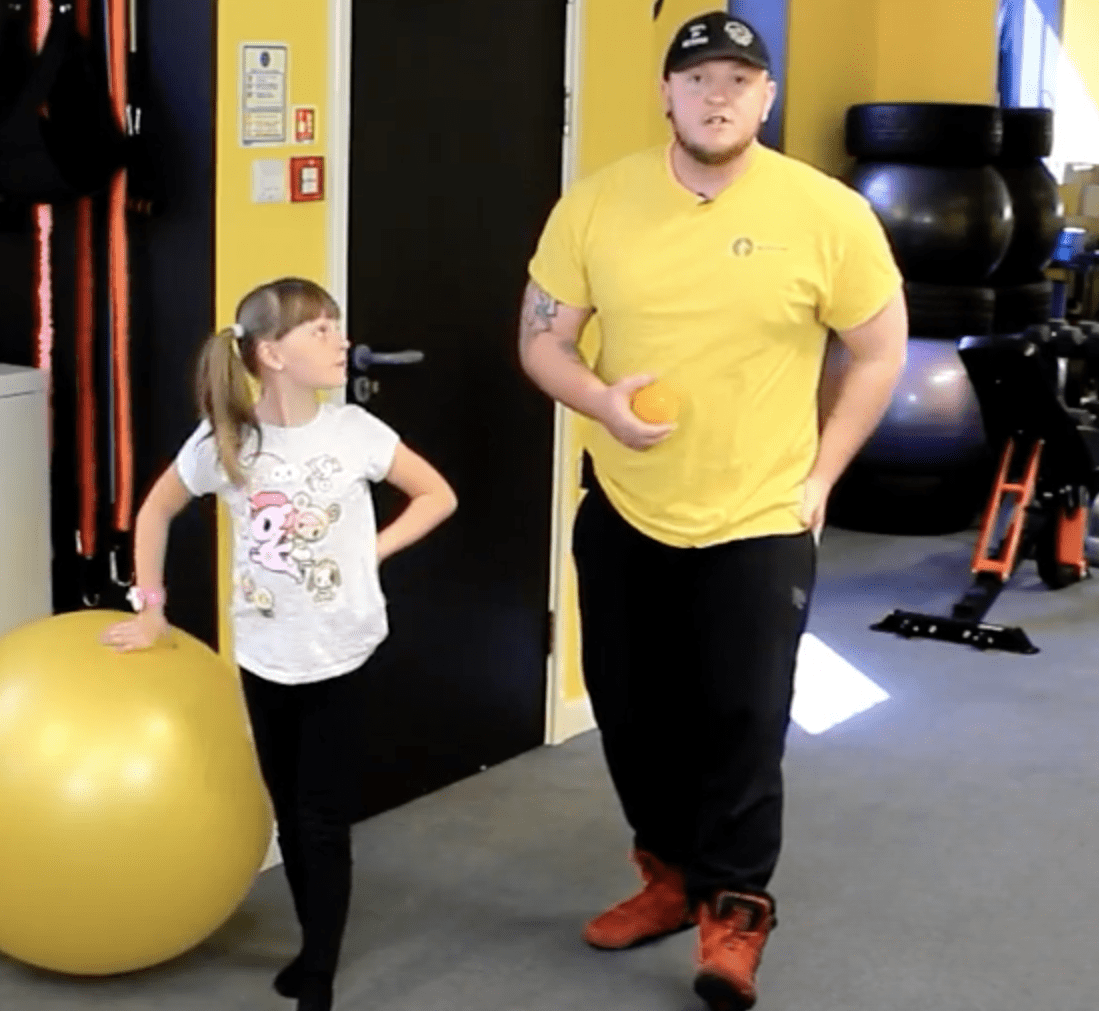
The video below is one of our favourite lower body stability games. There’s a bit of competition in it, it’s fairly daft, and it’s one legged closed chain work for the hips, knees and ankles without anybody ever having to call it that.
Hypermobility exercises for teenagers
Teenagers are a different job, and an easier one in most respects, as they can follow an instruction, hold a cue, and tell you what they can feel. Which means you can be precise with them, and the precision is most of the value.
Three things to work on, and they run in this order:
– Sensory clarity: giving the brain better information about where the joint actually is, usually through touch and pressure, before asking it to control anything.
– Endurance under load: being able to hold a position and use the tissue for a decent length of time without the whole thing falling apart.
– Functional integration: using the joint the way it’s built to be used, so the movement comes from muscular control rather than from sitting into the end of the available range.
A word on muscle tone, as it gets thrown about a lot and it’s probably the vaguest thing in this entire area. There aren’t any valid, reliable tools for measuring low tone in young children, which the people who went looking through the intervention research say plainly [34]. In practice, passive tone in hypermobility really is lower, active tone is often higher because the brain is bracing to make up for a poor signal, and what’s actually missing is readiness, the low level background activity that has a muscle ready to go before the joint needs it. Which is why a teenager who feels floppy and one who feels tight as a board can both be describing the same underlying problem.
Tactile cues are how we get at the sensory side, and the honest description is a modest one: touch and pressure at a joint give the brain extra information to work with while it’s learning a movement, and the joint is generally better controlled in that moment as a result. That’s it. There’s no rewiring going on and no map being restored, and neither of those descriptions holds up however often they get repeated.
Start with the core, as very nearly everything else sits on top of it. This isn’t planks and sit ups. It’s being able to find the muscles, coordinate them with the breath, and hold a light brace rather than gripping at full effort all day long. The video below walks through the whole thing from the floor up, including why constant hard bracing backfires in a hypermobile body.
Then the knees, which is where most hypermobile teenagers feel it first. The two videos below are the same exercise at two levels, using a band at the knee as a tactile cue. The first is the unloaded version, with most of the weight through the other leg and the working leg resting gently on the floor, and that’s where you start. The second is the same thing stood on the working leg, so the control has to hold up under body weight.
Load is the reason we’d push back gently on swimming, by the way. Swimming is great for plenty of things, and getting a hypermobile teenager moving and actually enjoying it is worth a great deal on its own. What water doesn’t give you is much load though, and control that’s only ever been practised unloaded doesn’t reliably turn up when they stand on one leg to put their shoes on. That’s a training argument rather than a research finding, and in fairness the writing on sport and hypermobility doesn’t test it either way [25]. Anything done on one leg transfers well, as walking is really a series of single leg tasks with a brief handover in between.
And then the shoulders, which hardly anybody traces back to the shoulder blade. Long stretches at a school desk and not much overhead work leave a lot of teenagers unable to actively set the shoulder blade at all, and a shoulder sitting on a blade that doesn’t move well is a great deal easier to slip. Most of the time in the studios the shoulder itself isn’t the problem, it’s the thing reporting the problem. That’s a control issue rather than a strength one, which is the same pattern behind why standard core advice tends to fail those with hypermobility.
How much exercise
The anxiety evidence worth quoting properly here is the forward looking sort, where people who were more physically active were less likely to go on to develop anxiety than the people who weren’t, children and adolescents included [20]. Note what that actually is though: people without anxiety at the start, followed forwards. It isn’t a treatment result in children who already have an anxiety disorder, and it gets quoted as though it were.
Then the practical limit. Too much too soon gives you delayed onset muscle soreness, and a child who’s never felt that before will find it alarming rather than satisfying. They’ve got school as well, and trying to concentrate through legs that hurt to sit down on isn’t much of a week. So build it up slowly.
Twice a week is where we usually start, and we’d rather put that forward as a sensible default than as a dose, as the work in hypermobile children hasn’t established a frequency [26]. For what it’s worth, the coordination programme that got results in five and six year olds ran two thirty minute sessions a week for eight weeks [33], which is at least in the same postcode.
What actually decides how this goes isn’t the programme though, it’s whether it keeps happening. Sessions really don’t need to be long. Sleep matters at least as much as the sessions do, as a badly slept child adapts to load poorly and hurts more, and how hypermobility and EDS affect sleep covers a lot more of that than we can fit in here.
The Fibro Guy

References
[1] Blajwajs, L., Williams, J.M., Timmons, W.M. and Sproule, J. (2023). Hypermobility prevalence, measurements, and outcomes in childhood, adolescence, and emerging adulthood: a systematic review. Rheumatology International, 43, pp.1423–1444. doi:https://doi.org/10.1007/s00296-023-05338-x.
[2] Tofts, L.J., Simmonds, J., Schwartz, S., Richheimer, R., O’Connor, C., Elias, E., Engelbert, R., Cleary, K., Tinkle, B., Kline, A., Hakim, A., van Rossum, M.V. and Pacey, V. (2023). Pediatric joint hypermobility: a diagnostic framework and narrative review. Orphanet Journal of Rare Diseases, 18. doi:https://doi.org/10.1186/s13023-023-02717-2.
[3] Quatman, C.E., Ford, K.R., Myer, G.D., Paterno, M.V. and Hewett, T.E. (2008). The effects of gender and pubertal status on generalized joint laxity in young athletes. Journal of Science and Medicine in Sport, 11(3), pp.257–263. doi:https://doi.org/10.1016/j.jsams.2007.05.005.
Read More[4] Graf, C., Schierz, O., Steinke, H., Körner, A., Kiess, W., Kratzsch, J. and Hirsch, C. (2019). Sex hormones in association with general joint laxity and hypermobility in the temporomandibular joint in adolescents: results of the epidemiologic LIFE Child study. Journal of Oral Rehabilitation. doi:https://doi.org/10.1111/joor.12834.
[5] Ituen, O., Duysens, J., Ferguson, G. and Smits-Engelsman, B. (2025). Age- and sex-related changes in children with and without generalized joint hypermobility: a two-year follow-up study. BMC Musculoskeletal Disorders, 26. doi:https://doi.org/10.1186/s12891-025-08684-y.
[6] Weyandt, L., Clarkin, C., Holding, E., May, S., Marraccini, M.E., Gudmundsdottir, B.G., Shepard, E. and Thompson, L. (2020). Neuroplasticity in children and adolescents in response to treatment intervention: a systematic review of the literature. Clinical and Translational Neuroscience, 4. doi:https://doi.org/10.1177/2514183X20974231.
[7] Engelbert, R.H.H., Uiterwaal, C.S.P.M. and Helders, P.J.M. (2005). The relationship between generalized joint hypermobility and motor development. Pediatric Physical Therapy, 17, pp.258–263. doi:https://doi.org/10.1097/01.pep.0000186505.32548.84.
[8] Juul-Kristensen, B., Kristensen, J.H., Frausing, B., Jensen, D.V., Røgind, H. and Remvig, L. (2009). Motor competence and physical activity in 8-year-old school children with generalized joint hypermobility. Pediatrics, 124, pp.1380–1387. doi:https://doi.org/10.1542/peds.2009-0294.
[9] Glans, M., Aziz, A., Kindgren, E., Knez, R., Landgren, M. and Landgren, V. (2025). No association between joint hypermobility, musculoskeletal pain and neurodevelopmental problems in a school-based sample of 11-year-old children. BJPsych Open, 11. doi:https://doi.org/10.1192/bjo.2025.10881.
[10] Romeo, D.M., Venezia, I., De Biase, M., Ascione, F., Lala, M.R., Arcangeli, V., Mercuri, E. and Brogna, C. (2022). Developmental coordination disorder and joint hypermobility in childhood: a narrative review. Children, 9. doi:https://doi.org/10.3390/children9071011.
[11] Mintz-Itkin, R., Lerman-Sagie, T., Zuk, L., Itkin-Webman, T. and Davidovitch, M. (2009). Does physical therapy improve outcome in infants with joint hypermobility and benign hypotonia? Journal of Child Neurology, 24(6), pp.714–719. doi:https://doi.org/10.1177/0883073808329526.
[12] Yıldız, A., Yıldız, R., Burak, M., Zorlular, R., Akkaya, K.U. and Elbasan, B. (2024). An investigation of sensory processing skills in toddlers with joint hypermobility. Early Human Development, 192, p.105997. doi:https://doi.org/10.1016/j.earlhumdev.2024.105997.
[13] Akkaya, K.U., Burak, M., Yıldız, R., Yıldız, A. and Elbasan, B. (2023). Examination of foot sensations in children with generalized joint hypermobility. Early Human Development, 180, p.105755. doi:https://doi.org/10.1016/j.earlhumdev.2023.105755.
[14] Yıldız, R., Yıldız, A., Camli, O., Akkaya, H., Aydin, M. and Başaran, Z. (2025). Effect of plantar sensory stimulation on sensorimotor organization in general joint hypermobility: a randomized controlled study. Healthcare, 13. doi:https://doi.org/10.3390/healthcare13202572.
[15] Daman, M., Shiravani, F., Hemmati, L. and Taghizadeh, S. (2017). The effect of combined exercise therapy on knee proprioception, pain intensity and quality of life in patients with hypermobility syndrome: a randomized clinical trial. Journal of Bodywork and Movement Therapies, 23(1), pp.202–205. doi:https://doi.org/10.1016/j.jbmt.2017.12.012.
[16] Bulbena-Cabré, A., Duñó, L., Almeda, S., Batlle, S., Camprodon-Rosanas, E., Martín-López, L.M. and Bulbena, A. (2019). Joint hypermobility is a marker for anxiety in children. Revista de Psiquiatría y Salud Mental, 12(2), pp.68–76. doi:https://doi.org/10.1016/j.rpsm.2019.01.004.
[17] Ezpeleta, L., Navarro, J.B., Penelo, E. and Bulbena, A. (2018). Joint hypermobility classes in 9-year-old children from the general population and anxiety symptoms. Journal of Developmental and Behavioral Pediatrics, 39, pp.481–488. doi:https://doi.org/10.1097/dbp.0000000000000577.
[18] Eccles, J.A., Quadt, L., McCarthy, H., Davies, K.A., Bond, R., David, A.S., Harrison, N.A. and Critchley, H.D. (2022). Variant connective tissue (joint hypermobility) and its relevance to depression and anxiety in adolescents: a cohort-based case-control study. BMJ Open, 12. doi:https://doi.org/10.1136/bmjopen-2022-066130.
[19] de Lima Osório, F., Udina, M., Martín-Santos, R. and Crippa, J.A.S. (2012). Anxiety and joint hypermobility association: a systematic review. Revista Brasileira de Psiquiatria, 34(Suppl 1), pp.S53–S60. doi:https://doi.org/10.1590/s1516-44462012000500005.
[20] Schuch, F.B., Stubbs, B., Meyer, J., Heissel, A., Zech, P., Vancampfort, D., Rosenbaum, S., Deenik, J., Firth, J., Ward, P.B., Carvalho, A.F. and Hiles, S.A. (2019). Physical activity protects from incident anxiety: a meta-analysis of prospective cohort studies. Depression and Anxiety, 36(9), pp.846–858. doi:https://doi.org/10.1002/da.22915.
[21] Carter, T., Pascoe, M., Bastounis, A., Morres, I.D., Callaghan, P. and Parker, A.G. (2021). The effect of physical activity on anxiety in children and young people: a systematic review and meta-analysis. Journal of Affective Disorders, 285, pp.10–21. doi:https://doi.org/10.1016/j.jad.2021.02.026.
[22] Schoenfeld, T.J., Rada, P., Pieruzzini, P.R., Hsueh, B. and Gould, E. (2013). Physical exercise prevents stress-induced activation of granule neurons and enhances local inhibitory mechanisms in the dentate gyrus. The Journal of Neuroscience, 33(18), pp.7770–7777. doi:https://doi.org/10.1523/jneurosci.5352-12.2013.
[23] Montgomery, T.R. and Grant, D.M. (2026). Neurobiological, molecular, and systemic mechanisms of exercise in the treatment of mental health disorders. Journal of Psychiatric Research, 195, pp.113–122. doi:https://doi.org/10.1016/j.jpsychires.2026.01.043.
[24] Bird, H.A. (2005). Joint hypermobility in children. Rheumatology, 44(6), pp.703–704. doi:https://doi.org/10.1093/rheumatology/keh639.
[25] Kwiatkowska, M., Palian, J., Huzarska, K., Kurzyński, S. and Baraniecka, A. (2026). Hypermobility spectrum disorders and sport participation: when movement helps and when it harms, a narrative review of the medical evidence. Quality in Sport. doi:https://doi.org/10.12775/qs.2026.64.73746.
[26] Brittain, M.G., Flanagan, S.C., Foreman, L.N. and Teran-Wodzinski, P. (2023). Physical therapy interventions in generalized hypermobility spectrum disorder and hypermobile Ehlers-Danlos syndrome: a scoping review. Disability and Rehabilitation, 46, pp.1936–1953. doi:https://doi.org/10.1080/09638288.2023.2216028.
[27] Winter, L., Huang, Q., Sertic, J.V.L. and Konczak, J. (2022). The effectiveness of proprioceptive training for improving motor performance and motor dysfunction: a systematic review. Frontiers in Rehabilitation Sciences, 3. doi:https://doi.org/10.3389/fresc.2022.830166.
[28] Shetty, K., Ravichandran, H., Ravikumar, K., Shivanna, M., Subramanian, S. and Janakiraman, B. (2026). Phenotype-based prediction of functional improvements following structured exercise intervention in children with hypermobility spectrum disorder. Revista Pesquisa em Fisioterapia. doi:https://doi.org/10.17267/2238-2704rpf.2026.e6668.
[29] Peng, C., He, J., Xu, K., Wu, X., Wang, D.-D. and Zhang, L. (2025). Effects of exercise interventions on motor coordination in children with developmental coordination disorder (DCD): a systematic review and meta-analysis. Research in Developmental Disabilities, 168, p.105184. doi:https://doi.org/10.1016/j.ridd.2025.105184.
[30] Hua, L., Song, Z., Liu, J. and Zhang, B. (2025). Intervention effect of physical activity on motor coordination in children and adolescents with developmental coordination disorder: a meta-analysis. Frontiers in Psychology, 16. doi:https://doi.org/10.3389/fpsyg.2025.1630439.
[31] Alharbi, M., Harris, D., Dodd, H., Wood, G. and Buckingham, G. (2026). Home-based immersive virtual reality to improve motor performance in children and adolescents with developmental coordination disorder: crossover study. JMIR Serious Games, 14. doi:https://doi.org/10.2196/84995.
[32] Asano, D., Sakai, H., Monden, H., Shimazaki, Y., Nakamura, K. and Ohmatsu, S. (2026). Immediate effect of digital game use and verbal encouragement on lower limb activity and psychological enjoyment during motor task in children with motor disorders. Physical and Occupational Therapy in Pediatrics, 46, pp.750–765. doi:https://doi.org/10.1080/01942638.2026.2618035.
[33] Şendil, A.M., Canlı, U., Sheeha, B.B., Alkhamees, N.H., Batrakoulis, A. and Al-Mhanna, S.B. (2024). The effects of structured coordinative exercise protocol on physical fitness, motor competence and inhibitory control in preschool children. Scientific Reports, 14. doi:https://doi.org/10.1038/s41598-024-79811-3.
[34] Paleg, G., Robles, Á., Govender, P. and Livingstone, R. (2025). Occupational and physical therapy interventions for young children with developmental central hypotonia: an overview of systematic reviews. Disabilities, 5. doi:https://doi.org/10.3390/disabilities5010014.