
This article is part of our comprehensive guide to exercise and rehabilitation for hypermobility.
Giving way is usually the thing people describe first. Not always painfully either, just a half second where the leg isn’t quite underneath you, and then it is again. What comes after it though, is generally the bigger problem, as once that has happened a handful of times you stop trusting stairs, then you stop trusting uneven ground, and then you notice you have been planning a route across a car park without ever really deciding to.
Most people reading this will have done the leg extensions and the wall sits already, probably more than once. Some of you will have been told it’s patellofemoral pain, some will have been told the quads are weak, and a fair few will have been told that the scan is clean so the knee should be fine, which has to be one of the least useful sentences in all of healthcare.
So, the short version. A symptomatic hypermobile knee is generally not short of muscle so much as it’s short of information, as the signal coming out of the joint is less precise than it ought to be, and a brain working off a vague signal will hedge. That hedging is where the gripping, the locking out and the sudden giving way all come from. The work, then, is to make that signal easier to read, using contact the joint can feel, and then to add load on top of it rather than instead of it. It starts at the foot, and it moves to the knee after that.
Three exercises then, in order, with the reasoning in between them. If you want the mechanisms in full rather than in summary, we’ve written all of that up properly in part two of our exercise guide.
Why the knee is usually the joint that goes first
Pool the lower limb work in hypermobility together and two things come out poorer than they do in people with ordinary mobility: knowing what position a joint is in, and noticing that it has started to move [1]. The knee is where that shows up most consistently, and it has been measured at the knee directly. Women with hypermobility syndrome needed a bigger movement before they registered that the knee had started to bend at all [2]. And women with the hypermobile type of Ehlers-Danlos syndrome put the knee back to a target angle a good deal less accurately than matched controls did, which still held after how much sport they did was accounted for [3].
Now, the part that tends to sound familiar. In more recent work, hypermobile people made larger errors placing the knee, and came out no different at all on the gross functional tests they were given in the same session [4]. So the sense is measurably worse, and you still pass the assessment, which is generally because you have spent years compensating and you have got very good at it.
What that actually costs you is not accuracy so much as steadiness. Your knee is reporting its angle constantly, and in a symptomatic hypermobile body that report wobbles a fair bit from one reading to the next. A control system handed a wobbly number does the sensible thing with it. It stiffens up, so there’s less to get wrong. It leans harder on the input it can still trust, which is nearly always your eyes. And it checks, constantly, out of exactly the same attention you were hoping to spend on the rest of your day. Which is why the knee behaves itself in good light and stops behaving the moment the light is poor, and why a busy, visually demanding environment leaves you far more wrecked than the walking alone would ever explain.
This is a symptomatic pattern rather than a hypermobile one, and that distinction matters. Plenty of hypermobile knees test perfectly normally. It’s the combination of laxity with pain, instability, fatigue and years of a slightly different movement history that produces the knee described above.
The strength thing, and why the leg extensions didn’t fix it
You were told to strengthen the quads because weakness is the obvious answer, and there genuinely is a force problem in there, it just isn’t the one that was described to you.
Women with the hypermobile type of Ehlers-Danlos syndrome produced considerably less force at the knee than controls did and tired sooner with it, while the amount of muscle on their legs came out much the same on a scan [5]. So the muscle is there, it is roughly the size it ought to be, and it still isn’t producing anything like what a muscle that size should produce.
How much your strength is worth also depends a lot on whether you can aim it. In the hypermobile type of Ehlers-Danlos syndrome, the relationship between how strong somebody was and what they could manage in daily life got fairly muddled once the accuracy of their joint position sense was taken into account [6]. Which is pretty much how somebody ends up with a perfectly respectable set of quads and a knee that still folds on a kerb, as force you can’t aim particularly well doesn’t do a lot for you.
None of which means you can’t get stronger, by the way. In people with hypermobility syndrome and long standing knee pain, strength improved at the same rate as it did in everybody else over a four month programme, they just started lower, and it took most of that time to reach the level the comparison group had begun at [7]. So you’re not slow to strengthen so much as starting further back and needing longer than somebody else would, and those are genuinely different problems.
If the tight and weak at the same time thing is the bit that rings true for you, why hypermobile muscles feel tight and weak at once is the piece that goes through all of that properly.

Start at the foot, not at the knee
The knee has to work with whatever the foot hands it. If the arch drops in as you take weight, the shin turns in along with it and the knee follows the shin, and you are then asking the knee to control a problem that started underneath it. Give the foot something stable to stand on though, and the knee’s job gets a great deal simpler. In the studios, this is far and away the most common reason a knee exercise isn’t working, as the knee is being coached and the foot is being completely ignored.
Now, there’s a sensory argument for starting down there as well. In young hypermobile adults, a fortnight of sensory work on the soles of the feet improved light touch, the ability to tell two points of contact apart, joint position sense and balance, with no change in strength at all [8]. Do keep in mind who that was actually done in though, as they were pain free young adults rather than people with years of knee pain sat behind them. So it gives us a reason to start at the foot, rather than a promise about your particular knee.
What you’re after is an arch you can hold while the rest of the leg is busy doing something, rather than an arch you can hold while concentrating on nothing else in the world. If it collapses the moment you add weight or look away, then that is the level to work at, and there’s really no rush to leave it.
Why we use tactile cues, and what they are not
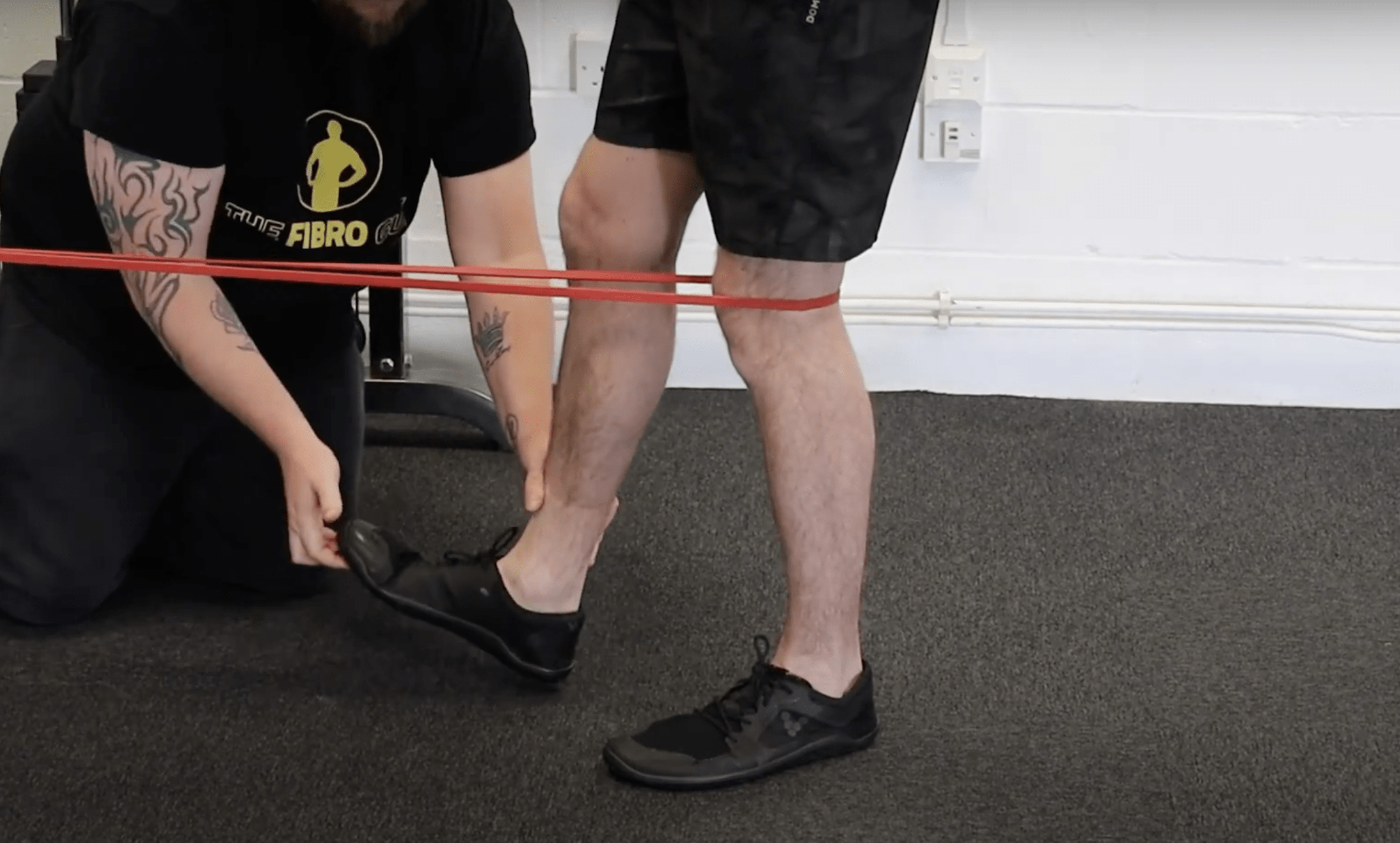
A tactile cue is anything that gives a joint an edge to feel. A band round the knee, a hand on the thigh, the floor under the arch, a strip of tape across the skin, that sort of thing. Your skin is part of how you know where a joint is in the first place, so when the information coming from inside the joint is vague, something the skin can feel gives the brain a second opinion to work with.
What makes sensory work do anything at all though, is the deciding. In long standing limb pain, touch training where people had to work something out, so which spot was being touched, or which of two things they could feel, brought pain down. The same amount of touch with nothing to work out did nothing whatsoever [9].
We use cues a lot, so the ground underneath them is worth setting out. Pooling the taping work across joints, taping reduced how far people missed a target angle by, and did nothing measurable for how well they detected that a joint had started moving [10]. In hEDS shoulders, taping improved rotation range and did not improve how accurately people could reposition the joint, and the people who ran it said plainly that they couldn’t recommend it for that purpose [11]. So a cue isn’t a treatment, and anybody selling tape as one has got a fair way ahead of what has been shown.
A cue, for us, is a question rather than a brace. Can you feel the band on the outside of the knee the whole way down and the whole way back up again. Is the pressure under your foot still where you left it. Then we take the cue off and ask whether the answer is still there without it, which is generally the bit most programmes skip entirely.
It’s also why we start regressed. Get the pattern somewhere nothing much is at stake, with plenty to feel, and then progressively take the feedback away and add the load, in that order rather than the other way round.
The unloaded knee
This is the starting version, and it’s where most people should probably be for a good deal longer than they’d like.
So, unloaded first, for a fairly simple reason. You’re trying to learn what the knee is doing, and bodyweight going through a joint you can’t locate accurately only adds consequences to a movement you haven’t got yet. Take the load out though, and you can spend your attention on the information rather than on staying upright.
Go slowly enough that you could stop at any point in the range and still know where you are. If you can only do it while staring at the knee, then do it while staring at the knee for now, and then do it looking away, and then do it while talking to somebody. That last version is the one real life actually asks for.
The loaded knee
Same movement, now with something to hold up.
Load isn’t the enemy here, loading a joint that nobody in the room can accurately locate is the enemy. Once the pattern holds without load though, it needs load, as a knee that behaves itself in a controlled position and then folds on a kerb has only really learned the controlled position.
Progress it by what happens the next day rather than by what the plan said six weeks ago. If the unloaded version has gone backwards this week, then the loaded version isn’t the answer this week either.
How we’d actually run the week
– Short and often beats long and occasional: Twenty attentive minutes, four times a week, will teach you far more than one long session at the weekend will, and it’s a far more achievable target on a rough day too.
– Judge it by tomorrow: Not by how it felt at the time and not by how it looked. Whether the thing is still there the next morning is the measure worth having, and changing that one scoring rule tends to reorganise an entire programme.
– Take the cue away on purpose: The band, the hand and the floor are only there to make something learnable, and leaving them in forever means you’ve gone and learned a movement that needs a band.
– Vary the conditions, not the exercise list: Same movement, different speed, different surface, head turned, shoes off. You’re building something your nervous system can use in a situation it hasn’t met before, and you can’t really build that out of three identical sets. There’s a lot more on that in our piece on how a nervous system actually learns a movement.
– Leave an angry knee alone: A joint that’s hot, swollen or freshly upset isn’t going to give you what the plan expects. Settle it first, then load it.
– Expect the first few weeks to look like nothing: What changes early is the quality of the information and the way the movement is organised, rather than the size of anything. Which is, unfortunately, the exact stage where nearly everybody quits.
What the evidence behind all this actually amounts to
So, exercise is the part with the most behind it, and none of it is particularly large.
Programmes built around closed chain work and position sense training have improved knee position sense, pain and quality of life in hypermobility syndrome, over eight weeks and over four [12][13][14]. Supervised heavy resistance training was tolerated in women with knee pain and knee hypermobility, with pain falling and knee position sense improving, although there was nobody at all to compare them against, so do hold that one fairly loosely [15]. Handed to women with generalised hypermobility as a self guided programme to do twice a week at home though, resistance training produced no measurable gain in strength, pain or disability [16]. Supervised and individualised, against a sheet of exercises and good luck, is not a small difference.
One more, for anybody who has ever been told that the end of their range is forbidden territory. In children with hypermobility syndrome and knee pain, a progressed individualised programme brought the worst knee pain down, and it made no real clinically significant difference whether the knee was worked into its hypermobile range or only to neutral [17].
What hasn’t been settled is whether heavier loading beats ordinary care for a symptomatic hypermobile knee. That comparison is being run at the moment, and the people running it wrote that nobody had ever made it before [18]. So our order, information first and load second, is our read of the mechanism and of what we watch happen in the studios day to day, rather than something anybody has gone and proven. If it turns out we’ve had it the wrong way round, we’ll say so and teach the other thing.
The rest of the argument, including why traditional strength training keeps stopping halfway, is in part one of our exercise guide.
The Fibro Guy

References
[1] Smith, T.O., Jerman, E., Easton, V., Bacon, H., Armon, K., Poland, F. et al. (2013) ‘Do people with benign joint hypermobility syndrome (BJHS) have reduced joint proprioception? A systematic review and meta-analysis’, Rheumatology International. https://doi.org/10.1007/s00296-013-2790-4
[2] HALL, M.G., FERRELL, W.R., STURROCK, R.D., HAMBLEN, D.L. and BAXENDALE, R.H. (1995) ‘THE EFFECT OF THE HYPERMOBILITY SYNDROME ON KNEE JOINT PROPRIOCEPTION’, Rheumatology. https://doi.org/10.1093/rheumatology/34.2.121
[3] Rombaut, L., De Paepe, A., Malfait, F., Cools, A. and Calders, P. (2009) ‘Joint position sense and vibratory perception sense in patients with Ehlers–Danlos syndrome type III (hypermobility type)’, Clinical Rheumatology. https://doi.org/10.1007/s10067-009-1320-y
Read More[4] Akaras, E., Deniz, G., Eymir, M. and Sönmez, M. (2025) ‘The effects of joint hypermobility on strength, proprioception, and functional performance’, Scientific Reports. https://doi.org/10.1038/s41598-025-24199-x
[5] Rombaut, L., Malfait, F., De Wandele, I., Taes, Y., Thijs, Y., De Paepe, A. et al. (2012) ‘Muscle mass, muscle strength, functional performance, and physical impairment in women with the hypermobility type of Ehlers‐Danlos syndrome’, Arthritis Care & Research. https://doi.org/10.1002/acr.21726
[6] Scheper, M., Rombaut, L., de Vries, J., De Wandele, I., van der Esch, M., Visser, B. et al. (2016) ‘The association between muscle strength and activity limitations in patients with the hypermobility type of Ehlers–Danlos syndrome: the impact of proprioception’, Disability and Rehabilitation. https://doi.org/10.1080/09638288.2016.1196396
[7] To, M. and Alexander, C.M. (2019) ‘Are People With Joint Hypermobility Syndrome Slow to Strengthen?’, Archives of Physical Medicine and Rehabilitation. https://doi.org/10.1016/j.apmr.2018.11.021
[8] Yildiz, R., Yildiz, A., Camli, O., Akkaya, H., Aydin, M. and Basaran, Z. (2025) ‘Effect of Plantar Sensory Stimulation on Sensorimotor Organization in General Joint Hypermobility: A Randomized Controlled Study’, Healthcare. https://doi.org/10.3390/healthcare13202572
[9] Moseley, L.G., Zalucki, N.M. and Wiech, K. (2008) ‘Tactile discrimination, but not tactile stimulation alone, reduces chronic limb pain’, Pain. https://doi.org/10.1016/j.pain.2007.10.021
[10] Ghai, S., Ghai, I. and Narciss, S. (2024) ‘Influence of taping on joint proprioception: a systematic review with between and within group meta-analysis’, BMC Musculoskeletal Disorders. https://doi.org/10.1186/s12891-024-07571-2
[11] Tudini, F., Jordon, M., Levine, D., Healy, M., Cathey, S. and Chui, K. (2024) ‘Evaluating the effects of two different kinesiology taping techniques on shoulder range of motion and proprioception in patients with hypermobile Ehlers–Danlos syndrome: a randomized controlled trial’, Frontiers in Rehabilitation Sciences. https://doi.org/10.3389/fresc.2024.1383551
[12] Ferrell, W.R., Tennant, N., Sturrock, R.D., Ashton, L., Creed, G., Brydson, G. et al. (2004) ‘Amelioration of symptoms by enhancement of proprioception in patients with joint hypermobility syndrome’, Arthritis & Rheumatism. https://doi.org/10.1002/art.20582
[13] Sahin, N., Baskent, A., Cakmak, A., Salli, A., Ugurlu, H. and Berker, E. (2008) ‘Evaluation of knee proprioception and effects of proprioception exercise in patients with benign joint hypermobility syndrome’, Rheumatology International. https://doi.org/10.1007/s00296-008-0566-z
[14] Daman, M., Shiravani, F., Hemmati, L. and Taghizadeh, S. (2019) ‘The effect of combined exercise therapy on knee proprioception, pain intensity and quality of life in patients with hypermobility syndrome: A randomized clinical trial’, Journal of Bodywork and Movement Therapies. https://doi.org/10.1016/j.jbmt.2017.12.012
[15] Henriksen, P., Junge, T., Bojsen-Møller, J., Juul-Kristensen, B. and Thorlund, J.B. (2022) ‘Supervised, Heavy Resistance Training Is Tolerated and Potentially Beneficial in Women with Knee Pain and Knee Joint Hypermobility: A Case Series’, Translational Sports Medicine. https://doi.org/10.1155/2022/8367134
[16] Luder, G., Aeberli, D., Mebes, C.M., Haupt-Bertschy, B., Baeyens, J.P. and Verra, M.L. (2021) ‘Effect of resistance training on muscle properties and function in women with generalized joint hypermobility: a single-blind pragmatic randomized controlled trial’, BMC Sports Science, Medicine and Rehabilitation. https://doi.org/10.1186/s13102-021-00238-8
[17] Pacey, V., Tofts, L., Adams, R.D., Munns, C.F. and Nicholson, L.L. (2013) ‘Exercise in children with joint hypermobility syndrome and knee pain: a randomised controlled trial comparing exercise into hypermobile versus neutral knee extension’, Pediatric Rheumatology. https://doi.org/10.1186/1546-0096-11-30
[18] Liaghat, B., Bojsen-Møller, J., Juul-Kristensen, B., Henriksen, P., Mohammadnejad, A., Heiberg, B.D. et al. (2024) ‘High-load strength training compared with standard care treatment in young adults with joint hypermobility and knee pain: study protocol for a randomised controlled trial (the HIPEr-Knee study)’, BMJ Open. https://doi.org/10.1136/bmjopen-2024-090812