

- Hypermobile hip exercises we use, and why clamshells aren’t one of them - 17 October 2026
- Is Fibromyalgia a Disability in the UK, and Can You Claim PIP? - 14 October 2026
- Fibromyalgia and Central Sensitisation, What Is It in Plain English? - 8 October 2026
The disclosure question, and why nobody gives you a straight answer
At some point, most people living with chronic pain or hypermobility end up in the same conversation with themselves: when do I tell someone I’m dating? Before the first date? On it? After? When it’s starting to feel serious? When a symptom forces the issue?
Nobody has a tidy answer, and the ones who pretend they do are either not chronically ill or they’ve never been rejected. The reality is messier. There’s no single correct timing, no magic script, no approach that guarantees a good response. What the research does show, though, is that some approaches are meaningfully better than others, and that a lot of the worst outcomes come from either extreme: disclosing so early that there’s no relational context to hold it, or concealing so long that the eventual conversation carries the additional weight of “why didn’t you tell me?”
This blog covers the disclosure question in full: what the research says about timing and approach, how dating apps change the calculation, what to actually say when the moment arrives, and what to do when it doesn’t go well. It also covers LGBTQ+ specific layers, and the particular situation faced by trans people who are managing illness disclosure alongside other identity disclosures at the same time.
This is part of the broader Chronic Pain, Relationships and Intimacy hub. If you’re reading because pain during sex is part of the picture, our pelvic floor and sex guide covers the physical side in detail. This blog is about what comes before that: the conversation that decides whether a new relationship even gets started.
What the research actually shows about when to tell
The academic literature on this is more useful than you might expect, mostly because it stops trying to give a single answer and instead identifies what actually matters.
The clearest signal in the research is that the quality of what you disclose, and how a partner responds, matters more than rigid rules about when. In a longitudinal study of couples managing a concealable chronic illness, greater illness disclosure was consistently linked to better health and relational outcomes, with perceived partner responsiveness (whether your partner responded with genuine care, validation and interest) tracking strongly alongside those outcomes [1]. The study did not directly compare early-versus-late timing, and the sample is small and skewed toward younger adults, so the timing takeaway is a reasoned read of the wider literature rather than a finding from a single trial. The practical version is that disclosing on date two to a warm, curious partner tends to go better than disclosing on month three to a cold or dismissive one.
That said, timing isn’t completely irrelevant. Twelve months of longitudinal data on couples where one partner has a concealable chronic illness showed measurable declines over time in illness-related communication, dyadic coping, relationship satisfaction and felt closeness, while sexual satisfaction stayed broadly stable across the year [2]. The authors observed those declines rather than testing a “default-decline-unless-maintained” rule, but the reasonable interpretation is that disclosure isn’t a single event with a right moment, it’s the start of an ongoing process that benefits from active upkeep. Getting that process going earlier tends to give you more runway.
There’s also the question of what happens when people don’t disclose. The theoretical literature on “passing for normal” with a chronic condition flags that the strategy carries psychological costs, even when it lowers the immediate social risk of disclosure [3]. Sustained concealment requires effort and creates anxiety about eventual full disclosure. In the wider literature on non apparent disability, daily choices about what to reveal can become a constant identity management task, and the corollary, drawing attention to one’s condition rather than continuing to pass, has been linked to a stronger and more coherent sense of identity over time [4].
Planned disclosure also tends to land better than reactive disclosure, although this is a principle drawn from clinical experience and the wider disclosure literature rather than a directly tested comparison. When a symptom event forces the conversation before you’ve chosen to have it, the other person receives emotionally loaded, incomplete information in a context where they’re already worried or confused. They have less capacity to respond well. The result often isn’t the response you needed, and it wasn’t really their fault either.
The case for telling early: early filtering, not confession
There’s a version of early disclosure that’s strategic, not desperate, and it’s worth understanding.
Anticipation of rejection is one of the documented barriers to forming relationships for people with physical disabilities, including in a small qualitative study of women with visible physical disabilities [5]. The population in that study isn’t a direct match for those with hypermobility or other concealable conditions, but the broader pattern of “what if they find out and leave?” anxiety is one many of those with hEDS, fibromyalgia, POTS, and similar conditions will recognise. In some cases that anxiety is doing more damage than the condition itself. Early disclosure removes it.
When it comes to filtering, the logic is straightforward: someone who responds badly to knowing you have a chronic condition is, almost certainly, not the right person for a long term relationship that will involve managing that condition. Finding this out before deep emotional investment is not pleasant, but it’s less damaging than finding it out after six months. The community pattern on this is consistent. On the r/actuallesbians chronic illness thread, the most commonly endorsed approach from those who’d been dating with chronic illness for years was to be honest early specifically because the situation isn’t changing. That’s not pessimism. It’s filtering.
Early disclosure also tends to produce more accurate information sharing. When you’re not anxious about concealment, you can give a clearer, calmer account of what the condition actually involves, rather than a stress compressed disclosure during a symptom event.
The catch is that very early disclosure, before any attachment has formed, does carry a real vulnerability: potential rejection before any relational investment has been made. It’s not comfortable. But for many of those with chronic conditions that significantly affect daily functioning, it’s the most efficient approach, and efficiency is part of managing energy when you don’t have unlimited amounts of it.
The case for waiting: energy management and safety
The case for waiting is also legitimate, and it’s not just about managing the other person’s reaction.
First, disclosure takes energy. The conversation itself, the preparation, the emotional cost of whatever reaction follows, and the ongoing processing afterwards. When you’re chronically ill, energy isn’t abstract. Spending it on a disclosure conversation very early, before you have any sense of whether this person is worth the investment, isn’t necessarily wise.
Second, there are safety considerations that don’t apply equally to everyone. For trans people, for people in marginalised communities, and for anyone with a history of difficult experiences following disclosure, the calculus is different. Safety assessment has to come first. The social and relational context, perceived safety, and the strength of someone’s sense of belonging to the wider community shape when any stigmatised identity disclosure feels appropriate, with community connectedness and identity salience among the more consistent predictors in the research [6].
Third, most chronic conditions are genuinely complex to explain, especially when you’re early in your own understanding of them. Ehlers-Danlos syndromes and hypermobility spectrum disorders in particular can be difficult to describe to someone who’s never encountered them. Partial, incremental disclosure is not deception. It reflects the reality that explaining a multi system condition takes time, and that both you and your partner’s understanding of it will develop across months, not a single conversation [1].
The research on this is clear: incremental disclosure is normal. The problem arises when concealment is total and sustained, not when disclosure happens gradually. There’s a meaningful difference between “I haven’t told them everything yet” and “I’ve been actively hiding this for four months because I’m terrified of what happens if they know.”
Ready to work through this with structure and support?
The Hypermobility Live Workshop is four weeks of breaking down the frameworks we use in our studios, with live Q&A so you can ask about your specific situation. Two free courses are included.
The sweet spot most clinicians, researchers and chronically ill communities seem to converge on is disclosure at a point of moderate relational investment. Not on the first message. Not after two years. Somewhere in the early to middle phase of the relationship forming, when both people have enough invested to weather a difficult conversation, but before either party has committed to something built on an incomplete picture. This is a reasoned synthesis rather than a finding from a single study.
How to disclose on dating apps
When it comes to dating apps specifically, the academic research is thin [7]. No decent study has tested which disclosure approach produces better long term outcomes in app based dating for people with chronic conditions. So what follows is based on community evidence, which is extensive, and general principles from the disclosure literature.
The main options are: profile disclosure, in message disclosure before meeting, or in person disclosure.
Profile disclosure is the boldest approach, and it does work for some people. Including something like “I live with a chronic health condition that affects my energy and mobility” in a bio functions as a filter before you’ve invested any time. The obvious downside is that it reduces match volume, and some of the people it filters out would have been perfectly fine partners who just didn’t know how to engage with the information in a two line bio. The other risk is that a profile disclosure gives you no control over the framing or the context, so the reader creates their own picture, which may not match the reality.
In message disclosure before meeting is a middle ground that has a lot going for it. You’ve established some basic connection. The person has chosen to engage with you as a person. You can frame the disclosure properly, with context, and gauge the response before committing to a first date. It also removes the in person pressure from both sides. Some people find it easier to respond thoughtfully to a message than to a face to face disclosure where the social pressure to perform “the right reaction” is higher.
In person disclosure remains the most common approach. Most people with non apparent conditions don’t disclose in profiles or messages, preferring to wait until in person contact is established [7]. The logic is that once someone has met you, formed impressions, and chosen to keep seeing you, they have more context for the disclosure. The risk is that the conversation can feel more loaded in person, particularly if it happens without prior planning.
There’s no ranking here because the right approach depends on your specific condition, how significantly it affects your life, your own energy management needs, and your read of the individual. What doesn’t work is no approach at all: deferring indefinitely, waiting for the perfect moment, or hoping the condition just won’t come up.
The conversation itself: what to actually say
The goal of the disclosure conversation is not confession, and it’s not a medical briefing. It’s giving the other person accurate information so they can make an informed choice about whether to continue, framed in a way that invites them to respond as a partner rather than as a caregiver or a judge.
A few things that the evidence and community experience consistently support:
Lead with the practical, not the dramatic. “I have a connective tissue condition that means my joints are unstable, my energy varies a lot day to day, and some days are significantly harder than others. I manage it well but it doesn’t go away” covers the essentials. It tells the person what they actually need to know without front loading every worst case scenario. You’re not downplaying it, you’re framing it accurately.
Give them a role. The communal coping research consistently shows that framing chronic illness as a shared stressor, something you’ll both manage together rather than a personal problem they’re being warned about, produces better relational outcomes [8]. “This is part of my life, and I want to be honest with you about it early” is different from “here’s a list of things that will be difficult about being with me.”
Let them ask questions. Most people, when they get a calm, matter of fact disclosure, don’t run. They ask questions. Those questions tell you a lot about them: whether they’re curious and engaged, or politely waiting for you to finish so they can change the subject. Both responses are information.
Don’t apologise for existing. The disclosure is not an apology. The literature on passing for normal with a chronic condition notes that one of its psychological costs is the implicit message it sends to yourself: that the information is shameful enough to conceal [3]. Disclosing directly and without excessive hedging is good for the other person, and it’s good for you.
When it comes to how much detail to give: start with the overview, and let them lead the depth. If they ask about specific symptoms, answer honestly. If they don’t, you don’t need to provide an unsolicited comprehensive account of every symptom. The first disclosure is not the last one. It’s the beginning of an ongoing set of conversations [1].
The bit nobody tells you: what to do when they respond badly
Some people respond badly. It happens. The response might be visible discomfort followed by a rapid change of subject. It might be “oh I’m sure it’ll be fine” in a tone that makes clear they haven’t processed what you’ve said. It might be outright withdrawal. It might happen in the moment, or it might happen in the days after, when the person has had time to think about it and decided they don’t want to continue.
There’s no way to make this not hurt. But a few things are worth knowing.
First, the anticipation of rejection frequently precedes actual rejection and can function as a self fulfilling constraint. Some of those who’ve made the most settled adjustments to their dating lives with chronic illness are the ones who’ve learned to separate the anxiety of disclosure from the actual response. The anxiety is almost always worse than what happens.
Second, a bad response to disclosure is information, not a verdict. Someone who cannot handle the information that you have a chronic condition is telling you something important about their capacity for a long term relationship with someone who will have that condition indefinitely. That information, painful as it is to receive it, is useful.
Third, it’s worth distinguishing between a bad immediate response and a bad ongoing response. Some people panic initially and then, given a bit of time and information, recalibrate. If someone responds awkwardly in the moment but comes back a few days later having clearly thought about it, that’s different from someone who goes quiet and disappears. The first might be worth a follow up conversation. The second probably isn’t.
The community pattern on rebuilding after a bad disclosure experience is consistent: the people who come out of it in the best shape are the ones who didn’t internalise the rejection as evidence that they’re undateable, and the ones who stayed in contact with others going through the same thing. Nobody should have to process this completely alone, and most chronic illness communities online have people willing to talk about it.
LGBTQ+ context: when disclosure stacks with other identities
For lived experience across these communities, see our piece on LGBTQ+, trans and polyamorous experiences of chronic pain and intimacy. People with both a chronic illness identity and an LGBTQ+ identity are doing two simultaneous disclosure processes, and they interact in ways that matter [9].
Minority stress theory describes the chronic distal and proximal stressors that LGB people carry: prejudice events, expectations of rejection, hiding and concealing, and internalised stigma [9]. Later scholarship has extended the same framework to trans populations through a parallel gender minority stress model. Adding chronic illness to this profile doesn’t just add more disclosure to manage. It compounds the stigma burden because both identities carry the potential for rejection, and because both require the same kind of ongoing identity negotiation in different relational and social contexts.
The evidence on youth illness disclosure found something useful here: for young people with chronic conditions, navigating others’ reactions was a distinct competency that some people developed and others didn’t [10]. For LGBTQ+ people who’ve already been through coming out processes, the skills involved in illness disclosure are largely the same: choosing timing, choosing confidants, managing reactions, deciding how much information to give and when. The coming out experience is directly relevant, and those skills transfer [10].
There’s also a meaningful structural difference in the dating context. When it comes to queer communities specifically, there’s consistent community evidence of higher baseline acceptance of accessibility needs and chronic illness than in many straight dating contexts. The r/actuallesbians chronic illness threads make this point directly: queer communities are more likely to have members who are themselves chronically ill, more likely to have explicit frameworks for communication about needs, and more likely to have already thought about disability, capacity, and care in relationships. This doesn’t mean queer dating is automatically easier. It means the context is sometimes different in ways that matter.
The social and relational context, perceived safety, and connection to the wider community remain the variables that consistently shape when any stigmatised identity disclosure is appropriate, regardless of which community is in view [6]. Safety assessment first. Disclosure when safety is reasonably established. That principle applies across all contexts.
Trans specific layers: hormone therapy, surgical history, what to share when
For trans people with chronic pain or hypermobility, illness disclosure and gender disclosure often happen in the same relationship, sometimes in the same conversation, and the research on this specific intersection is almost entirely absent from academic literature [7]. What follows draws on community evidence and the general disclosure literature.
The practical reality is that trans people on hormone therapy are already managing a set of bodily changes that intersect with chronic conditions in medically significant ways. Oestrogen therapy may affect skin sensitivity and pain perception, which can be relevant for conditions involving allodynia or widespread pain. Testosterone therapy in trans men has been documented to shift libido substantially, sometimes from very low or absent to functional, which has obvious relevance for anyone whose chronic condition had previously flattened that response. These aren’t just academic observations. They’re things that come up in relationships, and they’re things a partner eventually needs to understand.
The question of when to disclose trans identity alongside illness identity doesn’t have a single answer either, and the same principles apply: safety first, incremental disclosure is normal, and the quality of the response matters more than the precise timing. What’s different for trans people is that the stakes of getting the response wrong can be higher. Transphobic responses to disclosure are a real risk, they’re more likely to involve active hostility rather than just discomfort, and for trans people who also have conditions that affect mobility, energy, or access, the consequences of a relationship breakdown can be more significant.
Community evidence from trans spaces suggests that for many trans people, the decision about how to order multiple disclosures (trans identity first, illness first, or together) is very context dependent. Some prefer to establish trans identity early, on the basis that anyone who can’t accept that shouldn’t be in the running at all, and then address illness once that’s settled. Others find that illness disclosure is less charged and easier to begin with, and that the relational goodwill built through that conversation helps when the gender identity disclosure comes. Neither is universally right.
What the general disclosure literature suggests is that each disclosure, however they’re ordered, should be treated as its own conversation with its own space and its own response time, not stacked into a single session that leaves the other person overwhelmed and leaves you exposed across multiple fronts at once. Sequential, not simultaneous, where that’s possible.
Surgical history is a specific question that comes up: what to share, how much, when. The same framework applies: give enough for the person to understand your body and your needs, without front loading detail that isn’t yet relevant to the relationship you have. If there are specific physical realities that affect intimacy (for example, vaginal tissue changes following surgery, or the effects of hormone therapy on sexual function), those are relevant when the relationship is moving toward physical intimacy, and not necessarily before.
What the community has worked out
The academic literature handles the broad principles. What the community has worked out, in much more granular terms, is the texture of what this actually looks like day to day.
The clearest pattern from chronic illness communities when it comes to dating: the people who find disclosure easiest are the ones who’ve stopped treating it as a confession. The ones who describe it as simply “this is information you need to date me” tend to get better responses than the ones who approach it as “I need to warn you that there’s a problem.”
One thread from the chronically ill lesbians community was particularly direct about this: be honest and transparent about health challenges from the very beginning of dating because the situation isn’t changing. That’s not a resignation. It’s the recognition that filtering early is more efficient than performing wellness for months and then having the disclosure conversation at the point of highest emotional investment.
The vetting approach also comes up consistently: looking for people who are “comfortable with taking breaks during intimacy” or who handle flexibility around plans without drama is a screening criterion, not a wish list. Chronic conditions require partners who can manage unpredictability. Dating is partly a process of finding that out.
For those whose disclosures have gone badly and who are rebuilding: the community evidence is clear that this is common, that it doesn’t predict future outcomes, and that the people who come through it best are the ones who stayed connected to others who understand. The grief of a rejection that’s specifically about your condition, rather than about who you are, is real and it’s worth naming. It’s also not the end of the story.
The community on two disabled partners is also worth noting, because it’s an increasingly visible dating context. Where both people in a potential relationship are chronically ill, the disclosure dynamic shifts. There’s often less explanation needed, more implicit understanding, and sometimes a different set of negotiations around whose capacity gets prioritised on harder days. Those relationships involve their own work, but the initial disclosure barrier is frequently lower.
References
- Shrout, M.R., Buehler, E.M., Lee, G.D. and Renna, M.E. (2024) Illness-related partner communication predicts better health, COVID, and social-contextual outcomes amid the COVID-19 pandemic: a longitudinal study. Journal of Social and Personal Relationships, 41(11), pp. 3359 to 3384. doi: 10.1177/02654075241264852
- Shrout, M.R., Weigel, D.J. and Laurenceau, J.-P. (2024) Couples and concealable chronic illness: investigating couples’ communication, coping, and relational well-being over time. Journal of Family Psychology, 38(1), pp. 136 to 148. doi: 10.1037/fam0001136
- Joachim, G. and Acorn, S. (2000) Stigma of visible and invisible chronic conditions. Journal of Advanced Nursing, 32(1), pp. 243 to 248. doi: 10.1046/j.1365-2648.2000.01466.x
- Evans, H.D. (2017) Un/covering: making disability identity legible. Disability Studies Quarterly, 37(1). doi: 10.18061/dsq.v37i1.5556
- Ruiz, D., Kriofske Mainella, A. and Rosenthal, D.A. (2023) The pursuit of intimacy: intimate relationship development for women with physical disabilities. Frontiers in Rehabilitation Sciences, 4, 1070501. doi: 10.3389/fresc.2023.1070501
- Keene, L.C., Heath, R.D. and Bouris, A. (2022) Disclosure of sexual identities across social-relational contexts: findings from a national sample of Black sexual minority men. Journal of Racial and Ethnic Health Disparities, 9(1), pp. 201 to 214. doi: 10.1007/s40615-020-00944-y
- No peer reviewed study at the time of writing has tested disclosure timing in app based dating for chronic illness populations specifically. The relevant literature notes this gap (see Shrout et al. 2024 above).
- Helgeson, V.S., Jakubiak, B., Van Vleet, M. and Zajdel, M. (2018) Communal coping and adjustment to chronic illness: theory update and evidence. Personality and Social Psychology Review, 22(2), pp. 170 to 195. doi: 10.1177/1088868317735767
- Meyer, I.H. (2003) Prejudice, social stress, and mental health in lesbian, gay, and bisexual populations: conceptual issues and research evidence. Psychological Bulletin, 129(5), pp. 674 to 697. doi: 10.1037/0033-2909.129.5.674
- Woodgate, R.L., Tennent, P., Barriage, S. and Legras, N. (2022) The centrality of disclosure decisions to the illness experience for youth with chronic conditions: a qualitative study. Journal of Health Psychology, 27(3), pp. 521 to 533. doi: 10.1177/1359105320962242
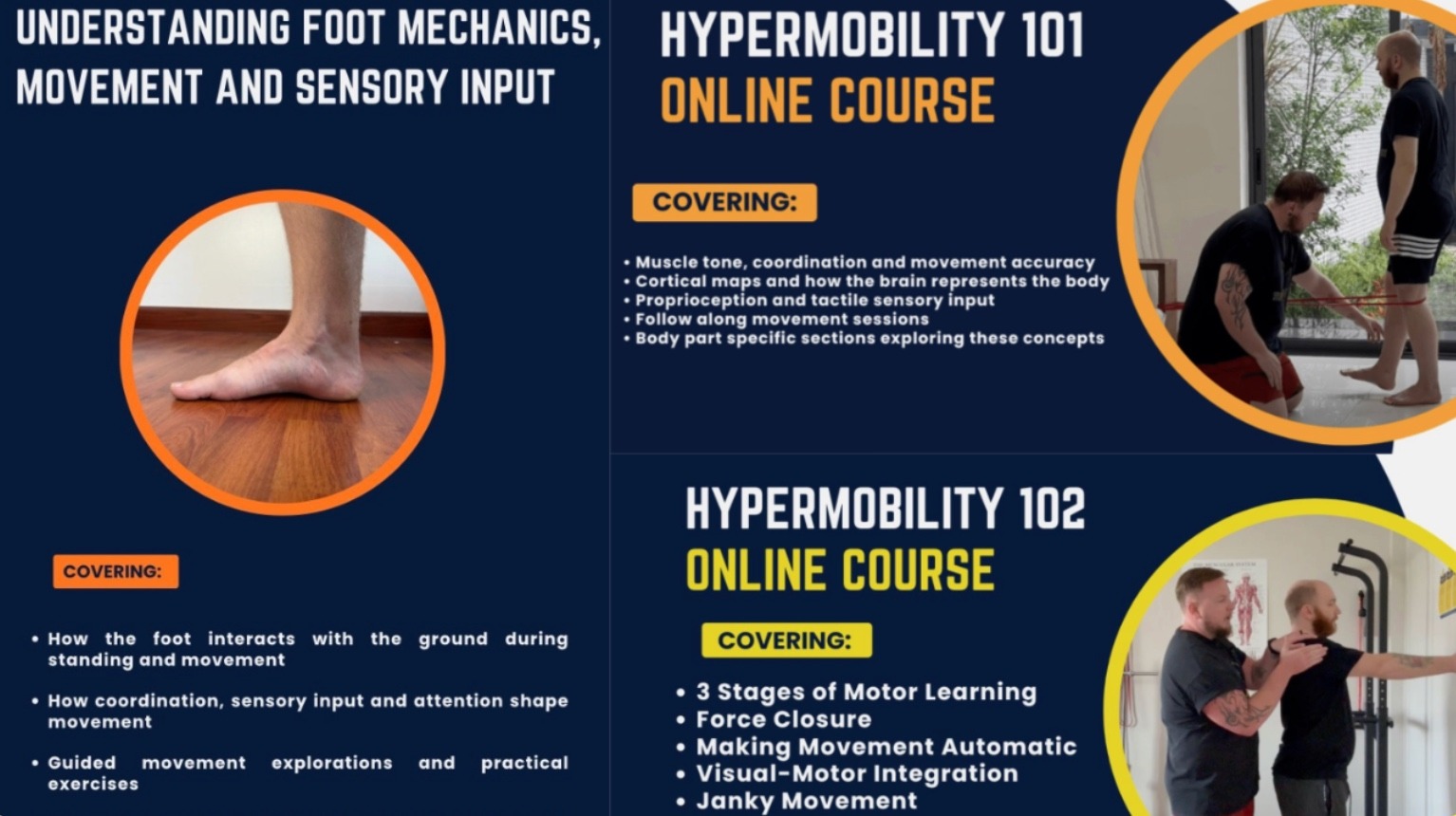
The Hypermobility Fundamentals Bundle
The Hypermobility Fundamentals Bundle is a structured education and movement pathway that starts at the bottom and builds upwards, grounded in motor learning and sensory motor science. Designed for people with hypermobility and persistent pain, it focuses on how strength and stability are organised and learned by the nervous system, beginning with the feet and progressing through sensory input, coordination, and motor learning. The courses are intended to be completed in sequence, with each one establishing the concepts and skills needed for the next.
Once you’ve told a partner, the conversation doesn’t stop there, and how couples keep communicating about chronic pain over time picks up where disclosure leaves off. The grief that can come with a rejection tied to your condition is a real part of this too, and how grief, identity, and intimacy intersect with chronic pain deals with that honestly.