
- Hypermobile hip exercises we use, and why clamshells aren’t one of them - 17 October 2026
- Is Fibromyalgia a Disability in the UK, and Can You Claim PIP? - 14 October 2026
- Fibromyalgia and Central Sensitisation, What Is It in Plain English? - 8 October 2026
The standard medical conversation about pain medication and chronic pain doesn’t tend to include sex. The standard sex education conversation doesn’t tend to include pain medication. Which leaves people living with chronic pain working out, alone and often by trial and error, how to bolt the two together. What gets taken when. What goes on which joint. What gets used after, and what very much shouldn’t get used before. This piece is about that.
If you’ve come over from the main guide, this is the practical pain management piece. We’re going to walk through what comes up across the chronic pain communities as the before-during-after routine, what to keep nearby, the topicals that get used, the medications that come up most, and the post-activity strategies that actually let people sleep that night rather than spending it in flare.
One quick framing note before we get into it. We’ve already covered the underlying pharmacology of pain medication in detail in our pain medication for hypermobility and EDS piece, including the evidence base, the side effects, and what actually works in different conditions. This piece doesn’t repeat that. It takes those medications and looks at how the chronic pain communities use them around intimacy specifically. If you want the mechanism, the doses, the side effects, that’s the post to read first.
The principle: plan it, don’t react to it
The single most consistent thing across the threads, from r/ChronicPain to r/Fibromyalgia to r/ankylosingspondylitis to r/disability, is that pain management around sex works best when it’s planned, not improvised. The instinct is to wait and see how the body responds, and use medication if it gets bad. The community wisdom is the opposite: if you know you want to be intimate, the pain management starts before anything else does.
One r/disability user put the underlying logic well: “Don’t wait until the flare hits. Trying to direct my partner to my medication is always the last thing I wanna do when I’m facing dropping off pleasure mountain into pain”. The point isn’t to medicate prophylactically out of fear. It’s to recognise that the same medications work better taken thirty minutes earlier than they do scrambled for at the wrong moment.
When it comes to the before-during-after structure, that’s the frame this whole piece sits inside. There’s a set of preparations that happen well before, a set of things kept nearby for during, and a routine for after that, when done properly, dramatically reduces the next day’s cost.
Before: the pre-intimacy window
Most oral pain medication needs about thirty minutes to reach useful blood levels. Topical NSAIDs are slower than people assume, with meaningful effect typically building over one to two hours rather than half an hour. The pre-intimacy window across the threads sits roughly at sixty to ninety minutes before, which gives oral medication time to work, topicals time to actually do something, warm heat time to settle the muscles, and the body time to arrive in the moment rather than rushing into it.
What goes into that window, drawn from across the chronic pain communities:
Oral pain medication, on schedule. Whatever you already take, taken with timing in mind. For some people that’s paracetamol or an NSAID, for others it’s prescribed gabapentin or pregabalin, for others it’s their breakthrough pain medication if they have one. One r/ChronicPain user put it simply: “If you know you want to be intimate ahead of time, take pain medication”. This isn’t medical advice on what to take. It’s a recommendation to use your existing medication regimen deliberately rather than reactively. If you don’t have a clear picture of what your medications can and can’t do for breakthrough pain, that’s the conversation to have with your prescriber.
Topical NSAID on the relevant joints. Voltaren (diclofenac) cream and equivalents come up repeatedly, particularly in the AS, hEDS, and fibromyalgia threads. Applied to SI joints, hips, lower back, or wherever the predictable pain point is, ideally sixty to ninety minutes before rather than the thirty minutes people often assume. One r/ankylosingspondylitis user described their routine bluntly: “I slather myself with NSAID cream (voltaren) just beforehand. It makes me feel like an old lady and is not very sexy but wygd”. The aesthetic concerns are real and the trade off is real. For most people the trade-off is worth it.
Cannabis where legal and appropriate. Across the AS, fibromyalgia, MCAS, and ChronicPain threads, THC and CBD come up consistently for both joint mobility and the anxiety component. Topical THC/CBD on hips and spine for stiffness. Inhaled or ingested THC for the combined pain and anxiety relief. The phrasing from one r/ankylosingspondylitis user is unusually direct: medical cannabis helping hips move “like the waves”. Multiple r/Fibromyalgia users describe THC making sex “AMAZING” by reducing pain and anxiety at the same time. The mechanism makes sense. The evidence base around cannabis is still developing, with a 2021 BMJ systematic review and meta analysis finding small to modest improvements in chronic non cancer pain and pain related sleep [1], while a 2026 Lancet Psychiatry review found no good evidence that cannabis effectively treats anxiety as a standalone condition. So the pain side has more evidence than the anxiety side at present, and the community reporting and the trial data point in broadly the same direction for pain without being identical. For UK readers specifically: medical cannabis is legal through private clinics, and the legal landscape is changing. We’ve covered the medication options including cannabis in more detail in the pain medication piece.
Warm heat on the relevant area. Heated blanket over the lower back, warm shower or bath before, warm moist heat towels over the hips. Comes up across every condition. The mechanism is straightforward: warmth increases blood flow, reduces muscle guarding, and starts the body in a different state than the cold, braced state most people with chronic pain default to. One r/rheumatoidarthritis user described a bath beforehand as a non-negotiable, not a luxury.
Partner massage as foreplay. A nice piece of structural framing from r/ChronicPain: massage of the sore spots can function as both pain management and intimacy at the same time. The partner is engaged, the body is being warmed and the muscles are unguarding. It’s not a workaround. It’s part of the encounter.
Ready to work through this with structure and support?
The Hypermobility Live Workshop is four weeks of breaking down the frameworks we use in our studios, with live Q&A so you can ask about your specific situation. Two free courses are included.
For POTS specifically: hydrate and salt-load. Beta blockers on schedule if prescribed. Electrolytes thirty to sixty minutes before. We’ve covered the orthostatic pre-loading routine in detail in the pacing piece, so we won’t repeat it here. Worth flagging that for migraine-prone people, particularly those who experience orgasm headaches, the medication question is best taken to a prescriber: indomethacin is the option most commonly reported in the literature as a pre emptive dose taken before sexual activity, with beta blockers like propranolol used as a daily prophylactic for people whose headaches occur frequently enough to warrant continuous prevention [2].
During: what stays within arm’s reach
The during phase isn’t about taking new medication. It’s about having the things you might need close enough that getting to them doesn’t break the moment. The community consensus on this is unanimous: the things you might need have to be already there.
Diclofenac gel or Voltaren on the bedside. If acute nerve or joint pain hits mid-session, having the topical NSAID already there rather than in the bathroom is the difference between a brief pause and a complete derailment.
Water and electrolytes. Bottle on the bedside table. Sweating significantly during sex without replacing fluid is asking the autonomic system to manage a worsening situation, particularly for POTS and dysautonomia. Even for people without orthostatic issues, dehydration mid-session contributes to post-session headache and crash.
Breakthrough pain medication, if you have it. Whatever you’d take during a flare in everyday life, accessible without leaving the bed.
Lube. Generously. This isn’t pharmacology, but it’s pain management. Many of the chronic pain conditions, particularly those with autoimmune components, MCAS, or hormonal involvement, come with reduced natural lubrication. Friction is a primary driver of pain during sex. Multiple types of lube exist, water-based, silicone, oil-based, and the right one varies by condition (silicone for example doesn’t work with silicone toys, oil based breaks down latex condoms). The point isn’t which one. The point is to have enough of the right one within reach.
Pillows and props. Covered in detail in the positions piece. The pre-positioned wedge, the body pillow, the supports. Already there, not retrieved mid-session.
The thing not to use during: Tiger Balm and other hot capsaicin rubs. This warrants its own warning because it comes up in the threads with such consistent emphasis. One r/disability user, in unusually direct terms, wrote: “What also helps me is Tigerbalm afterwards. NOT BEFORE, DEAR GOD DON’T PUT IT ON BEFORE, YOU DON’T WANT IT ON YOUR SENSITIVE AREAS, TRUST ME”. Capsaicin transfer to genital tissue during sex is, by the threads’ accounts, the kind of mistake you only make once. Same applies to all menthol and capsaicin rubs, including Deep Heat and similar.
After: the post-session routine that prevents next-day collapse
This is the bit that gets most underestimated. The instinct after sex, especially if it’s been pleasurable and you’re tired, is to just collapse and sleep. For someone managing a chronic pain condition, that’s often the worst thing to do. The post-session routine, applied within thirty to sixty minutes of finishing, makes a significant difference to the next day.
What comes up across the threads:
Ice on the relevant area. SI joint, hips, perineum, lower back, wherever was loaded during. The mechanism is reducing inflammatory response in tissue that’s been worked. Ice packs, frozen peas, gel packs, anything cold and conformable. Twenty minutes on, twenty off, repeat.
Muscle rubs and topicals, this time including the hot ones. Tiger Balm, Deep Heat, the capsaicin rubs that were strictly forbidden before now have their place. Applied to the muscles that worked, away from any sensitive areas. Comes up across the chronic pain communities as part of the post-sex care routine.
The Fibromyalgia RICE protocol. One r/Fibromyalgia user named a four-part post-session routine. Rest (warm bath, sauna, hot tub, acupressure mat, or partner massage). Ice (on perineum, lower back, inner thighs as appropriate). Compression (specific vaginal compression devices for those who use them). Elevation (legs raised to help circulation and clear out lactic acid). The framing as a structured protocol is useful, regardless of which elements you actually use.
Warm sitz bath for pelvic pain. A specific one from the r/Fibromyalgia threads: a warm sitz bath, often with epsom salts added, for around twenty minutes after penetrative sex helps with the pelvic floor and inner thigh soreness that often follows. The active ingredient here is the warmth, not the magnesium. Transdermal absorption of magnesium through skin is not well established, so the soak works because heat increases blood flow and reduces pelvic floor muscle guarding. The epsom salts don’t hurt, but they’re not the mechanism.
TENS unit for pelvic floor or other localised pain. Comes up specifically in the fibromyalgia and pelvic pain threads as a useful after-the-fact tool. Electrical stimulation of the affected area helps reduce post-session muscle tension.
Stretching the locked-up areas. Hip flexors particularly. Several threads describe hips that lock up post-activity, and hip flexor stretching providing meaningful relief. The foam roller comes up across multiple threads as a post-session reset tool, sometimes at unromantic hours of the morning.
Sleep position adjustments. If hips have shifted or the SI joint is angry, the standard sleep position may need adjusting. Pillows between knees for side-sleepers, pillow under the knees for back-sleepers, taking the load off whatever was loaded. Not glamorous, but it’s the difference between waking up flared and waking up workable.
The medication question: orgasm itself
One thing that comes up repeatedly across the fibromyalgia threads, and it’s worth addressing honestly: multiple users report that orgasm provides temporary pain relief. The often-quoted figure is that an orgasm provides pain relief comparable to a 10mg dose of morphine. There’s also a smaller note worth flagging for people who get orgasm-triggered headaches: indomethacin is the medication that most consistently shows up as first-line in the clinical literature for primary headache associated with sexual activity, with beta blockers like propranolol used as a secondary option. If sex headaches are a recurring feature, that’s a specific conversation to have with your prescriber.
The honest position on this claim: the morphine equivalence figure is repeated across the internet but doesn’t trace cleanly to a primary research source. There’s no rigorous trial that establishes the dose equivalence, though older laboratory work by Whipple and Komisaruk did document substantial pain threshold elevations during genital self stimulation in women [4]. What does exist is well established physiology: orgasm releases oxytocin and endorphins, both of which have known analgesic effects, and there’s documented reporting of orgasm providing temporary headache and migraine relief in some people. Orgasm also releases prolactin, which is sometimes lumped in with the analgesic story but actually points the other way at the receptor level. Prolactin is increasingly understood as pronociceptive, particularly in female pain models, with a 2025 PNAS study showing that a prolactin targeting antibody could prevent stress induced peripheral nociceptor sensitisation and female specific pain in animal and human tissue models [3]. That receptor level effect is part of why the post orgasm picture isn’t uniformly pain reducing for everyone. What doesn’t exist is a clean number on how much, for how long, or for whom.
So treat it as community-reported phenomenon, not pharmacological prescription. For some people in the threads, orgasm reliably provides thirty to ninety minutes of reduced pain, and they use it deliberately for that. For others, the post-orgasm crash and the energy cost of the sex it took to get there outweighs the relief. Both are valid. The honest version of the advice is: notice what your own body actually does, rather than trusting the meme.
LDN and the slower-burn medications
One that’s worth mentioning because it comes up across MCAS and Long COVID threads in connection with sexual function, even though it’s not an acute pain management tool. Low dose naltrexone (LDN) gets cited as something that, taken over months at a building dose, improves pain thresholds and therefore sexual function over time, with the published trial evidence in fibromyalgia showing consistent if moderate reductions in daily pain alongside improvements in mood and sleep [8].
This isn’t a “take it before sex” medication. It’s a “ask your prescriber whether your overall pain picture might respond to it” medication, and the time horizon for benefit is months, not minutes. We’ve covered LDN in more detail in the pain medication piece. It’s worth being aware of as part of the broader pain management toolkit, especially for fibromyalgia, MCAS, and Long COVID populations where conventional analgesics often fall short.
The thing about medication side effects working both ways
A piece worth sitting with: the same medications that manage chronic pain often interfere with sexual function. SSRIs and SNRIs reduce libido and delay orgasm in a significant proportion of people who take them, with the Cochrane review on managing antidepressant induced sexual dysfunction documenting prevalence estimates that vary widely by drug and outcome measure [5]. Long term opioids suppress hormonal axes and reduce desire and function, an effect now recognised as opioid induced androgen deficiency with reviews documenting hypogonadism in a substantial proportion of long term opioid users [6]. Gabapentin and pregabalin are less commonly flagged in everyday conversation than the SSRIs, but the literature is clear that they’re associated with reduced libido, erectile dysfunction, and anorgasmia in a meaningful minority of people taking them, not a rare edge case [7].
We’ve covered this in detail in the grief, identity, and intimacy piece, including the specific numbers and the medications that have lower sexual side effect profiles. The reason to flag it here is that the pain management routine isn’t separate from the sexual function conversation. The same prescriptions are doing both things. When it comes to balancing pain relief against sexual function, the conversation with your prescriber needs to include both, not just the pain side.
That doesn’t mean stopping medication that’s working. It means having an informed conversation about alternatives where they exist, and timing where it matters.
The honest framing
The pain management routine around intimacy works best when it’s treated as part of the encounter, not as something separate or shameful. The wedge pillows and the ice packs and the topical NSAIDs and the lube are tools that make intimacy possible. They’re not evidence that you’re doing it wrong. The people in the threads who have the most workable intimate lives are the ones who built routines, kept the kit nearby, planned the timing, and treated the after-care as seriously as the during.
If you’ve not had this conversation with your prescriber before, the place to start is naming what you’re already doing, what works, and what doesn’t, and asking what other options exist. The pain medication for hypermobility and EDS piece covers the evidence base in detail and is worth reading as preparation for that conversation.
And if the underlying pain levels are the binding constraint on intimacy, the work to bring them down sustainably is part of what we do at The Fibro Guy. Not by adding more medication, but by building the kind of body capacity that means the existing pain management does less work and the intimacy itself becomes more workable. That’s not a substitute for the pre/during/after routine. It’s the longer-term work that, over time, means the routine has less to compensate for.
References
- Wang, L., Hong, P.J., May, C., Rehman, Y., Oparin, Y., Hong, C.J., Hong, B.Y., AminiLari, M., Gallo, L., Kaushal, A., Craigie, S., Couban, R.J., Kum, E., Shanthanna, H., Price, I., Upadhye, S., Ware, M.A., Campbell, F., Buchbinder, R., Agoritsas, T. and Busse, J.W. (2021) ‘Medical cannabis or cannabinoids for chronic non-cancer and cancer related pain: a systematic review and meta-analysis of randomised clinical trials’, BMJ, 374, n1034. doi: 10.1136/bmj.n1034
- Utku, U., Var, A., Goknar, N. and Akbas, A. (2013) ‘Primary headache associated with sexual activity: case report’, Medical Principles and Practice, 22(5), pp. 507-510. doi: 10.1159/000350415
- Stratton, H.J., Patil, M.J., Park, K.A., Lo, T.K., Hu, H., Mecca, C.M., Wang, T., Han, M., Reuteler, J., Salas, N.S., Allen, H.N., Slivicki, R.A., Cusanno, A., Strobel, H.M., Joshi, M.M., Holdridge, S.V., Wang, K., Pan, B., Largent-Milnes, T.M., Patwardhan, A., Yan, J., Khanna, R., Gereau, R.W. IV, Watkins, L.R. and Price, T.J. (2025) ‘A prolactin-targeting antibody to prevent stress-induced peripheral nociceptor sensitization and female-specific pain’, Proceedings of the National Academy of Sciences, 122(23), e2501229122. doi: 10.1073/pnas.2501229122
- Whipple, B. and Komisaruk, B.R. (1988) ‘Analgesia produced in women by genital self-stimulation’, Journal of Sex Research, 24(1), pp. 130-140. doi: 10.1080/00224498809551403
- Taylor, M.J., Rudkin, L., Bullemor-Day, P., Lubin, J., Chukwujekwu, C. and Hawton, K. (2013) ‘Strategies for managing sexual dysfunction induced by antidepressant medication’, Cochrane Database of Systematic Reviews, (5), CD003382. doi: 10.1002/14651858.CD003382.pub3
- O’Rourke, T.K. and Wosnitzer, M.S. (2016) ‘Opioid-induced androgen deficiency (OPIAD): diagnosis, management, and literature review’, Current Urology Reports, 17(10), 76. doi: 10.1007/s11934-016-0634-y
- Calabro, R.S., De Luca, R., Pollicino, P., Bramanti, P. and Silvestri, R. (2013) ‘Anorgasmia during pregabalin add-on therapy for partial seizures’, Epileptic Disorders, 15(3), pp. 358-361. (See also pregabalin product information for documented prevalence of impotence in clinical trials.)
- Younger, J., Noor, N., McCue, R. and Mackey, S. (2013) ‘Low-dose naltrexone for the treatment of fibromyalgia: findings of a small, randomized, double-blind, placebo-controlled, counterbalanced, crossover trial assessing daily pain levels’, Arthritis & Rheumatism, 65(2), pp. 529-538. doi: 10.1002/art.37734
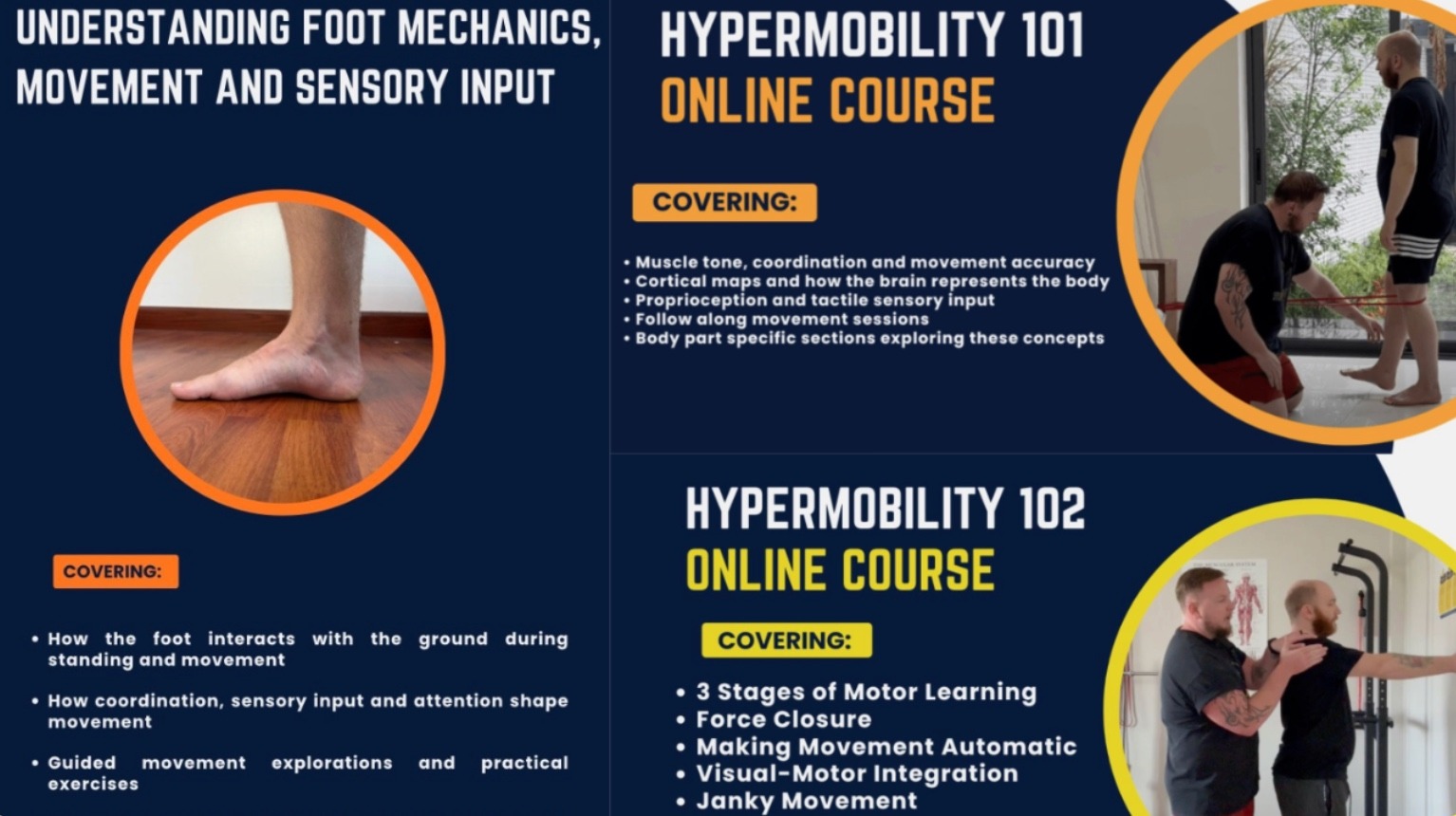
The Hypermobility Fundamentals Bundle
The Hypermobility Fundamentals Bundle is a structured education and movement pathway that starts at the bottom and builds upwards, grounded in motor learning and sensory motor science. Designed for people with hypermobility and persistent pain, it focuses on how strength and stability are organised and learned by the nervous system, beginning with the feet and progressing through sensory input, coordination, and motor learning. The courses are intended to be completed in sequence, with each one establishing the concepts and skills needed for the next.
— The Fibro Guy Team —