
- Hypermobile hip exercises we use, and why clamshells aren’t one of them - 17 October 2026
- Is Fibromyalgia a Disability in the UK, and Can You Claim PIP? - 14 October 2026
- Fibromyalgia and Central Sensitisation, What Is It in Plain English? - 8 October 2026
You didn’t sign up to be a carer. Neither did they. That wasn’t the deal when the relationship started. And yet here you are, a few years in, and the dynamic has quietly shifted into something neither of you fully named out loud. One of you is in pain a lot of the time. The other one is picking up the slack. Both of you are tired in ways that are hard to explain to people who haven’t lived it.
This post is for couples in that exact situation. Not the early, raw stage where everything is still new and frightening, that’s covered elsewhere in this series. This is the longer stretch. The years in. Where the patterns have had time to set, where the resentment and the guilt have had time to quietly accumulate, where sex has either adapted or quietly stopped being discussed, and where both of you are probably managing more than you’re letting on.
We’re going to look at what the research actually shows about long term relationships and chronic illness, which is a mix of reassuring and uncomfortable. The Glantz data on partner departure rates is in here. So is the evidence on caregiver depression. So is a straightforward look at polyamory as a structural choice some couples make when caregiving load becomes unsustainable. And so is the practical question of what happens when both of you are unwell.
One thing this post doesn’t do: tell you how to fix it in five steps. Relationships are complicated enough without chronic illness. With it, the complexity goes up significantly. What we can do is give you a clearer picture of what’s happening and why, because naming the thing is usually the first useful step.
The shift that happens, and why nobody warns you
Chronic illness doesn’t arrive all at once in most long term relationships. It tends to creep. There’s a period of confusion and diagnosis, then a period of adjustment, and then, before either partner quite notices, there’s a new normal that nobody explicitly agreed to. The well partner has taken on more of the household tasks. The unwell partner has had to pull back from things they used to do. The roles have shifted.
This role shift is one of the most consistently documented stressors in the chronic illness couple literature. What makes it particularly difficult is that it often happens without being named. Both partners adapt, both make concessions, neither has a direct conversation about the fact that the relationship they’re now in looks substantially different from the one they started. That conversation gets delayed, and delayed, and then it starts to feel too large and too awkward to have at all.
The longitudinal data on this is pretty clear. Couples managing chronic illness show measurable declines in shared illness appraisal, in illness related communication, in dyadic coping, and in relationship satisfaction over a twelve month period [1]. That’s a volunteer sample of people who agreed to be studied, which means the actual picture in the broader population is probably steeper. The one thing that didn’t decline significantly was sexual satisfaction, which is an interesting finding we’ll come back to. But everything else that makes a long term partnership function as a shared project tends to erode unless both partners actively work to maintain it.
The other thing worth naming at the outset: this erosion isn’t anyone’s fault. It isn’t a sign that the relationship is failing or that the partners are doing something wrong. It’s what happens when a substantial stressor is placed on a system that wasn’t designed to handle it, without any support, without anyone telling you what to expect, without a framework for thinking about what’s changed and why. Pain severity itself directly predicts lower relationship satisfaction and lower sexual satisfaction, independent of how well the couple communicates [1]. The illness is doing some of this. That matters to say out loud, because both partners tend to absorb it as personal failure.
From one person’s illness to a shared situation: the we-disease framing
When it comes to how couples manage chronic illness together, one of the more useful frameworks in the research is what some researchers call the “we-disease” concept. The idea is straightforward: rather than the illness being one person’s problem that the other person accommodates, it becomes something the couple owns jointly. Not in a co dependent, enmeshed way. More in the sense that the appraisal shifts from “I have this condition” to “we manage this condition together.”
This matters because shared appraisal is associated with meaningfully better outcomes for both partners. Couples induced to adopt a joint framing in research settings tend to show better psychological outcomes and illness management than couples who maintain the individual model [2]. Daily diary data finds that communal coping on any given day predicts improved mood and better self management behaviour. In a now classic study of heart failure couples by Rohrbaugh and colleagues, when the well partner used first person plural language (“we,” “our”) when talking about the illness, their partner’s physical symptoms and general health improved over the following six months, and the synthesis literature has built on this since [2]. Patient “we-talk” doesn’t show the same effect. It’s the partner taking on the shared framing that moves the needle, which is a bit counterintuitive but consistent with what we see in the studios.
The practical distinction here is between adaptive shared ownership and what psychologists call unmitigated communion: the over involvement where the well partner’s entire identity becomes the carer, their own needs disappear, and they can’t function separately from the caregiving role. That’s associated with worse outcomes for both people [2]. The we-disease framing isn’t “I have made your illness my whole life.” It’s “this is a thing we handle together, and we’re both still separate people with separate needs while we do it.”
Qualitative research with couples managing complex multi condition illness found this framing emerging spontaneously. Couples used “we” language and described their coping as inherently joint. Horn and colleagues captured this directly in the title of their study: “the worse we feel, the more intensively we need to stick together” [3]. The couples in that work were spontaneously co-constructing shared appraisals and coping strategies. That’s not pathological. That’s a resource.
The appraisal mismatch in the other direction is worth noting though. In diabetes couple research summarised in the Helgeson et al. review, a sizeable minority of people with the condition described their illness as fully shared with their partner, while a much larger share of partners saw it that way [2]. The exact percentages vary across the underlying primary studies, but the direction of the gap is consistent. The key variable is whether the couple frames things as “our problem” versus “your problem” [13]. The person with the illness is often managing it more privately than the partner realises. That gap is worth bridging, not by performing more openness, but by both people talking about what shared management actually looks like day to day.
Caregiver burden and what the research actually shows
When it comes to what happens to the well partner over time, the research is unambiguous. Caregiver burden is real, it’s measurable, and it produces depression.
Long married couples where one partner has become care dependent show four consistent patterns: struggling with changing tasks and roles; losing the normality and spontaneity that characterised the relationship before illness; the caring partner grieving the loss of intimacy; and both partners working to rebalance a partnership that has fundamentally changed [4]. That grief piece is important. The well partner is often mourning something they haven’t named as a loss, because naming it feels disloyal, or because they don’t want to make the unwell partner feel worse. So it goes unspoken, and builds.
In multiple sclerosis caregiving specifically, spousal depression, social isolation, fatigue, and loss of employment opportunity are consistently documented [5]. Higher caregiving burden directly predicts lower relationship satisfaction [6], though commitment to the relationship buffers some of that effect. The caregiver’s own health also matters: the caregiver’s wellbeing and the care recipient’s wellbeing independently predict how satisfied the caregiver is with the relationship [7]. They’re not separable. You can’t have one person in the couple thriving while the other is suffering, and expect the relationship to hold up without work.
None of this is a moral critique of well partners who are struggling. It’s just a description of what prolonged caregiving does to people. The research isn’t a character judgement, it’s a structural reality. Caregiving is demanding. It changes people’s lives, their social networks, their sense of identity, and their relationship with the person they’re caring for. That’s worth knowing, not so the well partner can feel guilty about struggling, but so that both partners can take it seriously as something that needs active attention rather than something to push through until it improves on its own.
What the well partner needs, and what often doesn’t exist in any form, is their own support. Not just in the sense of practical help, but someone to talk to who isn’t the person they’re caring for. The isolation of chronic illness caregiving is a consistent finding, and the reason it matters for the relationship is that the well partner who has no other outlet often ends up either suppressing everything or, eventually, exploding. Neither of those is useful for the couple.
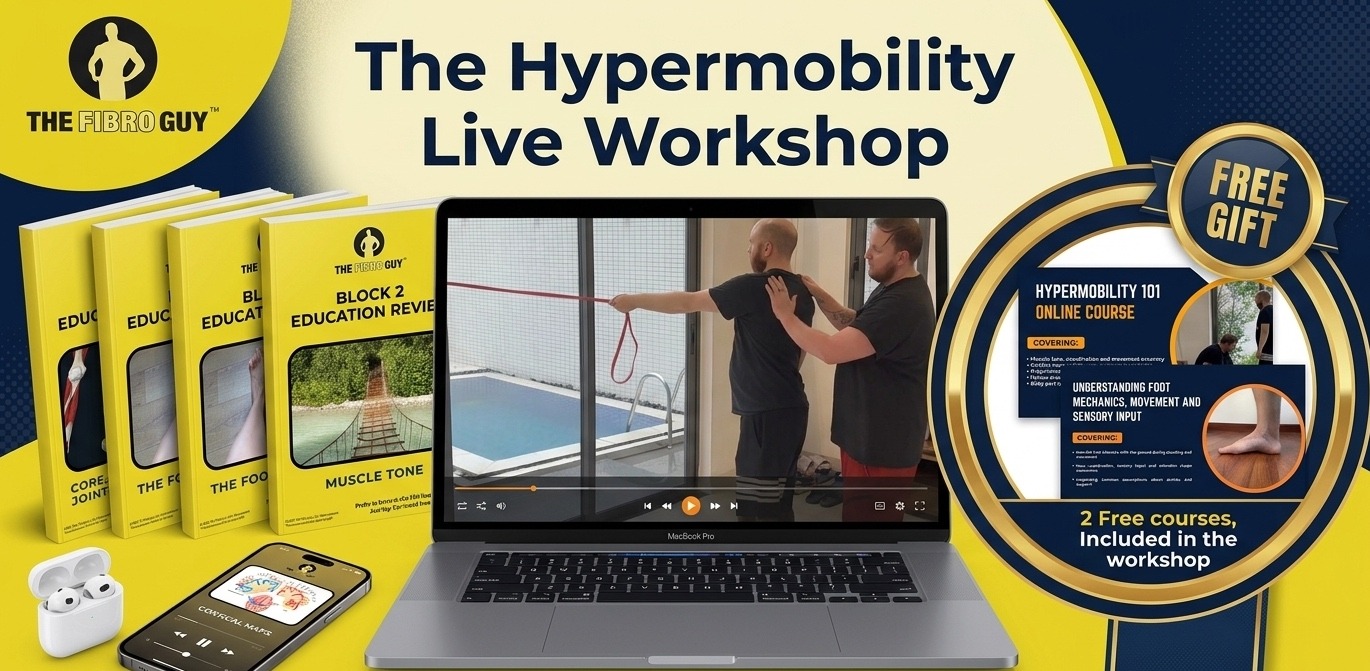
Ready to work through this with structure and support?
The Hypermobility Live Workshop is four weeks of breaking down the frameworks we use in our studios, with live Q&A so you can ask about your specific situation. Two free courses are included.
The thing nobody talks about: partner departure rates
This section is uncomfortable, and it’s going to be told straight, because softening it would be doing a disservice to anyone who’s already wondering about it.
The Glantz et al. study, published in 2009 and examining couples across three cohorts (brain tumours, general oncology, and multiple sclerosis), found a separation or divorce rate of 11.6% in the combined cohort, rising to around one in five (20.8%) when the ill partner was a woman [8]. That’s already a significant figure. But the finding that made this research widely cited is the gender disparity itself.
Women with the illness were significantly more likely to be abandoned by their male partners than men with the illness were by their female partners. Across the whole cohort, women made up 88% of all the abandoned partners, while men made up 12%. The framing “abandoned” is the authors’ own, and it’s appropriate. These were people leaving sick partners, not couples separating because the relationship had run its course in some mutual way.
This is not a gentle finding. It fits a pattern that’s documented in other ways too: women in caregiving roles for ill partners generally stay at higher rates than men in the same position. Whether that reflects socialisation, gender roles around caregiving, financial dynamics, or something else is a question the research hasn’t fully settled. What’s clear is that the disparity exists and is substantial.
It is worth flagging though that a 2015 follow-up paper that initially reported similar gender-based abandonment patterns was retracted after a data coding error came to light. The corrected re-analysis found a much smaller effect, statistically reliable in only one illness subtype rather than across the board. The Glantz cohort itself remains the cited figure, but the broader claim that women are systematically abandoned more often than men across all chronic illnesses sits on thinner ground than the 2009 numbers alone suggest.
For population level data specific to fibromyalgia or hypermobility spectrum disorder (HSD) or hEDS, that level of detailed breakdown doesn’t yet exist in the academic literature. The Glantz data comes from a cancer, brain tumour, and multiple sclerosis population. The dynamics in chronic pain conditions that don’t carry the same acute illness framing may differ. What we can say with confidence is that serious illness stresses long term relationships to breaking point in a meaningful proportion of cases, and that this risk isn’t equally distributed between genders.
If you’re a woman with chronic pain reading this and wondering whether the statistic applies to you: it’s a real finding, not a scary story. It’s also not inevitable. Relationships with active communication, shared illness appraisal, and genuine mutual support show better outcomes. But knowing the data exists is better than not knowing it.
If you’re a well male partner reading this and feeling defensive: fair enough. Most men who stay through serious illness aren’t the ones Glantz was documenting. The point of including this data isn’t to indict anyone. It’s to be honest about what the literature shows.
Sexual mismatch in a long term partnership
When it comes to sexual satisfaction in chronic illness couples, the picture is more complicated than either “it’s fine” or “everything stops.” The longitudinal research found that sexual satisfaction remained relatively stable over twelve months even as relationship closeness and satisfaction declined [1]. That’s worth sitting with for a moment, because it’s counterintuitive. Couples can maintain a degree of sexual connection even when the broader relationship is under strain, possibly because sex is the last thing either partner is willing to let go of, or because they’ve adapted to changed circumstances more successfully in that domain than in others.
But the mismatch problem is real and specific. When one partner’s desire has dropped, through pain, through medication effects (antidepressants, opioids, and gabapentin all have documented sexual side effects that are rarely foregrounded in prescribing conversations), through changed body image, or through the sheer effort of managing a chronic condition, the couple faces a structural incompatibility that doesn’t resolve itself through goodwill alone.
What the qualitative research on fibromyalgia couples shows is two broad responses to this mismatch [9]. One group actively rebuilds: they find new ways to be sexual together, renegotiate what sex means, work with what they have. The other group mourns the sexual relationship they used to have without rebuilding anything in its place. The difference isn’t about how much they love each other. It’s about whether they can talk directly about changed needs and desires without one or both partners retreating.
The avoidance spiral is what tends to happen when that conversation doesn’t happen. The person with chronic pain assumes their partner would rather have less contact than a modified version of the old sex life. The partner assumes their desire is unwelcome and stops initiating. Both withdraw. Both interpret the withdrawal as confirmation of their worst fear. Nothing gets said. Months pass.
Affectionate behaviour from the person with fibromyalgia, even non sexual touch, predicts better mental quality of life for themselves in the couple [14]. The effect is actor specific in that study rather than a shared bidirectional one, but the broader point still lands: affection matters, and the person living with the condition expressing it has measurable benefits for their own wellbeing. Perceived partner support is itself a protective factor for sexual satisfaction in chronic pain [10]. That’s not a platitude. It’s a finding that having a committed partner who is perceived as supportive independently predicts better sexual satisfaction. The relational context matters. Which means that the avoidance spiral, as understandable as it is, is actively working against something that could be better.
Community voices from chronic illness forums are consistent on this. The framing that lands most for people is separating desire from initiation: “I’m willing to try” as an opening bid, rather than needing to feel spontaneous arousal before anything starts. Responsive desire, where interest arrives after engagement begins rather than before, is a well documented and completely valid pattern. It’s not dysfunction. It’s what many people with chronic illness experience, and it’s manageable once it’s been named.
Solo time, redefined intimacy, and what the community has worked out
The practical side of this tends not to appear in medical consultations. Doctors don’t usually ask couples how they’re managing intimacy. So most of what people actually know has been worked out between themselves, or shared in online communities with other people in the same situation.
A few things come up consistently across chronic illness communities when it comes to long term couples working through this.
The first is redefining what counts. Not in a compensatory “settle for less” way, but in a genuinely broader sense: intimacy doesn’t require penetrative sex, doesn’t require both partners to be equally active, doesn’t require the interaction to look like what it looked like before illness. “Parallel play” is a term people actually use: masturbating separately in the same space, talking about it, being present with each other without one person having to perform. That’s intimacy. It requires less energy. It removes the performance pressure from the person in pain and the “am I enough?” pressure from the well partner.
The second is managing the post activity cost. In long term relationships this is already known territory, but it’s worth naming explicitly: building in rest time after intimacy is not a sign that something is wrong, it’s a practical accommodation. Some people in the community schedule intimacy around the day of the week where they can afford the day after. That’s not unromantic, it’s sensible, and it means sex actually happens rather than being perpetually deferred because it always costs too much.
The third, and the one that tends to go unspoken in long term relationships more than new ones: keeping the direct communication lines functional over time. Monthly check-ins on what’s working and what isn’t. Written communication when face to face gets too loaded. Both of these are strategies that chronic illness community members cite repeatedly, and both require the kind of deliberate maintenance that long term couples sometimes assume they don’t need because they know each other well enough. Knowing someone well doesn’t automatically mean you know what they need right now, this week, in the current phase of the illness.
When it comes to what medications are doing to libido and sexual function: antidepressants, opioids, gabapentin, and beta blockers all have documented effects on desire and orgasmic function that are rarely discussed at prescription. This isn’t something to manage in silence. It’s worth having a direct conversation with whoever prescribes the medications about what the side effect profile includes and whether there are alternatives. If the GP or specialist isn’t raising it, raise it yourself.
Polyamory as a structural solution to caregiving load
This section is written with the assumption that consensual non monogamy is a legitimate relationship structure and that people reading it are capable of evaluating whether it applies to their situation without being told how to feel about it. We’re not going to frame this as exotic or as a last resort. For some couples with chronic illness, it’s a considered structural choice that addresses a specific problem.
The problem it addresses is this: one partner has chronic illness and limited energy. A monogamous relationship requires that one partner to meet all the emotional, practical, and sexual needs of the other, and the other to meet all of theirs, including the sexual needs the person with chronic illness can no longer reliably meet. That’s a lot to ask of any partnership. When energy is genuinely limited and caregiving demands are high, the pressure on the well partner to have all their needs met within the relationship, and on the unwell partner not to feel guilty about being unable to meet them, can become corrosive.
People in chronic illness communities who have arrived at non monogamy tend to describe it in practical terms. The framing that appears repeatedly is: “I cannot handle a traditional monogamous relationship because I don’t have enough time and energy to keep my partner happy and myself healthy. I prioritise my health.” That’s from someone with chronic illness talking about why non monogamy works for them structurally, not ideologically.
There’s no peer reviewed literature specifically examining polyamory as a caregiving solution in chronic illness populations, which is an honest gap to acknowledge. What does exist is evidence that people in consensually non monogamous relationships emphasise the ethics, consent, and relational quality of these arrangements rather than the sexual novelty [11]. The POLYBABES study documented polyamorous families’ healthcare-seeking behaviour and found that these family structures are practically present in healthcare settings even though they’re rarely accounted for [12]. The academic literature is behind the community reality on this.
The community level knowledge is more developed than the research. What chronic illness people in CNM relationships describe includes: the ability to have needs met outside the primary relationship without guilt or pressure; the reduction of caregiving burden when a partner has other emotional connections; the freedom for the unwell partner to be unavailable without it threatening the entire relational structure. For some configurations, particularly where the well partner has other connections, it also means the person with chronic illness doesn’t feel like a burden in quite the same way, because the well partner’s social and emotional life isn’t entirely dependent on them being functional.
A consistent warning from chronic illness communities: don’t open a relationship under duress. Emotional stress reliably triggers physical flares for many conditions. If the motivation is panic or desperation rather than genuine considered choice, the stress cost is likely to outweigh the structural benefit. This is a decision that works when both partners are genuinely on board. When it’s done as a concession or under pressure, it tends to cause harm.
When the well partner is also unwell: two disabled partners
The framing “well partner” assumes a clean binary that doesn’t always exist. In hypermobility, EDS, fibromyalgia, and co occurring conditions like POTS, it’s common for both members of a couple to be managing something. Hypermobility in particular has genetic components, and it’s not unusual for it to be present in more than one person in a family. Couples where both partners have significant health conditions face a specific version of this that requires a different set of tools.
The two disabled partner dynamic that comes up most vividly in chronic illness communities involves lesbian couples, particularly where both partners have hEDS or fibromyalgia. The language that appears in these threads is energy budgeting. Both partners have a finite amount of capacity. Caregiving, intimacy, and household management all draw from the same pool. The question isn’t “who takes care of whom” but “how do we allocate what we’ve both got.”
What works in these configurations, according to people living them, is verbal direction from whoever has more capacity that day. One person might be able to do very little physically but can direct a session, make decisions, hold the relational weight of what’s happening. The other person takes the active role that day. They swap when it reverses. “Constant communication” and “a sense of humour” are cited as the two most important tools [r/disability, intimacy research]. Neither of those is a small thing. The communication piece is obvious. The humour piece is about not treating every adaptation, every modified position, every “hold on, my hip” moment as a tragedy. It’s allowed to be a bit ridiculous. Relationships are ridiculous. Bodies are ridiculous, especially hypermobile ones.
Morning timing comes up in this context specifically because energy levels for people with fatigue based conditions are often least depleted before the cumulative demands of the day set in. That’s practical information, not a limitation. It’s just working with biology rather than against it.
The harder question in two disabled partner dynamics is who carries the emotional labour of managing the relationship’s health. In able bodied couples, one person often takes more of that on. When both partners have variable energy and cognitive capacity, the assumption that one of them will be reliably available for that role stops holding. This is worth naming explicitly between partners rather than hoping it’ll sort itself out.
Resentment, guilt, and the conversations that get postponed
Neither resentment nor guilt is a sign that something has gone morally wrong. They’re both predictable emotional products of a situation that is genuinely hard.
The well partner accumulates resentment not because they don’t love the person they’re with but because they’ve taken on a lot and haven’t talked about it. The resentment isn’t about the person, it’s about the situation. But it tends to attach itself to the person because that’s what’s in front of them. That’s a normal progression and a destructive one if it stays unnamed.
The person with chronic illness accumulates guilt. Guilt about what they can’t contribute. Guilt about having bad days, and sometimes about having good ones, because a good day feels like evidence they’ve been overdramatic on the bad ones. The guilt tends to produce its own form of withdrawal: staying quiet about needs in order not to ask for more.
These two dynamics reinforce each other. The well partner is resentful but not saying so. The unwell partner is guilty and pulling back. Both interpret the other’s behaviour as confirmation of what they’re worried about. Nobody has the direct conversation that would disrupt the cycle.
The research on couples who manage this well doesn’t identify a magic intervention. What it identifies is that the couples who do better are the ones who find ways to stay in direct communication rather than managing everything internally [1]. That sounds obvious. It’s surprisingly hard to do when the topic feels too loaded and both people are already exhausted.
One practical thing that chronic illness communities return to repeatedly: stop saving the conversation for when you’re both calm and well rested and it’s a good moment. That moment is rare. Have it on an ordinary day, a bit imperfectly. The imperfect conversation is better than the perfect one that never happens.
Holding the relationship together over the long haul
There’s no point pretending that chronic illness doesn’t make long term relationships harder. The longitudinal data shows erosion of shared coping and closeness over time. The caregiver data shows real and measurable burden. The Glantz data shows that departure happens. Being realistic about all of that is more useful than optimism that pretends otherwise.
What the research also shows is that shared illness appraisal, the we-disease framing, direct communication, and active relational maintenance are associated with better outcomes for both partners, not just one of them [1, 2, 3]. That’s also real data. The erosion isn’t inevitable if it’s being actively worked against.
When it comes to what “actively worked against” looks like in practice, the couples who manage this over years tend to do a few things. They name what’s changed rather than performing continuity with a relationship structure that no longer exists. They have specific conversations about caregiving load rather than leaving it as an unspoken arrangement. They treat sexual adaptation as an ongoing project rather than something that resolved itself once. They find ways for both people to have needs met, whether that’s within the relationship or through other structures. And they get help. Couples therapy with a therapist who understands chronic illness is genuinely useful. Sex therapy, if intimacy has stopped. A support group for the well partner, if the isolation of caregiving has become significant.
None of that is small or easy. It also isn’t extraordinary. It’s the same kind of ongoing maintenance work that any long relationship needs, just with a higher baseline difficulty because of the illness.
The community voices from people who’ve been doing this for years tend to land somewhere between realistic and genuinely warm. One person who’d been managing ME/CFS in a long term partnership wrote: “All of these experiences are really shaping us into exceptional partners who truly understand what matters.” That’s not denial. That’s someone who’s been through something difficult and found that it changed what they value and how they connect. That’s available.
It’s not available to everyone in every relationship. Some long term relationships don’t survive chronic illness, and that’s a reality the Glantz data reflects. But the ones that do tend to look different from how they started, not diminished, just different. The terms have been renegotiated. The definition of intimacy has been broadened. The roles have been talked about explicitly rather than assumed. That isn’t a lesser relationship. It’s a more honest one.
References
- Shrout, M.R., Weigel, D.J. and Laurenceau, J.-P. (2024) ‘Couples and concealable chronic illness: investigating couples’ communication, coping, and relational well-being over time’, Journal of Family Psychology, 38(1), pp. 136-148. doi: 10.1037/fam0001136
- Helgeson, V.S., Jakubiak, B., Van Vleet, M. and Zajdel, M. (2018) ‘Communal coping and adjustment to chronic illness: theory update and evidence’, Personality and Social Psychology Review, 22(2), pp. 170-195. doi: 10.1177/1088868317735767
- Horn, A.B., Zimmerli, L., Maercker, A. and Holzer, B.M. (2023) ‘The worse we feel, the more intensively we need to stick together: a qualitative study of couples’ emotional co-regulation of the challenge of multimorbidity’, Frontiers in Psychology, 14, 1213927. doi: 10.3389/fpsyg.2023.1213927
- Niedling, K. and Hämel, K. (2023) ‘Longing for normalcy in couple relationships: how chronic illness and care dependency change the relationship of long-married couples’, Frontiers in Public Health, 11, 1117786. doi: 10.3389/fpubh.2023.1117786
- Benini, S., Pellegrini, E., Descovich, C. and Lugaresi, A. (2023) ‘Burden and resources in caregivers of people with multiple sclerosis: a qualitative study’, PLoS ONE, 18(4), e0265297. doi: 10.1371/journal.pone.0265297
- Tzitzika, M., Lampridis, E. and Kalamaras, D. (2020) ‘Relational satisfaction of spousal/partner informal caregivers of people with multiple sclerosis: relational commitment, caregiving burden, and prorelational behavioral tendencies’, International Journal of MS Care, 22(2), pp. 60-66. doi: 10.7224/1537-2073.2019-003
- Monin, J.K., Levy, B., Doyle, M., Schulz, R. and Kershaw, T. (2019) ‘The impact of both spousal caregivers’ and care recipients’ health on relationship satisfaction in the Caregiver Health Effects Study’, Journal of Health Psychology, 24(12), pp. 1744-1755. doi: 10.1177/1359105317699682
- Glantz, M.J., Chamberlain, M.C., Liu, Q., Hsieh, C.-C., Edwards, K.R., Van Horn, A. and Recht, L. (2009) ‘Gender disparity in the rate of partner abandonment in patients with serious medical illness’, Cancer, 115(22), pp. 5237-5242. doi: 10.1002/cncr.24577
- Granero-Molina, J., Jiménez-Lasserrotte, M. del M., Dobarrio-Sanz, I., Correa-Casado, M., Ramos-Rodríguez, C. and Romero-Alcalá, P. (2023) ‘Sexuality in women with fibromyalgia syndrome: a metasynthesis of qualitative studies’, Healthcare, 11(20), 2762. doi: 10.3390/healthcare11202762
- Barr, A., Moore, K., Flegge, L.G., Atsaphanthong, E., Kirby, K.E. and Craner, J.R. (2024) ‘Predictors of sexual satisfaction among patients with chronic pain’, Frontiers in Pain Research, 5, 1375546. doi: 10.3389/fpain.2024.1375546
- Cardoso, D., Pascoal, P.M. and Maiochi, F.H. (2021) ‘Defining polyamory: a thematic analysis of lay people’s definitions’, Archives of Sexual Behavior, 50(4), pp. 1239-1252. doi: 10.1007/s10508-021-02002-y
- Arseneau, E., Landry, S. and Darling, E.K. (2019) ‘The Polyamorous Childbearing and Birth Experiences Study (POLYBABES): a qualitative study of the health care experiences of polyamorous families during pregnancy and birth’, CMAJ, 191(41), pp. E1120-E1127. doi: 10.1503/cmaj.190224
- Rentscher, K.E. (2019) ‘Communal coping in couples with health problems’, Frontiers in Psychology, 10, 398. doi: 10.3389/fpsyg.2019.00398
- Dewan, M.F., Jones, K.D. and Lyons, K.S. (2024) ‘The protective roles of affectionate behaviors and communication on mental quality of life of couples living with fibromyalgia: movement toward a dyadic perspective’, Psychology, Health & Medicine, 29(2), pp. 375-384. doi: 10.1080/13548506.2023.2282957
For more in this series:
- Pelvic floor and pain during sex (Post 20567)
- Disclosure and dating with chronic pain (Post 20568)
- Couples communication and chronic pain (Post 20569)
- Grief, identity, and intimacy (Post 20571)
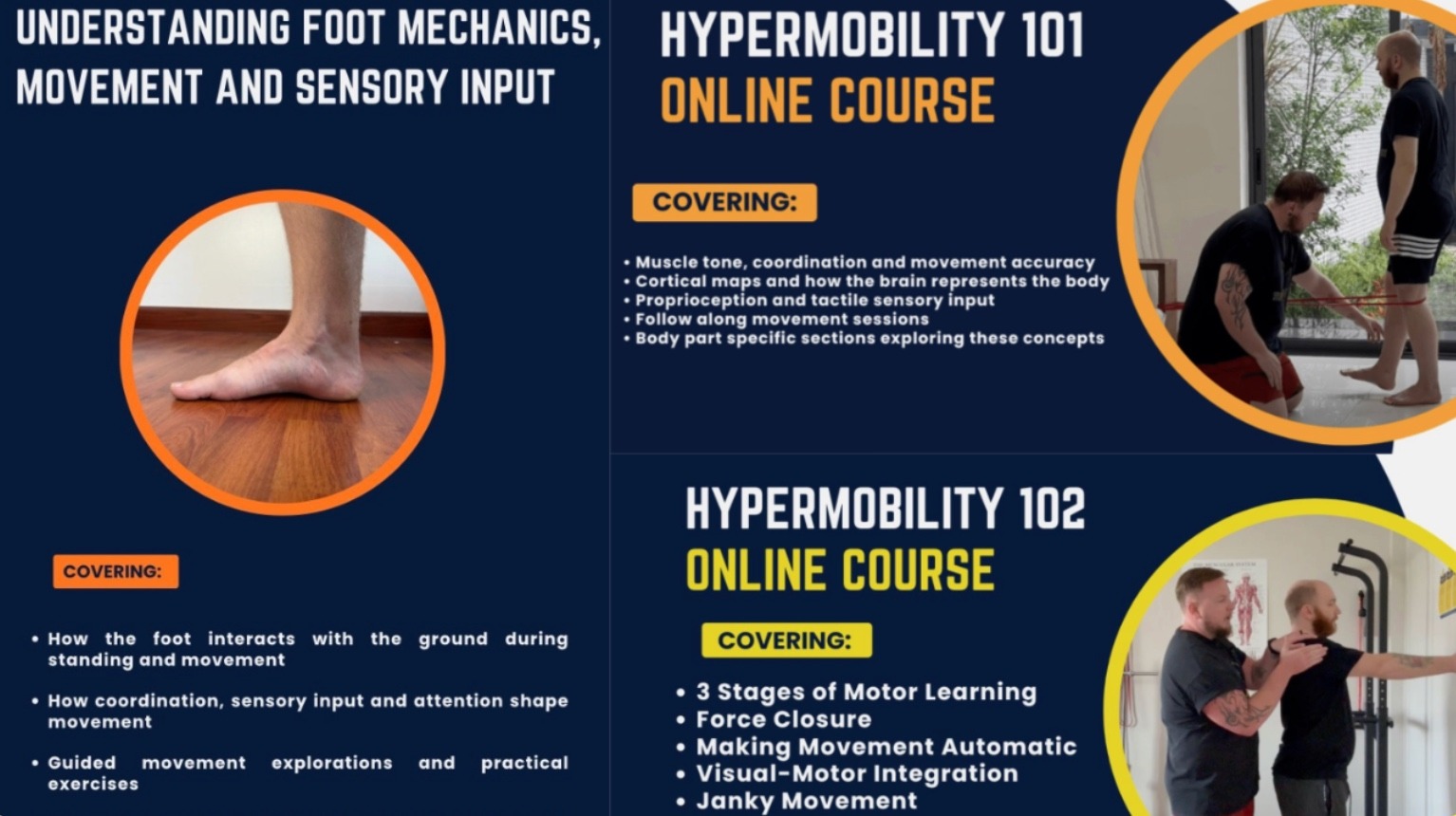
The Hypermobility Fundamentals Bundle
The Hypermobility Fundamentals Bundle is a structured education and movement pathway that starts at the bottom and builds upwards, grounded in motor learning and sensory motor science. Designed for people with hypermobility and persistent pain, it focuses on how strength and stability are organised and learned by the nervous system, beginning with the feet and progressing through sensory input, coordination, and motor learning. The courses are intended to be completed in sequence, with each one establishing the concepts and skills needed for the next.
— The Fibro Guy Team —