
- Walking with fibromyalgia: how much, and why it costs what it costs - 2 November 2026
- Water exercise and hydrotherapy for fibromyalgia - 2 November 2026
- Hypermobile hip exercises we use, and why clamshells aren’t one of them - 17 October 2026
This article is part of our comprehensive guide to living with fibromyalgia.
If you have Fibro, then walking costs you more than it costs the person who told you to do it, and the extra isn’t going where anybody ever looks for it. Match speed on a treadmill and the oxygen burned, and it comes out much the same in fibromyalgia as in healthy controls [1]. However, the effort reported doesn’t: about 1.0 to 2.0 out of 10 in controls, against about 3.0 to 5.8 in fibromyalgia [1]. That’s 6 matched pairs, which is small don’t get me wrong, and not finding a difference in the oxygen isn’t the same as proving there isn’t one [1].
Effort isn’t a fuel gauge though. It gets assembled rather than measured, built out of what’s coming back from the muscles and joints, how hard you’re breathing, how warm you are, how far there is left to go, and what happened the last time you tried this. Turn the volume up anywhere along that chain and the effort arrives higher for exactly the same job, with the fuel bill unchanged. So the effort you feel isn’t a readout of your fitness, and almost every piece of walking advice you’ve been handed was written as though it were.
Where the extra effort is going
Walking with fibromyalgia comes out slower, with shorter strides and a lower cadence, meaning fewer steps a minute [2]. On the 6 minute walk test, which is just how far you can cover in 6 minutes and is the one clinics reach for, the distance lands roughly 68 to 106 metres shorter than in people without it [2]. That holds across 36 studies and 4,078 people, and all nine direct head to head comparisons went the same way [2].
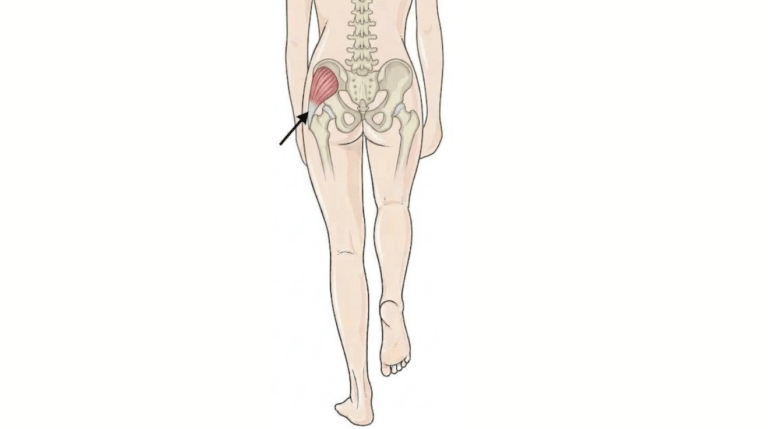
The way the work gets shared out is different as well. More of the push comes from the hip flexors and less from the calf at the ankle [3]. Your calf is the engine of ordinary walking: it loads up as your weight rolls over the foot, then fires to throw you forward, and it’s cheap to run because the Achilles tendon takes the energy in on the way down and gives most of it back on the way up, the way a spring does. The hip flexors sit at the front of the hip and their job is to swing the leg through rather than to drive you along. Hand them the propulsion and you’re asking muscle to do a job a tendon was built for, with no spring in it and nothing coming back.
That doesn’t have to show up as a bigger number on a gas analyser, and it didn’t. Walking 500 metres took longer and felt harder without burning more total oxygen [4]. Matching the speed on a treadmill didn’t show a difference in energy expenditure either [1]. Total oxygen is the whole body’s bill for the whole job, and it doesn’t itemise, so it can’t tell you that one part of the leg has been quietly covering for another. In a studio that’s the thing we plan a session around, because the cost of a walk is what it took out of you rather than what a watch thinks you spent.
Those differences still turn up when the groups are matched for how much physical activity people actually do [5]. They aren’t simply what’s left behind by having moved less. Which doesn’t make activity irrelevant, and it does mean the standard explanation, that you’re out of condition and need to build back up, is at best half of it.
Walking while your head is busy
Give someone with fibromyalgia something to think about while they walk and the stride shortens and the walking cycle slows down [6]. That’s the laboratory version of the big shop.
A flat, empty path with nothing to decide is one session. The same distance pushing a trolley, reading labels, working out which till queue is moving and holding a conversation at the same time is a different session, and it’ll cost you more while your watch logs an identical number of steps. Add uneven ground, a hill or cold weather and the same thing happens.
So when you’re comparing this week’s walk against last week’s, distance is one variable out of several. Where you walked, what you were carrying, who you were talking to and how much of the route you had to think about all belong in the same column.
The two hour rule is checking the wrong day
The rule you’ve most likely been given goes like this: if you still hurt two hours after you finish, you did too much. It sounds sensible and it’s pointed at the wrong moment.
Pool the pain response to exercise and it comes out bigger in the 8 to 72 hour window than in the first two hours [7]. That window is the evening of the day you walked and the two days after it, which is where Thursday lives. A check at two hours reads the smallest part of the response, so it’ll clear you on the exact afternoon you overdid it.
That pooled figure combines fibromyalgia with ME/CFS, myalgic encephalomyelitis or chronic fatigue syndrome, the two hour readings inside it came from an ME/CFS experiment, and what it describes is how far a group sat from a comparison group rather than your odds of a flare [7]. Use it to decide where to look, and not to predict your week.
The direct experiments disagree with each other as well, and that’s more useful than it sounds. In one moderate exercise challenge, pain and fatigue were still raised at 48 hours in the fibromyalgia group [8]. In a small cycling study there was no delayed pain worsening at all out to 96 hours [9]. Both are real results, so the thing people call payback isn’t automatic and some sessions cost you nothing, though a walk that cost you nothing still isn’t proof you got the dose right.
Which leaves you one thing to do, and it’s small. After a walk, write down three things: how long you were out, how hard it felt out of ten, and then, over the next two days, what those days did. One line in the notes app on your phone. Not a paid app, not a spreadsheet, not a symptom diary with a mood tracker bolted on, because those get abandoned by week two and this has to survive a bad fortnight.
Four or five entries in and you’ll see something memory can’t give you, because memory keeps the weeks that went wrong and quietly bins the ones that didn’t. The question that line answers isn’t whether you hurt. You hurt. It’s whether Thursday has anything to do with Monday.
What the trials actually prescribed
Almost none of them prescribed a distance. They prescribed minutes and an effort level, and distance was usually what got measured at the end rather than what anybody was told to go and do [10]. So every page handing you a mileage or a step target is extrapolating from somebody else’s outcome.
The shapes are worth having in plain words. The best described was supervised Nordic walking: 15 weeks, twice a week, sessions of 40 to 45 minutes starting with a 10 minute warm up, then blocks of two minutes harder alternating with two minutes easier, graded on how hard it felt rather than on pace [10]. A progressive programme started people at 25 to 30 minutes three times a week and rewrote the prescription every four weeks, reaching 50 minutes by the end [11]. The gentlest asked only for 30 minutes a day of self chosen moderate activity, picked up in pieces across the day, five to seven days a week [12].
The four week review
Every one of those numbers is where somebody arrived, not where anybody started. People got to those lengths over months, supervised, with somebody watching and adjusting them. Copying the end point is how a first week turns into a bad fortnight.
What does transfer is the review interval. The progressive programme rewrote what it was asking every four weeks [11], and that’s the piece worth taking, because it does two jobs. It stops you creeping the walk up by a minute a day until something gives, and it stops you sitting at the same length for a year because one bad week frightened you off.
So, where we’d start. Pick a length you could repeat on a bad week rather than the one you managed on your best day. If you can’t name one, take the shortest walk you did last week and halve it. Hold it for four weeks, with the three line note after each one. Then read the notes back, and if the two days afterwards have been unremarkable, add a few minutes rather than another kilometre. It’s deliberately smaller than anything you’ve been told, and a size you can repeat in a bad week is the only size that adds up to anything in the long term.
Two wins, and you might get only one
The Nordic walking programme put about 37.7 metres onto the six minute walk distance against about 8.6 metres in the comparison group, and it didn’t beat that comparison on pain [10]. People got measurably better at walking while the pain stayed where it was.
Pain does move on average across the aerobic trials, by around 11 points out of 100, with physical function around 10 [13]. Real and modest, and averages over a lot of people, some of whom did far better and some of whom got nothing.
Fatigue is the weakest of the three. In that same review the fatigue result didn’t separate from no change at all [13], and in the Nordic trial general and physical fatigue were no different between the groups straight after treatment [10]. If you start a walking programme expecting the tiredness to lift in six weeks, you’re expecting the outcome these trials got least reliably.
Attendance in the Nordic trial ran at 62%, people got transient pain, and one person stopped because pain over the hip got worse [10]. Across the aerobic trials about 20% of the exercise group withdrew against 17 per cent of the controls, a gap small enough to be nothing [13]. And the line everyone quotes, that no serious adverse events were reported [14], sits on top of a set of trials where most didn’t measure side effects at all [13].
Picking your own number
When women with fibromyalgia were allowed to choose their own exercise intensity and compared against a prescribed one, they chose lower, and neither condition produced delayed pain worsening afterwards [9]. That was cycling rather than walking, so don’t carry it across whole. A small walking pilot pointed the same way though, with lower intensity looking more favourable and higher intensity going with more pain [15].
One review works a dose backwards out of the trials and lands at 25 to 40 minutes, two to three times a week [16]. Another models the best pain improvement at somewhere around 90 minutes a week in total [17]. Those are estimates made across trials rather than head to head tests, so take them as the range other people landed in.
On breaking a walk into chunks, be careful what you’re being promised. Splitting the same daily minutes into two shorter bouts was tested against one continuous go, and it came out with no advantage on symptoms, on function or on sticking with it [18]. More people dropped out of the split version, 38 per cent against 29 [18]. That trial used home aerobics rather than walking, so it’s not the last word on short walks [18]. Accumulating activity in pieces across a day did improve pain and perceived function in its own trial, and left fatigue where it was [12]. Short walks are a reasonable accommodation if that’s what your day has room for, and anybody promising they’ll head off a flare is guessing.
The step counts are the part that usually arrives with shame attached. In a large accelerometer cohort, people with fibromyalgia took about 1,881 fewer steps a day than controls and spent 39 more minutes sitting [19]. That describes a group. It isn’t a target your Tuesday should be measured against.
The one worth knowing is this. The trial that actually moved pain moved people from about 3,788 steps a day to about 5,837 [12]. That’s a long way under the default your watch wants from you, and it was enough, so change the target or turn the ring off.
In one cohort, how active people were tracked with function and with the fatigue that comes on with movement, more than it tracked with pain [20]. In another, less sitting and more light activity went with lower pain and lower fatigue [21]. Light activity. Standing up and pottering counts, and it counts without needing a warm up.
When the bad week isn’t your fault
Boom and bust, the idea that you overdo it on a good day and then pay for it with a flattened week, gets quoted at you as though it were settled. The 30 per cent figure that keeps getting repeated for it came out of a chronic fatigue syndrome cohort rather than a fibromyalgia one [22], and it’s been carrying the wrong label ever since.
What turned up when symptoms and activity were both monitored continuously points the other way. Symptoms predicted the inactivity that followed them, while activity didn’t predict the symptoms that followed it [23]. The bad patch came first and the quiet days came after, which is what you’d expect if the quiet days were a response rather than a punishment. It was a mixed fibromyalgia and ME/CFS sample, so hold it loosely [23].
Pacing, which means spreading the activity out and stopping at a planned point instead of at the point where you run out, is worth doing and it isn’t a cure. The trials improved how people managed their activity, their function and their sleep, without reducing average pain or usual fatigue [24]. So pacing buys you a week you can plan, and if you’ve been doing it for months and the pain hasn’t shifted, that’s the documented result rather than a failure of execution. There’s a full guide to the mechanics of it elsewhere on the site, and that’s the better place to learn them.
So a flare isn’t proof of a mistake. Sometimes it is, and the three line note and the two day window are how you find out which. Often it isn’t, and the audit you run after every bad week, going back over Monday hunting for the error, is unpaid work with no finding at the end of it.
One thing before you go, because it’s the place this advice could do harm. If what follows a walk isn’t next day soreness but a whole system shutting down, arriving a day or two later, out of all proportion to what you did and taking far longer to lift than soreness would, that pattern is post exertional malaise and it has its own rules. Nothing above is written for it, and the ME/CFS piece is the one to read instead. Same goes if standing is the real problem rather than walking: light headed, heart going, worse in the heat, better the moment you sit down. That’s a circulation question with its own post. Running is a different question with a different answer, and it has its own post too.
So, the short version.
Telling whether a walk was too much. Read the next two days rather than the next two hours, and keep the three line note so Thursday has something to point at.
Your starting size. The length you could repeat on a bad week. If you can’t name one, halve the shortest walk you managed last week.
Making it bigger. Hold it for four weeks, read your own notes, then add a few minutes. Not a kilometre, and not because the four weeks are up.
A bad week. On its own it isn’t evidence that you did anything wrong, so the audit can stay unrun.
None of that is the advice you were handed, and all of it is smaller. Smaller is the version that survives a bad fortnight.
Adam

References
[1] MacPhee, R.S., McFall, K., Perry, S.D. and Tiidus, P.M. (2013) ‘Metabolic cost and mechanics of walking in women with fibromyalgia syndrome’, BMC Research Notes. https://doi.org/10.1186/1756-0500-6-420
[2] Carrasco-Vega, E., Ruiz-Muñoz, M., Cuesta-Vargas, A., Romero-Galisteo, R.P. and González-Sánchez, M. (2022) ‘Individuals with fibromyalgia have a different gait pattern and a reduced walk functional capacity: a systematic review with meta-analysis’, PeerJ. https://doi.org/10.7717/peerj.12908
[3] Pierrynowski, M.R., Tiidus, P.M. and Galea, V. (2005) ‘Women with fibromyalgia walk with an altered muscle synergy’, Gait & Posture. https://doi.org/10.1016/j.gaitpost.2004.09.007
Read More[4] Huijnen, I.P.J., Verbunt, J.A., Meeus, M. and Smeets, R.J.E.M. (2014) ‘Energy Expenditure during Functional Daily Life Performances in Patients with Fibromyalgia’, Pain Practice. https://doi.org/10.1111/papr.12245
[5] Tavares, L.F., Germano Maciel, D., Pereira Barros da Silva, T.Y. and Brito Vieira, W.H.D. (2020) ‘Comparison of functional and isokinetic performance between healthy women and women with fibromyalgia’, Journal of Bodywork and Movement Therapies. https://doi.org/10.1016/j.jbmt.2019.05.024
[6] Radunović, G., Veličković, Z., Rašić, M., Janjić, S., Marković, V. and Radovanović, S. (2021) ‘Assessment of gait in patients with fibromyalgia during motor and cognitive dual task walking: a cross-sectional study’, Advances in Rheumatology. https://doi.org/10.1186/s42358-021-00212-5
[7] Barhorst, E.E., Boruch, A.E., Cook, D.B. and Lindheimer, J.B. (2021) ‘Pain-Related Post-Exertional Malaise in Myalgic Encephalomyelitis / Chronic Fatigue Syndrome (ME/CFS) and Fibromyalgia: A Systematic Review and Three-Level Meta-Analysis’, Pain Medicine. https://doi.org/10.1093/pm/pnab308
[8] Light, A.R., Bateman, L., Jo, D., Hughen, R.W., VanHaitsma, T.A., White, A.T. et al. (2011) ‘Gene expression alterations at baseline and following moderate exercise in patients with Chronic Fatigue Syndrome and Fibromyalgia Syndrome’, Journal of Internal Medicine. https://doi.org/10.1111/j.1365-2796.2011.02405.x
[9] NEWCOMB, L.W., KOLTYN, K.F., MORGAN, W.P. and COOK, D.B. (2011) ‘Influence of Preferred versus Prescribed Exercise on Pain in Fibromyalgia’, Medicine & Science in Sports & Exercise. https://doi.org/10.1249/mss.0b013e3182061b49
[10] Mannerkorpi, K., Nordeman, L., Cider, Å. and Jonsson, G. (2010) ‘Does moderate-to-high intensity Nordic walking improve functional capacity and pain in fibromyalgia? A prospective randomized controlled trial’, Arthritis Research & Therapy. https://doi.org/10.1186/ar3159
[11] Couto, N., Monteiro, D., Cid, L. and Bento, T. (2022) ‘Effect of different types of exercise in adult subjects with fibromyalgia: a systematic review and meta-analysis of randomised clinical trials’, Scientific Reports. https://doi.org/10.1038/s41598-022-14213-x
[12] Fontaine, K.R., Conn, L. and Clauw, D.J. (2010) ‘Effects of lifestyle physical activity on perceived symptoms and physical function in adults with fibromyalgia: results of a randomized trial’, Arthritis Research & Therapy. https://doi.org/10.1186/ar2967
[13] Bidonde, J., Busch, A.J., Schachter, C.L., Overend, T.J., Kim, S.Y., Góes, S.M. et al. (2017) ‘Aerobic exercise training for adults with fibromyalgia’, Cochrane Database of Systematic Reviews. https://doi.org/10.1002/14651858.cd012700
[14] Andrade, A., Dominski, F.H. and Sieczkowska, S.M. (2020) ‘What we already know about the effects of exercise in patients with fibromyalgia: An umbrella review’, Seminars in Arthritis and Rheumatism. https://doi.org/10.1016/j.semarthrit.2020.02.003
[15] MEYER, B.B. and LEMLEY, K.J. (2000) ‘Utilizing exercise to affect the symptomology of fibromyalgia: a pilot study’, Medicine & Science in Sports & Exercise. https://doi.org/10.1097/00005768-200010000-00005
[16] Casanova‐Rodríguez, D., Ranchal‐Sánchez, A., Rodríguez, R.B. and Jurado‐Castro, J.M. (2025) ‘Aerobic Exercise Prescription for Pain Reduction in Fibromyalgia: A Systematic Review and Meta‐Analysis’, European Journal of Pain. https://doi.org/10.1002/ejp.4783
[17] Núñez-Cortés, R., Suso-Martí, L., Almonacid-Lleida, J., Salazar-Méndez, J., López-Bueno, R., Cruz-Montecinos, C. et al. (2025) ‘Optimal Dose of Aerobic Exercise Programs to Reduce Pain Intensity and Improve Health Status in Patients With Fibromyalgia: A Dose-Response Meta-Analysis’, Physical Therapy. https://doi.org/10.1093/ptj/pzaf057
[18] Schachter, C.L., Busch, A.J., Peloso, P.M. and Sheppard, M.S. (2003) ‘Effects of Short Versus Long Bouts of Aerobic Exercise in Sedentary Women With Fibromyalgia: A Randomized Controlled Trial’, Physical Therapy. https://doi.org/10.1093/ptj/83.4.340
[19] Segura‐Jiménez, V., Álvarez‐Gallardo, I.C., Estévez‐López, F., Soriano‐Maldonado, A., Delgado‐Fernández, M., Ortega, F.B. et al. (2015) ‘Differences in Sedentary Time and Physical Activity Between Female Patients With Fibromyalgia and Healthy Controls: The al‐Ándalus Project’, Arthritis & Rheumatology. https://doi.org/10.1002/art.39252
[20] Merriwether, E.N., Frey-Law, L.A., Rakel, B.A., Zimmerman, M.B., Dailey, D.L., Vance, C.G.T. et al. (2018) ‘Physical activity is related to function and fatigue but not pain in women with fibromyalgia: baseline analyses from the Fibromyalgia Activity Study with TENS (FAST)’, Arthritis Research & Therapy. https://doi.org/10.1186/s13075-018-1671-3
[21] Segura‐Jiménez, V., Borges‐Cosic, M., Soriano‐Maldonado, A., Estévez‐López, F., Álvarez‐Gallardo, I.C., Herrador‐Colmenero, M. et al. (2015) ‘Association of sedentary time and physical activity with pain, fatigue, and impact of fibromyalgia: the al‐Ándalus study’, Scandinavian Journal of Medicine & Science in Sports. https://doi.org/10.1111/sms.12630
[22] King, E., Beynon, M., Chalder, T., Sharpe, M. and White, P.D. (2020) ‘Patterns of daytime physical activity in patients with chronic fatigue syndrome’, Journal of Psychosomatic Research. https://doi.org/10.1016/j.jpsychores.2020.110154
[23] Kop, W.J., Lyden, A., Berlin, A.A., Ambrose, K., Olsen, C., Gracely, R.H. et al. (2005) ‘Ambulatory monitoring of physical activity and symptoms in fibromyalgia and chronic fatigue syndrome’, Arthritis & Rheumatism. https://doi.org/10.1002/art.20779
[24] Racine, M., Jensen, M.P., Harth, M., Morley-Forster, P. and Nielson, W.R. (2019) ‘Operant Learning Versus Energy Conservation Activity Pacing Treatments in a Sample of Patients With Fibromyalgia Syndrome: A Pilot Randomized Controlled Trial’, The Journal of Pain. https://doi.org/10.1016/j.jpain.2018.09.013