

- Hypermobile hip exercises we use, and why clamshells aren’t one of them - 17 October 2026
- Is Fibromyalgia a Disability in the UK, and Can You Claim PIP? - 14 October 2026
- Fibromyalgia and Central Sensitisation, What Is It in Plain English? - 8 October 2026
There’s a conversation that happens in a lot of relationships where one person has chronic pain. It goes something like this: the person with pain says “I’m fine.” The partner either believes it or doesn’t. Either way, something gets lost. The saying “I’m fine” continues. The guessing continues. The gap between what’s happening and what’s being said about it grows, slowly, quietly, until both people feel like they’re failing at something they can’t quite name.
This post is for couples already in that gap. Not for people newly dating, not for the disclosure conversation with someone you’ve just met. We covered that in our post on disclosure, and the longer arc of how chronic pain reshapes a long term relationship separately. This is for the couple who’ve been together a while, where chronic pain is already part of the furniture, and where the communication around it has maybe got a bit stuck.
The research on this is actually pretty good. We know which partner response styles work and which ones don’t. We know why the “I’m fine” reflex exists and what it costs. We know what happens in relationships when pain communication goes wrong over time. And we have decent evidence for what couples can do about it. None of it is complicated. Most of it nobody tells you.
So here it is.
What this post is not: it’s not couples therapy, it’s not a substitute for professional support when you need it, and it’s not going to solve a relationship that’s broken in other ways. What it is, is the practical evidence base that most people in chronic pain relationships never get handed to them.
The Single Biggest Predictor of How a Relationship Handles Chronic Pain
When it comes to what separates couples who manage well from couples who find it difficult, the answer from the research isn’t compatibility, or how long they’ve been together, or even how severe the pain is. It’s whether they treat the illness as something that belongs to both of them.
Dyadic coping theory is the framework for understanding this. The core idea is that when a significant stressor enters a relationship, couples can respond to it individually or jointly. The jointly part matters more than you’d expect. A systematic review of 49 publications on couples dealing with chronic physical illness (33 distinct datasets across cancer, diabetes, COPD and arthritis) found that the couples doing best weren’t the ones where the partner was most helpful, or most stoic, or most accommodating [1]. They were the couples where both people had taken some kind of shared ownership of the problem [1]. Worth flagging up front: that review explicitly excluded chronic pain studies because a separate review by Prenevost and Reme had already covered that ground, and the chronic pain specific work points in the same direction [14].
A conference report on 177 chronic pain couples described associations between communication, collaborative decision making, the sense of facing things together, and mental health for both the person with pain and their partner [2]. Not just one of them. Both. The relational quality of how you handle it bleeds in both directions.
That’s the “we-disease” reframe, which we’ll come back to later. The quick version: pain that belongs to “you” is an isolating burden. Pain that belongs to “us” is a joint problem. Both people are still separate individuals with separate experiences, but the orientation changes what’s possible in terms of communication.
Why Partners Get It Wrong Even When They’re Trying
Here is something that comes up again and again in the research: people with chronic pain and their partners often interpret the same interaction completely differently [3]. What the person with pain experiences as being dismissed, the partner experiences as encouraging them to stay active. What the partner thinks is helpful is sometimes the thing that’s making things worse. Neither person is lying. They’re just operating from different mental models with no shared map.
The partner in a chronic pain relationship is usually trying. That’s worth saying out loud, because the failure mode isn’t malice. It’s that they’ve never been given a framework for how to respond, so they improvise. Some improvise in ways that work. Most don’t, at least not consistently.
The research gives us a reasonably clear picture of what happens when things go wrong. Within the same day that partners are more critical or hostile than usual, the person with pain reports increased pain about three hours later [4]. This isn’t a perceptual trick. It’s a real effect, tracked with electronic diary entries multiple times a day, pointing to a negative spiral where relational conflict makes pain worse within hours, and worse pain then strains the relationship further [4].
Nobody told the partner that. Nobody told the person with pain either. And in the absence of that information, arguments about whether the pain is “really that bad today” or frustration about plans being cancelled tend to just feel like relationship problems rather than pain problems with a communication fix.
The Three Partner Response Styles: Solicitous, Distracting, Validating
The chronic pain literature has spent a lot of time on how partners respond to pain expression. The shorthand is that responses tend to cluster into three styles, and understanding yours (and your partner’s) is genuinely useful.
Solicitous responding is what it sounds like: the partner rushes in to help with anything the person with pain expresses. Takes over the task, brings the medication, insists they rest. On its face this looks like support, and sometimes it is. The research picture is more complicated. Solicitous responding can, in some circumstances, inadvertently amplify pain behaviour by providing reinforcement for expressing pain, and it can undermine the person’s sense of agency over their own body [5]. This is the over helping partner. The one who means really well and whose constant assistance can feel, after a while, like being handled rather than helped.
The thing is: the clinical literature has over weighted this finding. Solicitousness gets a lot of attention because it’s counterintuitive, because it’s the surprise in the data. But the actual harm in chronic pain relationships comes much more reliably from the next category.
Punishing or invalidating responding is the one that does real damage. Dismissal, hostility, scepticism about whether the pain is as bad as claimed, expressions of disbelief. This is not clinically neutral [6]. Research on 92 chronic pain couples found that spouse invalidation was significantly more strongly linked to poor relationship outcomes than solicitousness was [6]. Spouse validation, by contrast, was associated with better marital satisfaction and perceived spousal support [6].
This matters because a lot of the couples who end up struggling have drifted into a pattern where the person with pain has stopped communicating fully (because previous expressions were met with scepticism), and the partner has developed a slightly hostile or dismissive response to ongoing pain expression (because they’re exhausted and feel helpless). Both responses make sense individually. Together they lock the relationship into a shape that makes everything worse.
Validating responding is what actually works. Acknowledging what the person with pain is experiencing. Interest in their internal state. Not jumping immediately to problem solving. There’s a neurological piece to this too: partner presence and response style appears to modulate pain perception at a neurological level. A small EEG study (ten participants per group, so worth treating as a signal rather than a settled finding) showed enhanced central nervous system processing and higher pain ratings during pain stimulation when a solicitous spouse was present compared to a non solicitous spouse or no partner at all [5]. The sample is small but the effect direction lines up with the broader behavioural literature: how your partner responds when you’re in pain seems to change how much pain you actually experience.
The practical version of validating responding isn’t complicated. It’s “that sounds genuinely rough, what do you need from me right now?” instead of immediately trying to fix it or, worse, question it.
The “I’m Fine” Problem
Let’s be honest about this one. “I’m fine” is doing a lot of work for people with chronic pain. It’s keeping the peace. It’s protecting the relationship from becoming a pain update every hour. It’s holding onto some version of normal, some sense that you’re still you and not just a collection of symptoms. These are understandable reasons. They are also making things significantly worse.
The research calls this concealment. A longitudinal study of couples managing a concealable chronic illness found that more frequent symptom concealment was associated with poorer perceived partner responsiveness and lower relational wellbeing for both partners over time, and that the effect ran in both directions: concealment damaged the relationship, and a damaged relationship made more concealment more likely [7]. In the sexuality literature on fibromyalgia specifically, male partners interviewed about their experience of their wife’s condition described feeling shut out of the physical side of the relationship, uncertain about what was safe to initiate, and frustrated by the inability to read what their partner needed in the moment [8]. That same pattern, partner flying blind and the person with pain protecting them from the truth, is what the wider concealment literature describes at the level of day to day pain communication too.
There’s also the problem of what happens to those with high catastrophising in particular. When someone is experiencing pain as genuinely overwhelming but perceives their partner as unlikely to take it seriously, they tend to either withhold pain communication entirely (which denies the partner any information to work with), or they escalate pain expression to try to communicate severity, which can read as catastrophising and trigger the very dismissal they were anticipating [9]. It’s a communication trap with the lock on both sides.
The “I’m fine” reflex doesn’t protect anyone. It just means the relationship is running on inaccurate data.
The community voices on this are pretty direct. People who’ve been through it describe the exhausting calculus of deciding how much to say, whether this flare is worth mentioning, whether admitting to pain today means the partner stops making plans for the weekend. One person put it plainly: “I do wish he’d just understand it’s never personal, it has never been even the slightest bit personal.” Not saying “I’m in pain” is not the same as not being in pain. It’s just pain with a door closed in front of it.
So what to say instead? We’ll get to that in the next two sections. The starting point is just noticing how often “fine” is doing the work that honesty should be doing, and asking what that costs both people over time.
Asking for What You Need (and the Trap in the Middle)
This is where the operant pain behaviour theory becomes relevant, because it sets up a real tension for the person with chronic pain trying to communicate their needs.
The original operant model, going back to Fordyce in the 1970s, proposed that pain behaviour is partly maintained by the responses it produces [10]. If expressing pain gets you attention and help, the behaviour gets reinforced. This led to clinical approaches that were, let’s say, not always kind to people with chronic pain, and to the “solicitous spouse” concept discussed above.
Here’s the tension: if you ask for help, you risk becoming dependent on the help, and you risk your partner responding in ways that amplify rather than settle the pain. If you don’t ask, your partner doesn’t know what you need and defaults to guessing, which goes badly more often than not. If you mask, you’ve removed the information your partner needs entirely.
The resolution the research actually points to is not to suppress pain expression but to change the shape of it. There’s an important distinction between verbal pain expression as a behaviour to be reinforced or extinguished on one hand, and verbal pain expression as emotional self-disclosure that builds intimacy on the other [11]. The same communication can be either one, depending on the relational context it happens in and how the partner receives it.
Ready to work through this with structure and support?
The Hypermobility Live Workshop is four weeks of breaking down the frameworks we use in our studios, with live Q&A so you can ask about your specific situation. Two free courses are included.
When it comes to asking for what you need in practice, the community has actually worked this out. Some versions that show up consistently:
- “I’m up for X but not Y today, that cool?” stated before things start, not during a flare.
- “What would help me most right now is [specific thing]” rather than just expressing pain and leaving the partner to guess.
- “I need you to listen, I’m not asking you to fix it” as a frame setter for conversations that aren’t looking for solutions.
- Monthly check ins as a standing conversation, not a crisis intervention. “How are we doing with this, what do you need from me, what am I missing?” on a normal Tuesday, not in the middle of a bad week.
Written communication also shows up in the community evidence for the harder conversations. When verbal communication in the moment is too fraught, a letter or an email gives both people time to organise their thoughts, read without defensiveness, and respond without the heat of the immediate exchange.
Communicating During a Flare in Real Time
A flare is not the moment for a communication overhaul. This is worth saying because a lot of the difficult conversations about chronic pain and relationships happen during flares, when the person with pain has the least cognitive and emotional bandwidth for nuanced discussion, and when the partner is probably alarmed and responding to that alarm in ways that aren’t necessarily helpful.
What actually works during a flare is having the framework in place beforehand. The community puts it like this: “Set up both verbal and non verbal signals that mean ‘stop now’ so I can pause if something becomes painful.” That’s about physical intimacy, but the principle extends more broadly. Having pre agreed signals and phrases removes the cognitive load of figuring out how to communicate in the moment when you don’t have the resources for it.
Some real time phrases that work, drawn from what people with chronic pain and their partners actually say to each other:
- “It’s not working for me, I need to stop.” Neutral, no blame assigned.
- “I need you to just be here, I don’t need anything fixed.”
- “Can we just sit together for a bit?”
- “I’m having a bad one. I’ll tell you what would help.”
What tends not to work during a flare, even when well intentioned:
- The partner immediately offering solutions or suggestions (including “have you tried…?” which is its own category of unhelpful).
- The person with pain saying “I’m fine” and then being visibly not fine, which puts the partner in an impossible position.
- Either person raising unrelated relationship concerns in the middle of the pain event.
The practical version: agree on a short, low effort signal system when you’re both well. “Yellow” means I’m struggling, I might need help soon. “I need a minute” means back off, I’ll come to you. Whatever works for your specific relationship. The content doesn’t matter. Having it before you need it does.
Dyadic Coping: The “We-Disease” Reframe
Earlier we mentioned the idea that couples who handle chronic pain best are the ones who treat it as something that belongs to both of them. The research term for this is dyadic coping, and the particular framing that comes out of the literature is what some researchers call the “we-disease” orientation.
The idea is that a couple’s illness appraisal, how they mentally categorise what the pain is and whose problem it is, shapes how they respond to it together [12]. Couples who frame chronic illness as a shared problem, who use language like “our pain management” or “what works for us”, rather than treating the pain as something that belongs to the person with the diagnosis and requires management by the partner, have better outcomes on psychosocial measures and relationship satisfaction [12].
This is not about the partner owning an experience that isn’t theirs. It’s about the orientation. Pain is still happening in one body. But the decision making, the adaptation, the planning around it, those are relational. And when both people approach them relationally, things work better than when it’s a one person problem that the other person is just trying to accommodate.
In practice this sounds like: “what do we need to adjust this week?” rather than “what do you need this week?” It sounds like joint problem solving around the calendar or the energy budget rather than the person with pain issuing requests and the partner deciding whether to grant them. It’s a small linguistic shift with a real structural change underneath it.
We see this in the studios with clients who come in alongside their partners. The ones who move fastest in rehab are usually the ones where both people are invested in the understanding, not just the one with the condition. The partner who’s done the reading, who comes in with questions, who’s adapted how they talk about flares at home. That’s dyadic coping in action, and it shows up in the outcome data.
Pain Catastrophising in a Partnership
Catastrophising is one of those terms that can feel accusatory when you first hear it, so let’s be clear about what it actually means. It’s a pattern where pain gets perceived as more threatening than the body’s signals warrant, leading to rumination, a magnification of the threat, and a sense of helplessness. It’s associated with worse pain outcomes and it’s not a character flaw. It’s a nervous system response that’s more common in people whose pain has been dismissed, who’ve had bad diagnostic experiences, or whose pain has genuinely not been well managed [9].
The relational dimension of catastrophising is the bit that doesn’t get talked about enough. When one person in a couple catastrophises about pain and their partner doesn’t, or catastrophises in the opposite direction (dismissing), the mismatch creates communication pressure [9]. The high catastrophising person needs to communicate severity; the low catastrophising partner isn’t receiving it at the intended volume; the high catastrophising person turns up the volume to be heard [9]. The partner experiences this as dramatic. The cycle continues.
There’s also the quieter version: someone who catastrophises internally while presenting “fine” to their partner. The partner has no idea. The pain experience intensifies with no outlet. That’s a pattern that tends to end in a conversation that’s been deferred too long [9].
The fix isn’t to tell someone to catastrophise less. It’s to build the relational environment where full pain communication can happen without triggering the defensive response that was anticipated. That starts with the partner learning to receive pain communication with interest rather than alarm.
When Professional Help Becomes Useful
When it comes to couple based approaches to chronic pain, the systematic evidence is modest but consistent. Across many studies, dyadic coping interventions are associated with better physical health outcomes, better psychological wellbeing, and better relationship satisfaction for couples dealing with chronic physical illness [1]. The evidence is strongest in cancer and diabetes, thinner for fibromyalgia and hypermobility specifically [1], but the mechanism (shared coping reduces individual burden and improves communication) is generalisable.
The best evidence in a closely related area comes from vulvodynia research. A randomised clinical trial comparing cognitive behavioural couple therapy with topical lidocaine for provoked vestibulodynia found that both treatments produced similar improvements in sexual function, with neither producing a significant group difference and neither normalising scores out of the clinical range [13]. Couple therapy did outperform lidocaine on sexual distress, pain unpleasantness, pain anxiety, pain catastrophising and treatment satisfaction, though the sexual distress advantage was significant at post-treatment and not maintained at the six-month follow-up [13]. The trial also had an important caveat that’s worth knowing about: a moderator analysis showed that for women with high attachment avoidance or a history of childhood maltreatment, couple therapy actually performed worse than lidocaine alone [15]. That matters because attachment avoidance and trauma history are not rare in those with hypermobility and chronic pain. So the broad point holds, that treating the relational layer alongside the physical does something the physical treatment alone can’t, but for some people, particularly trauma survivors, jumping straight into couple based work may not be the right first move. A therapist who understands that nuance is the one to look for.
So when is professional help worth seeking? A few markers:
- The same conversation keeps cycling without resolution. You’ve had the same argument about whether the pain is “really” that bad, or about how much help is too much help, more times than you can count.
- One or both partners has started withdrawing from emotional intimacy because the pain conversations are too charged.
- The person with pain feels consistently unheard and the partner feels consistently blamed, or vice versa.
- There’s an accumulation of unspoken resentment that’s starting to affect other parts of the relationship.
A therapist who understands chronic illness is worth looking for specifically. General couples therapists are sometimes unfamiliar with the specific dynamics that emerge in chronic pain relationships, and some of the standard models don’t translate well. Look for someone with chronic illness experience, or at least a willingness to read the research you bring them.
The Community Shortlist: What People Actually Say
We pulled the communication section of our community research, which represents the lived experience of people across fibromyalgia, hEDS, POTS, ME/CFS, and other overlapping conditions. What people actually say to each other, and what they wish they could say, is the most practical layer of this.
From the person with chronic pain to the partner:
- “I’m having a bad one. I’ll tell you what would help when I know.”
- “I’m up for [X] but not [Y] today. Is that okay?”
- “It’s not working for me, I need to stop. It’s not you.”
- “I just need you to be here. I don’t need you to fix anything.”
- “When I say I’m fine, I don’t always mean I’m fine. Can we have a different word?”
From the partner to the person with pain:
- “That sounds genuinely rough. What do you need from me right now?”
- “I’m not going to guess. Tell me.”
- “We don’t have to do anything. We can just be here.”
- “What would make today more manageable?”
- “I’m not going anywhere. You don’t have to perform fine for me.”
The community also consistently endorses a monthly check in habit: a deliberate conversation, outside of a flare, about how the communication is going, what’s working, what each person needs more or less of. Not a crisis intervention. A standing conversation that prevents the gap from growing.
And written communication for the bigger things. “When we find it hard to communicate, my husband and I sometimes write letters to one another. It gives us time to collect our thoughts.” This is genuinely useful for any topic that’s too charged to handle in real time.
One thing that’s worth pinning to the actual fridge, if you live with chronic pain: “It’s never personal. It has never been even the slightest bit personal.” That’s what people with chronic pain consistently want their partners to understand about the flares, the cancelled plans, the days when they can’t be present the way they want to be. It’s not a verdict on the relationship. It’s the condition. Making that distinction is one of the most useful things a couple can share.
A Quick Word on Unsolicited Illness Talk
One pattern in the wider research on chronic illness couples that surprises people: unsolicited illness focused conversation initiated by the well partner can be associated with lower relational wellbeing over time, a dynamic discussed in the literature on protective buffering and partner over involvement. The well meaning partner who converts every interaction into health management, “how did you sleep? have you taken your medication? is today a good day?”, may be expressing care. It can land as a constant reminder that your health is now the organising principle of the relationship.
The person with pain should drive the health conversation when they’re ready for it. The partner’s job is to be available, not to keep knocking on that particular door.
Frequently Asked Questions
What if my partner doesn’t believe my pain is as bad as I say it is?
This is probably the most common and the most corrosive problem in chronic pain relationships. Dismissal and scepticism about pain severity aren’t just hurtful, they’re associated with worse pain outcomes for the person with pain and worse relationship outcomes for both of you [6]. If it’s a persistent pattern, it’s worth naming it directly and specifically: “When you respond that way, I stop telling you how I’m actually doing, and then you don’t have the information you need either.” If naming it directly doesn’t shift anything, that’s a conversation to have with a professional. Sustained invalidation of a partner’s pain experience is not a minor communication quirk.
Is it okay to sometimes not tell my partner how bad it is?
Choosing your moment, not dumping every flare update in real time, is fine. Consistent masking as a strategy to protect the relationship isn’t. The research on this is pretty clear: over time, symptom concealment is associated with lower perceived partner responsiveness and lower wellbeing for both partners, and the effect runs in both directions [7]. You’re not protecting the relationship by concealing how things are. You’re just making both of you operate on inaccurate data.
My partner is very solicitous, always trying to help. Is that actually a problem?
It depends on how it’s playing out for you specifically. If the over helping is undermining your sense of agency, or if it means every time you mention pain your partner tries to take something over, it’s worth talking about. The phrase that tends to help here is “what I need right now is [specific thing], not [specific other thing].” That gives your partner something concrete to do rather than leaving them to default to maximum helpfulness. The research does suggest that excessive solicitousness can complicate pain management [5], but it’s a much smaller problem than the alternative, which is a dismissive or invalidating response. An over helpful partner who listens when you tell them what you actually need is a very manageable situation.
We keep having the same argument. When should we consider couples therapy?
When the same conversation cycles repeatedly without resolution and you’ve genuinely tried to address it directly, that’s a reasonable moment to bring in a third party. Also when one or both of you has started withdrawing emotionally because the pain conversations are too charged. Look for a therapist who has chronic illness experience, or at least who’s willing to engage with the evidence base rather than applying generic relationship models that don’t account for the specific dynamics chronic pain creates [1].
References
- Weitkamp K, Feger F, Landolt SA, Roth M, Bodenmann G. Dyadic coping in couples facing chronic physical illness: a systematic review. Front Psychol. 2021;12:722740. doi: 10.3389/fpsyg.2021.722740
- Lyons KS. The roles of communication, collaboration, and social support on dyadic mental health in the context of chronic pain. Innovation in Aging. 2020;4(Supplement_1):648. doi: 10.1093/geroni/igaa057.2233
- Akbari F, Mohammadi S, Dehghani M, Sanderman R, Hagedoorn M. Interpretations of partners’ responses to pain behaviours: perspectives of patients and partners. Br J Health Psychol. 2021;26(2):401-418. doi: 10.1111/bjhp.12490
- Burns JW, Peterson KM, Smith DA, Keefe FJ, Porter LS, Schuster E, Kinner E. Temporal associations between spouse criticism/hostility and pain among patients with chronic pain: a within-couple daily diary study. Pain. 2013;154(12):2715-2721. doi: 10.1016/j.pain.2013.07.053
- Nees F, Ditzen B, Flor H. When shared pain is not half the pain: enhanced central nervous system processing and verbal reports of pain in the presence of a solicitous spouse. Pain. 2022;163(9):e1006 to e1012. doi: 10.1097/j.pain.0000000000002559
- Cano A, Barterian JA, Heller JB. Empathic and nonempathic interaction in chronic pain couples. Clin J Pain. 2008;24(8):678 to 684. doi: 10.1097/AJP.0b013e31816753d8
- Shrout MR, Weigel DJ, Laurenceau JP. Couples and concealable chronic illness: investigating couples’ communication, coping, and relational well-being over time. J Fam Psychol. 2024;38(1):136-148. doi: 10.1037/fam0001136
- Romero-Alcala P, Hernandez-Padilla JM, Fernandez-Sola C, Coin-Perez-Carrasco MdR, Ramos-Rodriguez C, Ruiz-Fernandez MD, Granero-Molina J. Sexuality in male partners of women with fibromyalgia syndrome: a qualitative study. PLOS ONE. 2019;14(11):e0224990. doi: 10.1371/journal.pone.0224990
- Caño A, Leong LE, Heller JB, Lutz JR. Perceived entitlement to pain-related support and pain catastrophising: associations with perceived and observed support. Pain. 2009;147(1-3):249-254. doi: 10.1016/j.pain.2009.09.023
- Fordyce WE. Behavioral Methods for Chronic Pain and Illness. St. Louis: Mosby; 1976.
- Cano A, Williams AC de C. Social interaction in pain: reinforcing pain behaviours or building intimacy? Pain. 2010;149(1):9-11. doi: 10.1016/j.pain.2009.10.010
- Lyons KS, Lee CS. The theory of dyadic illness management. J Fam Nurs. 2018;24(1):8-28. doi: 10.1177/1074840717745669
- Bergeron S, Vaillancourt-Morel MP, Corsini-Munt S, Steben M, Delisle I, Mayrand MH, Rosen NO. Cognitive-behavioral couple therapy versus lidocaine for provoked vestibulodynia: a randomized clinical trial. J Consult Clin Psychol. 2021;89(4):316-326. doi: 10.1037/ccp0000631
- Prenevost MH, Reme SE. Couples coping with chronic pain: how do intercouple interactions relate to pain coping? Scand J Pain. 2017;16(1):150-157. doi: 10.1016/j.sjpain.2017.05.010
- Charbonneau-Lefebvre V, Vaillancourt-Morel MP, Rosen NO, Steben M, Bergeron S. Attachment and childhood maltreatment as moderators of treatment outcome in a randomized clinical trial for provoked vestibulodynia. J Sex Med. 2022;19(3):479-495. doi: 10.1016/j.jsxm.2021.12.013
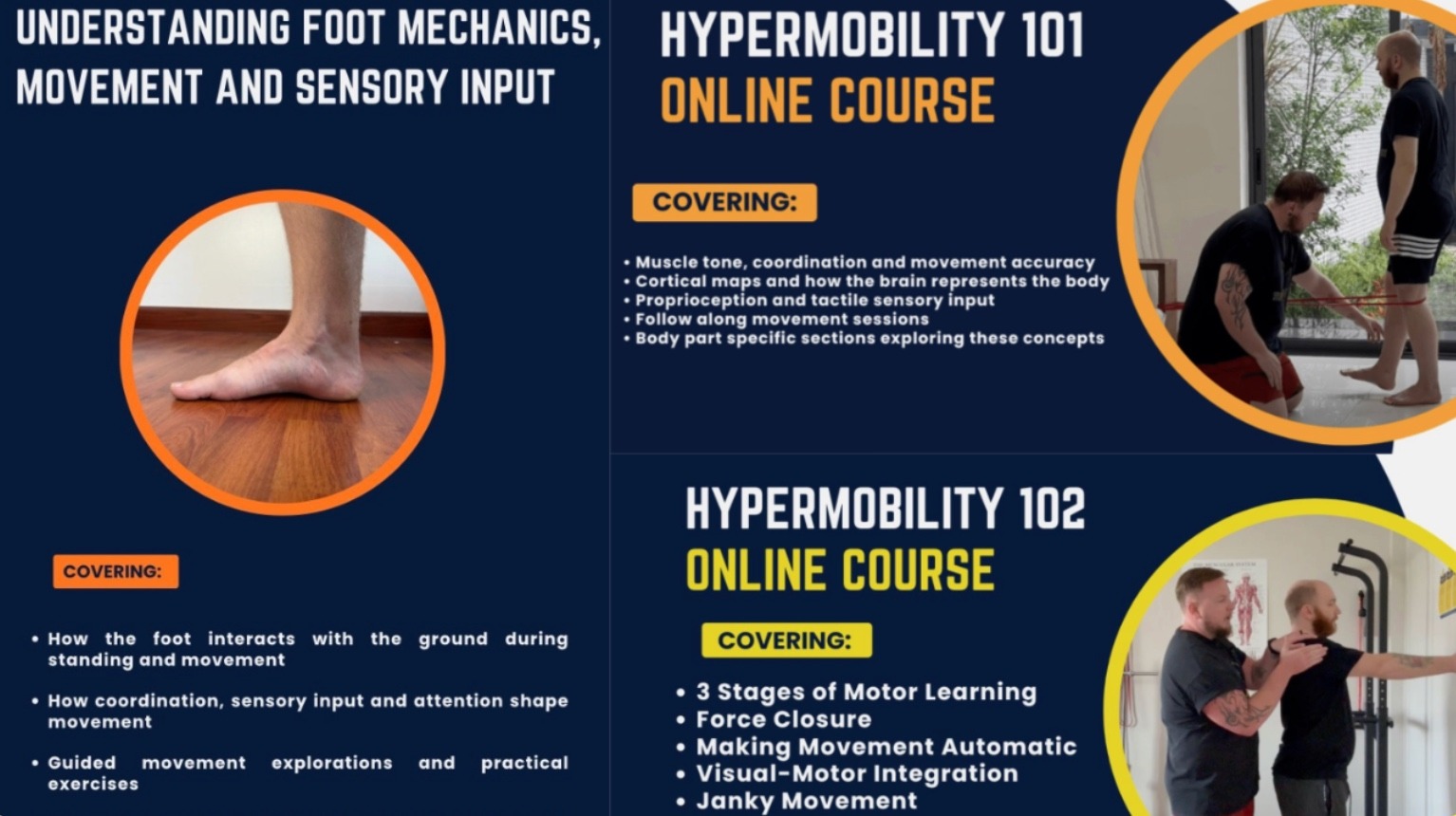
The Hypermobility Fundamentals Bundle
The Hypermobility Fundamentals Bundle is a structured education and movement pathway that starts at the bottom and builds upwards, grounded in motor learning and sensory motor science. Designed for people with hypermobility and persistent pain, it focuses on how strength and stability are organised and learned by the nervous system, beginning with the feet and progressing through sensory input, coordination, and motor learning. The courses are intended to be completed in sequence, with each one establishing the concepts and skills needed for the next.
— The Fibro Guy Team —