
- Swollen legs and hypermobility: pooling, lymphoedema and lipoedema - 4 November 2026
- Walking with fibromyalgia - 2 November 2026
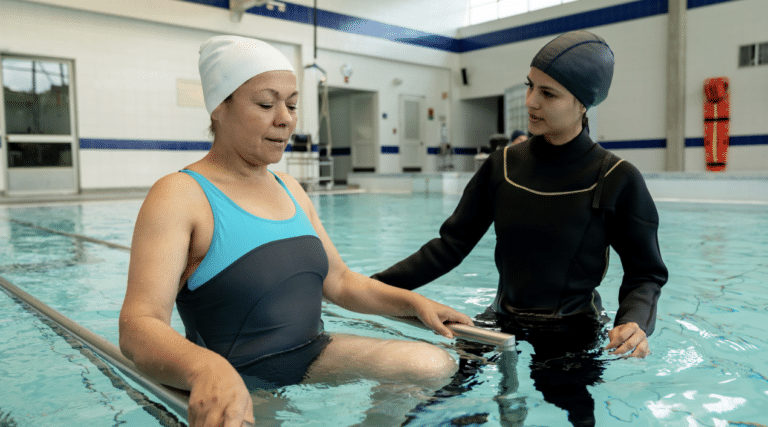
- Water exercise and hydrotherapy for fibromyalgia - 2 November 2026
This article is part of our comprehensive guide to hypermobility and Ehlers-Danlos syndrome.
Swollen legs get the same advice nearly everywhere, which is feet up and buy some socks. That’s fair enough when what’s in the leg, is blood sitting in overfilled veins. It’s almost close to useless, however, once fluid has crossed out of them and into the tissue, and it does nothing whatever for lipoedema, where the thing making the leg bigger is fat. What’s in there decides what helps, so that’s where we shall start.
Which one have you got?
The quickest sorting question is time, and you’ll already know your own answer to it. Does it come and go? Swelling that comes on after a day on your feet, and gone by morning, behaves like a fluid shift driven by posture, and orthostatic symptoms, meaning the ones that belong to being upright, and characteristically improve when you lie down [1]. A leg that’s the same size first thing upon waking as it was last thing at night is a different conversation entirely. Early lymphoedema can settle with rest too, mind, so a normal morning leg doesn’t clear you [2].
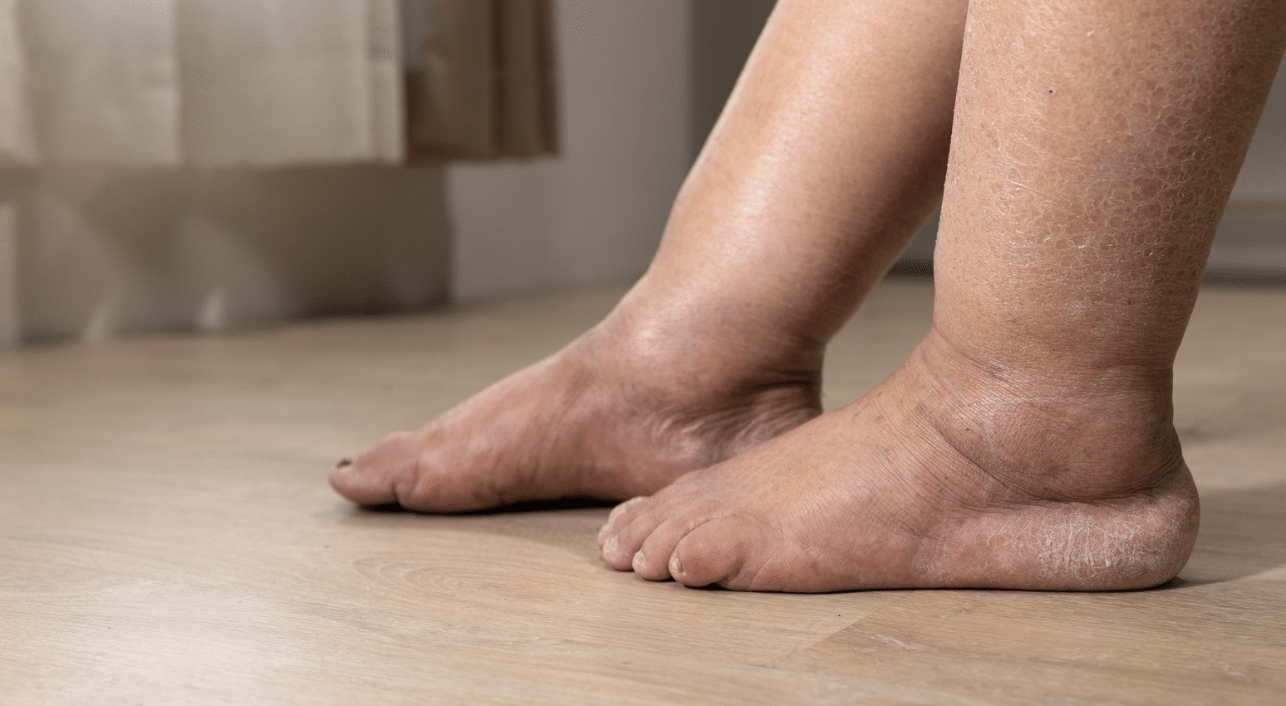
Press a thumb into the worst of it, and hold it there for a few seconds. A dent that stays behind means fluid has collected in the tissue, in the spaces between your cells [3]. Pitting, that gets called, and you’ll likely hear it in an appointment. Lipoedema doesn’t generally pit [4], partly because the tissue is firmer and more fibrous than ordinary fat and won’t hold a dent [2]. After that it’s whether your feet and toes are swollen or conspicuously left alone, whether the two legs match, whether it hurts when somebody grabs a handful of your thigh, and whether you bruise without remembering the cause. Which gives you a rough sorting:
Up through the day, gone by morning, feet and toes fine. That’s pooling, and it’s gravity and volume rather than drainage [4].
Still there in the morning, foot and toes involved, skin thickening, more than one skin infection. That’s pointing at lymphoedema, where the drainage itself is what’s failed [4].
Both legs, out of proportion with your top half, a cuff at the ankle where it stops dead, tender to grab, bruises easily, and it stays when the weight comes off. That’s pointing at lipoedema [4].
There’s one more test you can do sitting on the edge of the bath. If you can’t pinch and lift the skin on the top of your second toe, that points towards lymphoedema, and lifting it doesn’t entirely clear you either, because lymphoedema can develop alongside something else and still give a negative sign [5].
And yes, you can have more than one at once, which is where most of the arguing in online groups comes from. Lipoedema and lymphoedema can sit in the same pair of legs and that combination has a name of its own, lipolymphoedema [6], while long standing vein problems can overload lymphatic drainage and produce a mixed picture as well [4]. So, the question worth taking into your appointments is what’s making your legs bigger, and in what proportion, because where two things are going on you want both of them treated.
Lipoedema
Lipoedema or “Lipedema” for those reading in certain breakaway UK territories (wot wot), is painful, disproportionate subcutaneous fat, meaning the fat layer sitting just under the skin, usually in both legs and sometimes the arms too, with easy bruising and the hands and feet largely left out of it [7]. Your own description of it tends to beat the textbook one: my legs don’t match my top half, there’s a cuff at the ankle where it stops dead, my knees are lumpy, and it hurts when somebody grabs my thigh.
Set it against lymphoedema and what separated the two was disproportion, feet left alone, easy bruising and the same picture on both legs, while pitting, hardened tissue and repeated skin infections pointed the other way [8]. Easy bruising is worth less to you than to anybody else, mind, because it arrives with EDS regardless, so in a hypermobile body it stops doing much work at all in telling them apart [9].
Why it doesn’t shift when the weight does
This is the feature you notice first and get told off for mentioning. The disproportion stays put. Weight comes off your face, your chest and your waist, and the legs sit there unchanged. Part of why is what the tissue is made of, because a sample of lipoedema fat comes back with enlarged cells and fibrous material laid down between them [10]. That fibrous material is a good part of why a lipoedema leg feels firmer and lumpier under a hand, than fat has any business feeling [2], and the tenderness when somebody grabs a handful is one of the defining features rather than something you’re imagining [4].
It also turns up across the whole range of body weights, slim people included [11], so it isn’t a weight problem despite what the plebs on instagram keep saying. The stronger version of this, the one saying lipoedema fat responds to nothing at all, goes too far though, because leg volume has come down with dietary change [12]. What nobody has watched happen is the disproportion correcting itself.
Getting it recognised
Lipoedema gets diagnosed by looking, feeling, and asking about history. It rests on fat distribution, palpation, meaning what the tissue feels like under a hand, tenderness and bruising, with no single mandatory test behind it [13]. Imaging performs poorly as a way of confirming it [14], which is worth knowing before you go asking for one, and a lymphoedema clinic won’t reliably pick it up either, because a service set up to measure limb volume is measuring a different thing. So ,if what you’re offered only looks at fluid, say out loud that what’s bothering you is the shape, the tenderness and the bruising, because those are the features that separate the two [8].
Lipoedema and hypermobility
The overlap is real and it explains considerably less about your own legs than you’d actually want it to. Where hypermobility was clinically measured, it came out at around four in ten of a lipoedema clinic group [7], and a national survey of women with a lipoedema picture, found far more of them reporting hypermobility than women without it, which held up once age and body weight were accounted for as well [15]. The international lipoedema consensus group read the same reports and called the relationship unresolved [16].
Every one of those numbers was gathered by starting with lipoedema and looking backwards, so what they tell you is how much hypermobility shows up in lipoedema. Your question is the opposite one, and nobody has answered it. Which leaves two conditions that genuinely keep company, and still get assessed and managed separately, because having one of them does nothing to treat the other.
Lymphoedema
Lymphatics are the drains. Fluid leaves your capillaries constantly, pushed out by the pressure inside of them, and it bathes the cells. The old textbook version has most of it drawn back into the veins further along, but it turns out the bulk of it is returned by a separate network of very thin vessels instead [4, 17]. Those drain upwards through the limb, pass through lymph nodes on the way, and empty back into the bloodstream through the big veins under your collarbone [17, 18]. There’s no central heart pushing lymph round, but the network does have a pump of its own. The larger lymph vessels are divided by one way valves into short segments, each wrapped in muscle that contracts rhythmically and pushes the lymph on to the next, and on top of that the muscles and tissues around them squeeze them from outside every time you move [19, 17, 18]. Movement adds to that pumping rather than replacing it [17], which is most of the reason gentle movement even earns a place here at all.
Lymphoedema, spelled lymphedema on roughly every American page you’ll land on, means the lymphatics can no longer carry the load of fluid and protein that normally leaks out of the blood [3]. Early on it pits under a thumb, and lifting the leg brings it down [3]. Later the tissue itself changes, laying down fibrous material and fat and thickening the skin, and the dent gets harder to make and can stop appearing altogether [2, 3]. It’s also the one where the top of the foot and the toes get involved [4], and where repeated skin infections start appearing also [3].
Being hypermobile doesn’t explain it, and as far as anyone has shown, EDS doesn’t cause it. Primary lymphoedema is a condition in its own right, where the lymphatic vessels and valves have either formed badly or work badly, and in roughly a third of people, a causative gene change can be pinned down [20], in genes belonging to lymphatic development rather than to general tissue laxity. So, it gets worked up on its own terms, separating primary disease from the acquired causes, meaning surgery, infection, injury, cancer and severe obesity [21]. Treating it as already explained by your hypermobility is how something treatable sits there for years getting missed. Plenty of other conditions get mistaken for hypermobility and for each other, and we’ve been through the commonest ones in what can be mistaken for hypermobility.
Pooling, and why standing still is the hard bit
The second you stand up, a large volume of blood drops out of your chest and down into the veins of your legs, your pelvis and your gut [22], because veins are soft, stretchy, low pressure tubes and gravity never takes a day off. Pressure sensors in your neck and chest register that drop [22], and the normal response is to tighten the small arteries feeding the lower half of you, so less blood goes down there in the first place. In POTS, that tightening is often the part that falls short [23].
Your calves handle the rest. The deep veins of your lower leg run right through the muscle, so every time the calf contracts it flattens those veins and shoves the blood upwards, and one way valves inside them stop it sliding back down between steps [24]. That’s your calf pump, and it’s the reason standing still is harder work for a leg than walking is. The pump stops, gravity takes over, pressure in the veins down at your ankle climbs [24], and higher pressure in the veins pushes more fluid out into the tissue [4]. Supermarket queues, school gates, waiting at a station, standing in the shower. If you’ve ever wondered why the grey vision and the ringing ears turn up after four minutes of queuing and never after four minutes of walking, your calves are a large part of the answer.
If your heart rate climbs when you stand, this is measurable rather than theoretical. Stand someone with POTS up, and the calf holds close to a third more blood than the calf of someone without it [25], and more fluid than normal crosses out of the capillaries into the tissue as well, so part of what’s swelling genuinely is tissue fluid [26]. Why it happens is messier than the version you’ve probably read, because reduced blood volume, damage to the fine nerves supplying the vessel walls and a sympathetic system firing too hard all overlap, in different proportions in different people [23]. Hypermobility and POTS do keep company, and in one specialist POTS group roughly a third met the criteria for hEDS [27]. Read that as a clinic number though, because hypermobile schoolchildren out in the community turned out to have no more POTS than their classmates [28].
Heat makes all of it worse as well, which is why warm environments sit right next to prolonged standing on the list of things people with POTS get told to avoid [1]. A flight parks you upright, immobile and with your knees bent for hours, which switches the calf pump off at precisely the point you need it most. The dusky blue a leg goes while you’re upright, acrocyanosis, is also documented in POTS [29]. It looks far more alarming than it is.
One story to put down while we’re here, because you’ll find it absolutely everywhere: that lax connective tissue leaves the veins unusually stretchy, offered up as the explanation for pooling in hypermobile people. It has been proposed and never established [30], and when somebody went and measured the veins they came back no more compliant than anybody else’s, while what was actually missing was the arterial squeeze that’s supposed to keep blood out of the legs in the first place [29].
Compression
Compression has more evidence behind it than anything else here , but farmore confusion attached to it, and nearly all of that confusion comes from one thing: it’s doing a completely different job in each of these conditions.
In pooling, it keeps blood in circulation where you need it. In lymphoedema it controls fluid and holds the limb at whatever size a treatment got it down to, and it’s the core of that treatment rather than an extra on top [3]. In lipoedema it supports the tissue and brings the pain down, and any fluid sitting alongside the fat can respond while the fat itself won’t [31]. Same garment, different purpose, which is why advice copied from one group into another disappoints us all so reliably.
Coverage is the bit everybody skips at the point of buying, and for pooling it’s the thing that decides whether you’ll get anything out of it. In POTS, the more of the body the garment covered, the further the standing heart rate came down, and the step that made the difference was covering the abdomen rather than the calves [32]. Which makes sense the moment you remember where the blood actually goes when you stand up, because a lot of it doesn’t stop at your legs. It pools in the splanchnic circulation as well, the veins of your gut and abdomen [22], and in POTS more of it pools there than should [23]. Those are soft, they hold a lot, and they sit a long way above your socks. Abdominal compression on its own, worn in ordinary daily life rather than on a tilt table, brought the rise in heart rate on standing down by around 14 beats a minute [33], while calf stockings by themselves bought healthy volunteers no extra time before they felt faint [34].
So, if there’s money for one item, buy the one that covers your middle. Knee highs are the most bought and the least likely to do the job you wanted doing. For lymphoedema the rule is simpler, in that the garment covers the whole affected region, because squeezing one stretch of the limb can simply push the fluid further up, which is a recognised problem with pumps that leave the top of the limb untreated [3]. For lipoedema, cover the tissue that’s symptomatic, which usually means thigh high or waist high. In hEDS and HSD the evidence is thin, but points the right way, with compression on top of physiotherapy improving dynamic balance in a randomised trial while adding nothing for pain [35], and four in five reporting less pain in a group given garments, with nothing to compare them against [36].
Two things to know before you buy. Class numbers are less standard than they sound, because a class II in the European system is a lighter garment than a class II in the American lipoedema standard [37], so a class copied off a forum post may not mean what the woman who typed it meant. And a garment that doesn’t fit can stop you receiving the treatment it was meant to deliver [38], so get measured, which in the UK is usually a lymphoedema service or a tissue viability nurse, meaning a nurse who specialises in skin, wounds and the things that press on them. Flat knit, circular knit, pressures and the rest of it are in our piece on compression garments for hypermobility, EDS and POTS.
It also mostly only works while it’s on, since compression can hold visible swelling off without doing a thing about the lymphatic problem underneath it [37]. So can glasses, and nobody’s upset about that. Wear it the hours you’re upright for pooling, and most of the day for lymphoedema, with a separate and usually lighter night time arrangement if one’s been prescribed. If it hurts, rolls down or cuts in, that’s a fitting fault rather than something you’ve done wrong, and it goes back to whoever measured you. Irritation, discomfort and pain are the usual complaints, while serious tissue or nerve injury is rare where the garment is correct and worn properly [39], though it’s worth keeping an eye on fragile skin, numb patches and bony points like the shin and the ankle bone [40]. The hard stops are severe arterial disease in the legs and heart failure that isn’t under control [41].
Getting them on with hands like yours
Nobody writes about this bit, and it decides whether any of the above actually gets done. Strong compression is hard to get on for anybody with ordinary hands. Give it unstable thumbs, sore finger joints and shoulders that object to being hauled against resistance, and it becomes the entire reason an expensive garment lives in a drawer for the next year. Whether one gets worn, comes down to comfort, slipping, heat, cost and how hard it is to put on [42].
Put them on before you stand up. First thing, in bed, before your feet hit the floor. The leg is at its smallest after a night spent horizontal [4], so that’s the moment you’re fighting the least amount of tissue.
Rubber washing up gloves. Grip changes the job completely, and it spreads the pull across your whole hand instead of loading it into only two fingertips.
A donning frame, or a silk slip sock. The frame holds the garment open so you post your foot in rather than stretching the thing with your hands, and the slip sock is a slippery sleeve you pull back out at the toe once the garment is up. For anybody with thumb or wrist trouble that’s the biggest single change here.
Ask for a zip, an open toe, or wraps instead of hosiery. Velcro gets fastened with a palm, which is a very different demand on a thumb than a pinch is, and for lymphoedema the wraps came out no worse than multilayer bandaging and more comfortable with it [43].
Ask to be shown. Being handed a bag with hosiery in it and no demonstration is a completely standard experience, but it isn’t good enough.
Movement, and everything else you’ve been offered
Movement drives the calf pump, which is the main thing getting venous blood back out of your lower leg [24], and it squeezes the lymphatics from outside as well, on top of their own pumping [19]. Expect function rather than circumference from it though. Pull the lower limb exercise research together and what comes out is better function and fewer symptoms, with the swelling itself not reliably shifting [44], so judge it on how far you can walk and how your legs feel at six o’clock, and put the tape measure away.
Cycling has the best showing of anything that’s been tested. Added on top of decongestive treatment, which is the standard lymphoedema package of bandaging, compression, skin care and drainage, it beat that treatment on its own for volume, function and quality of life [45], and cycling with the leg bandaged brought volume down there and then [46]. A bike also drives the calf pump hard with your body roughly horizontal and your head held still. Water comes next, where aquatic work looks promising for function without beating anything else at bringing volume down [47]. Water also takes much of gravity’s pull off the leg, which cuts how much fluid leaks out into the tissue [48]. The popular idea that it squeezes the leg like a stocking is contested though, because the extra pressure at depth spreads evenly through all of the tissue rather than pressing on the vessels [48]. In lipoedema the picture is softer again, with six small studies suggesting exercise helps [49] and full decongestive treatment beating exercise on its own in severe lipoedema [50]. Which reads as worth doing and not enough by itself.
The way it usually goes wrong in hypermobility though, is the dose rather than the kind, and specifically a week that jumps from nothing to a great deal. Pick the thing you could still manage on a bad day, then repeat it on the good ones instead of doubling it. Where being upright is itself the problem, the work starts horizontal, on a recumbent bike, a rower or in water, and comes upright as your tolerance builds. That’s the order we’d keep to in a studio.
Manual lymphatic drainage is a slow, extremely light massage technique, and anybody arriving expecting a sports massage is in for a surprise at how little appears to be happening. The logic is sound, because lymphatic vessels run through the skin itself [18], and the smallest of them fill as the tissue around them is pressed and released [17]. What’s open is how much it adds on top of compression: less than the price list implies, because bandaging on its own came out no worse than bandaging with drainage added [51]. People still preferred the hands though which is understandable [52]. So, have it if it helps you, on the understanding that compression is doing the work and this is the comfortable addition that sometimes makes a week more bearable. A lymphoedema service will teach you a simple version to do at home.
If you’re looking at a pneumatic pump, pressure is the detail that decides whether it does anything at all and it’s the one the advertising skips. In legs with combined vein and lymph swelling, a high pressure setting produced a real reduction, while a low pressure setting was indistinguishable from having no pump at all [53], so ask about that before you ask about the number of chambers. And massage guns are a different proposition altogether. They’re percussive devices built for muscle, which is a different tissue sitting at a different depth from the one draining your leg. The vessels you’re trying to reach are in the skin itself [18]. A percussion head isn’t aiming there.
Elevation works and it works fast [1], at least while the swelling is still the soft, pitting kind [3]. The version that does something is legs above the level of your heart, meaning properly up a wall or on a stack of pillows rather than resting on a footstool, for ten or twenty minutes at a go, a few times across the day. Short and frequent beats one long session in the evening, because you’re draining the day as it accumulates instead of trying to clear the lot at ten at night. On a flight or a long drive, get your ankles moving every half hour whether or not you can get out of the seat, and put the compression on before you set off rather than once the ankles have gone. Standing all day is the hardest version of the lot, and the only answer to it is interruption: shift your weight, rise onto your toes, walk for thirty seconds.
Water tablets get asked about constantly, and a diuretic makes your kidney dump salt and water out of the bloodstream, which is the wrong compartment for this job twice over. In lymphoedema the fluid causing the trouble has already left the bloodstream and carries more protein than ordinary swelling does [3], and the international lymphoedema consensus rates long term diuretics as of marginal benefit, with a real risk of upsetting your fluid and salt balance [3]. In pooling, reduced blood volume is one of the mechanisms in play to begin with [23], so taking more volume out points the opposite way to where you want to go. They get prescribed for perfectly good reasons, and heart, kidney, liver and thyroid disease, along with a long list of medications, all get considered before swelling is put down to hypermobility [54]. What they aren’t is a treatment for lymphoedema or for pooling, and that’s worth raising with whoever prescribes yours. Drinking less won’t empty a swollen ankle either.
When swelling needs looking on the same day
Swelling that builds through the day and has gone by morning isn’t an emergency. These are:
One leg, suddenly, especially if it’s hot, red, painful or tight. That’s a clot until somebody proves otherwise [4]. The scan that answers it is a duplex ultrasound of the veins [55].
Swelling with breathlessness or chest pain. Straight away, every time.
Skin that’s breaking down or weeping, or an area that’s hot, spreading and red. Cellulitis, meaning a bacterial infection of the skin and the tissue just under it, is a known complication in a swollen limb and needs antibiotics rather than elevation [3].
Swelling that appeared or worsened after starting a new medication. Worth a phone call rather than a wait, because a long list of common drugs cause leg swelling, the calcium channel blockers used for blood pressure among them [4].
Where we’d start
If your legs swell while you’re upright and settle when you aren’t, that’s pooling, and the work is coverage above the knee, a calf pump that fires regularly through the day, and legs up in short frequent doses.
If what you’ve got is persistent enlargement, tenderness, bruising and a shape that doesn’t match your top half, push for a proper lipoedema assessment instead of sitting through another conversation about your weight. Go in knowing that compression will support the tissue and bring the pain down without shifting the fat.
If the foot and the toes are involved, the skin is thickening, or you’ve had more than one skin infection, that belongs with a lymphoedema service, where compression stops being an accessory and becomes the treatment.
So yes, it does come back round to feet up and compression, which is roughly what somebody told you in the first place. What changes is which garment, how far up your body it goes, whether it fits well enough that you’ll genuinely wear it, and how often that calf fires. Get measured instead of guessing a class off a forum, ask to be shown how to get the things on before you leave the appointment, and if being upright is the problem, start the movement lying down and work your way up. None of that is exciting in a rehab sense, but all of it is doable, which around here counts as good news.
Adam

References
[1] Raj, S.R., Guzman, J.C., Harvey, P., Richer, L., Schondorf, R., Seifer, C. et al. (2020) ‘Canadian Cardiovascular Society Position Statement on Postural Orthostatic Tachycardia Syndrome (POTS) and Related Disorders of Chronic Orthostatic Intolerance’, Canadian Journal of Cardiology. https://doi.org/10.1016/j.cjca.2019.12.024
[2] Duhon, B.H., Phan, T.T., Taylor, S.L., Crescenzi, R.L. and Rutkowski, J.M. (2022) ‘Current Mechanistic Understandings of Lymphedema and Lipedema: Tales of Fluid, Fat, and Fibrosis’, International Journal of Molecular Sciences. https://doi.org/10.3390/ijms23126621
[3] Consensus (2024) ‘THE DIAGNOSIS AND TREATMENT OF PERIPHERAL LYMPHEDEMA: 2023 CONSENSUS DOCUMENT OF THE INTERNATIONAL SOCIETY OF LYMPHOLOGY’, Lymphology. https://doi.org/10.2458/lymph.6372
Read More[4] Gasparis, A.P., Kim, P.S., Dean, S.M., Khilnani, N.M. and Labropoulos, N. (2020) ‘Diagnostic approach to lower limb edema’, Phlebology: The Journal of Venous Disease. https://doi.org/10.1177/0268355520938283
[5] Vazirnia, A., Smart, D.R., Mohseni, Y. and Amron, D.M. (2026) ‘Lipedema Diagnosis, Clinical Manifestations, and Therapeutics: A Systematic Review’, International Journal of Dermatology. https://doi.org/10.1111/ijd.70227
[6] Herbst, K.L., Kahn, L.A., Iker, E., Ehrlich, C., Wright, T., McHutchison, L. et al. (2021) ‘Standard of care for lipedema in the United States’, Phlebology: The Journal of Venous Disease. https://doi.org/10.1177/02683555211015887
[7] FORNER-CORDERO, I., FORNER-CORDERO, A. and SZOLNOKY, G. (2021) ‘Update in the management of lipedema’, International Angiology. https://doi.org/10.23736/s0392-9590.21.04604-6
[8] FORNER-CORDERO, I., MUÑOZ-LANGA, J. and MORILLA-BELLIDO, L. (2025) ‘Building evidence for diagnosis of lipedema: using a classification and regression tree (CART) algorithm to differentiate lipedema from lymphedema patients’, International Angiology. https://doi.org/10.23736/s0392-9590.25.05207-1
[9] Malfait, F., Castori, M., Francomano, C.A., Giunta, C., Kosho, T. and Byers, P.H. (2020) ‘The Ehlers-Danlos syndromes’, Nature Reviews Disease Primers. https://doi.org/10.1038/s41572-020-0194-9
[10] Felmerer, G., Stylianaki, A., Hägerling, R., Wang, A., Ströbel, P., Hollmén, M. et al. (2020) ‘Adipose Tissue Hypertrophy, An Aberrant Biochemical Profile and Distinct Gene Expression in Lipedema’, Journal of Surgical Research. https://doi.org/10.1016/j.jss.2020.03.055
[11] Faria, A.M., Valerio, C.M., Barcellos, C.R., Oliveira, R.A., Trujilho, F.R., Baiocchi, J.M.T. et al. (2026) ‘Unraveling lipedema: comprehensive insights and the path to future discoveries’, npj Metabolic Health and Disease. https://doi.org/10.1038/s44324-025-00093-y
[12] Lundanes, J., Sandnes, F., Gjeilo, K.H., Hansson, P., Salater, S., Martins, C. et al. (2024) ‘Effect of a low‐carbohydrate diet on pain and quality of life in female patients with lipedema: a randomized controlled trial’, Obesity. https://doi.org/10.1002/oby.24026
[13] Mortada, H., Alhithlool, A.W., AlBattal, N.Z., Shetty, R.K., AL-Mekhlafi, G.A., Hong, J.P. et al. (2025) ‘Lipedema: Clinical Features, Diagnosis, and Management’, Archives of Plastic Surgery. https://doi.org/10.1055/a-2530-5875
[14] van la Parra, R.F.D., Deconinck, C. and Krug, B. (2023) ‘Diagnostic imaging in lipedema: A systematic review’, Obesity Reviews. https://doi.org/10.1111/obr.13648
[15] Aday, A.W., Donahue, P.M., Garza, M., Crain, V.N., Patel, N.J., Beasley, J.A. et al. (2023) ‘National survey of patient symptoms and therapies among 707 women with a lipedema phenotype in the United States’, Vascular Medicine. https://doi.org/10.1177/1358863×231202769
[16] Kruppa, P., Crescenzi, R., Faerber, G., Forner-Cordero, I., Cornely, M., Shayan, R. et al. (2026) ‘Lipedema World Alliance Delphi Consensus-Based Position Paper on the Definition and Management of Lipedema: Results from the 2023 Lipedema World Congress in Potsdam’, Nature Communications. https://doi.org/10.1038/s41467-025-68232-z
[17] Moore, J.E. and Bertram, C.D. (2018) ‘Lymphatic System Flows’, Annual Review of Fluid Mechanics. https://doi.org/10.1146/annurev-fluid-122316-045259
[18] Breslin, J.W., Yang, Y., Scallan, J.P., Sweat, R.S., Adderley, S.P. and Murfee, W.L. (2018) ‘Lymphatic Vessel Network Structure and Physiology’, Comprehensive Physiology. https://doi.org/10.1002/cphy.c180015
[19] Zawieja, D.C. (2009) ‘Contractile Physiology of Lymphatics’, Lymphatic Research and Biology. https://doi.org/10.1089/lrb.2009.0007
[20] Brouillard, P., Witte, M.H., Erickson, R.P., Damstra, R.J., Becker, C., Quéré, I. et al. (2021) ‘Primary lymphoedema’, Nature Reviews Disease Primers. https://doi.org/10.1038/s41572-021-00309-7
[21] Seo, S.H., Lee, S., Park, J.K.H., Yang, E.J., Kim, B., Lee, J.S. et al. (2022) ‘Clinical staging and genetic profiling of Korean patients with primary lymphedema using targeted gene sequencing’, Scientific Reports. https://doi.org/10.1038/s41598-022-17958-7
[22] Stewart, J.M. and Montgomery, L.D. (2004) ‘Regional blood volume and peripheral blood flow in postural tachycardia syndrome’, American Journal of Physiology-Heart and Circulatory Physiology. https://doi.org/10.1152/ajpheart.00086.2004
[23] Mar, P.L. and Raj, S.R. (2020) ‘Postural Orthostatic Tachycardia Syndrome: Mechanisms and New Therapies’, Annual Review of Medicine. https://doi.org/10.1146/annurev-med-041818-011630
[24] Recek, C. (2013) ‘Calf Pump Activity Influencing Venous Hemodynamics in the Lower Extremity’, International Journal of Angiology. https://doi.org/10.1055/s-0033-1334092
[25] Pugh, G.E., Thomas, K.N., Fan, J.L. and Fisher, J.P. (2026) ‘Central arterial stiffness, flow-mediated dilation, and venous function in postural orthostatic tachycardia syndrome’, American Journal of Physiology-Heart and Circulatory Physiology. https://doi.org/10.1152/ajpheart.00590.2025
[26] Stewart, J.M. (2003) ‘Microvascular Filtration Is Increased in Postural Tachycardia Syndrome’, Circulation. https://doi.org/10.1161/01.cir.0000070951.93566.fc
[27] Miller, A.J., Stiles, L.E., Sheehan, T., Bascom, R., Levy, H.P., Francomano, C.A. et al. (2020) ‘Prevalence of hypermobile Ehlers-Danlos syndrome in postural orthostatic tachycardia syndrome’, Autonomic Neuroscience. https://doi.org/10.1016/j.autneu.2020.102637
[28] Velasco-Benitez, C.A., Axelrod, C., Falcon, A.C., Fernadez Valdes, L. and Saps, M. (2022) ‘Prevalence of joint hypermobility, postural orthostatic tachycardia syndrome (POTS), and orthostatic hypotension in school-children’, Andes Pediatrica. https://doi.org/10.32641/andespediatr.v93i1.3755
[29] Stewart, J.M. (2002) ‘Pooling in Chronic Orthostatic Intolerance’, Circulation. https://doi.org/10.1161/01.cir.0000016348.55378.c4
[30] Roma, M., Marden, C.L., De Wandele, I., Francomano, C.A. and Rowe, P.C. (2018) ‘Postural tachycardia syndrome and other forms of orthostatic intolerance in Ehlers-Danlos syndrome’, Autonomic Neuroscience. https://doi.org/10.1016/j.autneu.2018.02.006
[31] Mosti, G., Benigni, J.P. and Caggiati, A. (2025) ‘What is the recommended compression pressure for different clinical indications?’, Phlebology: The Journal of Venous Disease. https://doi.org/10.1177/02683555251410002
[32] Bourne, K.M., Sheldon, R.S., Hall, J., Lloyd, M., Kogut, K., Sheikh, N. et al. (2021) ‘Compression Garment Reduces Orthostatic Tachycardia and Symptoms in Patients With Postural Orthostatic Tachycardia Syndrome’, Journal of the American College of Cardiology. https://doi.org/10.1016/j.jacc.2020.11.040
[33] Bourne, K.M., Karalasingham, K., Siddiqui, T., Mammarella, B., Patel, A., Exner, D.V. et al. (2026) ‘Abdominal-only Compression Garments Reduce Orthostatic Tachycardia and Improve Symptoms in Patients With Postural Orthostatic Tachycardia Syndrome’, Canadian Journal of Cardiology. https://doi.org/10.1016/j.cjca.2025.11.038
[34] Protheroe, C.L., Dikareva, A., Menon, C. and Claydon, V.E. (2011) ‘Are Compression Stockings an Effective Treatment for Orthostatic Presyncope?’, PLoS ONE. https://doi.org/10.1371/journal.pone.0028193
[35] Benistan, K., Foy, M., Gillas, F., Genet, F., Kane, M., Barbot, F. et al. (2023) ‘Effects of compression garments on balance in hypermobile Ehlers-Danlos syndrome: a randomized controlled trial’, Disability and Rehabilitation. https://doi.org/10.1080/09638288.2023.2209742
[36] Boulu, X., Karam, J.D. and Schmidt, J. (2025) ‘Compression garments in hypermobile Ehlers-Danlos syndrome and hypermobility spectrum disorders: a retrospective cohort study’, BMC Musculoskeletal Disorders. https://doi.org/10.1186/s12891-025-09318-z
[37] Kurpiewska-Pieniążek, J., Ochałek, K., Grądalski, T. and Szuba, A. (2025) ‘Efficacy of Compression Stockings in Prophylaxis of Lower Limb Lymphedema in Women Undergoing Treatment for Gynecological Malignancies: A Prospective Randomized Study’, Cancers. https://doi.org/10.3390/cancers17152530
[38] Macintyre, L., Murden, S. and Welsh, L. (2026) ‘Compression for managing the symptoms of lipoedema: findings from a user experience survey’, British Journal of Community Nursing. https://doi.org/10.12968/bjcn.2025.0192
[39] Rabe, E., Partsch, H., Morrison, N., Meissner, M.H., Mosti, G., Lattimer, C.R. et al. (2020) ‘Risks and contraindications of medical compression treatment – A critical reappraisal. An international consensus statement’, Phlebology: The Journal of Venous Disease. https://doi.org/10.1177/0268355520909066
[40] Robinson, H., Atkin, L. and Gray, S. (2023) ‘Medical device-related pressure injury from compression therapy’, British Journal of Nursing. https://doi.org/10.12968/bjon.2023.32.sup20.s30
[41] Dissemond, J., Protz, K. and Stücker, M. (2023) ‘Compression therapy in dermatology’, JDDG: Journal der Deutschen Dermatologischen Gesellschaft. https://doi.org/10.1111/ddg.15161
[42] Medina Rodríguez, M.E., Socorro Suárez, R., Albornoz Cabello, M., Aranda Rodríguez, C., Domínguez Trujillo, P.D. and Peña Curbelo, V. (2025) ‘Adherence to Compression Garments in Lymphedema Patients: A Cross-Sectional Study’, Medicina. https://doi.org/10.3390/medicina61040685
[43] Reisshauer, A., Tsatrafilis, E., Kornappel, S., Huscher, D. and Liebl, M.E. (2025) ‘A randomized, controlled noninferiority study of adjustable compression wraps compared with inelastic multilayer bandaging used in the intensive complex decongestive therapy of lower leg lymphedema’, Journal of Vascular Surgery: Venous and Lymphatic Disorders. https://doi.org/10.1016/j.jvsv.2025.102214
[44] Wittenkamp, M.C., Christensen, J., Vinther, A. and Juhl, C.B. (2025) ‘The effect of exercise in patients with lower limb lymphedema: a systematic review’, Acta Oncologica. https://doi.org/10.2340/1651-226x.2025.42560
[45] Kara, O., Mete Civelek, G., Şahbaz Pirinççi, C., Tarlabölen, R. and Dalyan, M. (2025) ‘Effects of aerobic cycling training in patients with gynaecologic cancer-related lower extremity lymphedema: A randomised comparative study’, Supportive Care in Cancer. https://doi.org/10.1007/s00520-025-09354-4
[46] Fukushima, T., Tsuji, T., Sano, Y., Miyata, C., Kamisako, M., Hohri, H. et al. (2017) ‘Immediate effects of active exercise with compression therapy on lower-limb lymphedema’, Supportive Care in Cancer. https://doi.org/10.1007/s00520-017-3671-2
[47] Dionne, A., Goulet, S., Leone, M. and Comtois, A.S. (2018) ‘Aquatic Exercise Training Outcomes on Functional Capacity, Quality of Life, and Lower Limb Lymphedema: Pilot Study’, The Journal of Alternative and Complementary Medicine. https://doi.org/10.1089/acm.2018.0041
[48] Weenink, R.P. and Wingelaar, T.T. (2021) ‘The Circulatory Effects of Increased Hydrostatic Pressure Due to Immersion and Submersion’, Frontiers in Physiology. https://doi.org/10.3389/fphys.2021.699493
[49] Lanzi, S., Porceddu, E., Pousaz, A., Jaques, C. and Mazzolai, L. (2026) ‘Exercise training in women with lipedema – A systematic review’, Vasa. https://doi.org/10.1024/0301-1526/a001250
[50] Atan, T. and Bahar-Özdemir, Y. (2021) ‘The Effects of Complete Decongestive Therapy or Intermittent Pneumatic Compression Therapy or Exercise Only in the Treatment of Severe Lipedema: A Randomized Controlled Trial’, Lymphatic Research and Biology. https://doi.org/10.1089/lrb.2020.0019
[51] DUYGU-YILDIZ, E., GENEZ, S., YAŞAR, M.F. and ÖZENGİN, N. (2026) ‘Manual Lymph Drainage in Lower Extremity Lymphedema Management: An Essential Component or An Optional Extra? A Single-Blind, Randomized Non-Inferiority Trial’, Archives of Physical Medicine and Rehabilitation. https://doi.org/10.1016/j.apmr.2026.09.001
[52] Schiltz, D., Eibl, D., Mueller, K., Biermann, N., Prantl, L. and Taeger, C.D. (2024) ‘Therapist versus Machine-Immediate Effects of Manual versus Mechanical Lymphatic Drainage in Patients with Secondary Lymphedema’, Journal of Clinical Medicine. https://doi.org/10.3390/jcm13051277
[53] Dymarek, R., Taradaj, J., Rosinczuk, J., Halski, T. and Schneider, W. (2015) ‘Comparison of efficacy of the intermittent pneumatic compression with a high- and low-pressure application in reducing the lower limbs phlebolymphedema’, Therapeutics and Clinical Risk Management. https://doi.org/10.2147/tcrm.s92121
[54] Pandey, S.R. and Rai, M.M.R. (2022) ‘Differential Diagnosis of Lower Extremity Oedema’, Approach to Lower Limb Oedema. https://doi.org/10.1007/978-981-16-6206-5_7
[55] Markarian, B., Toro, C., Moreira, K., Polam, S., Mathew, N. and Mayrovitz, H.N. (2024) ‘Assessment Modalities for Lower Extremity Edema, Lymphedema, and Lipedema: A Scoping Review’, Cureus. https://doi.org/10.7759/cureus.55906