
- Hypermobile hip exercises we use, and why clamshells aren’t one of them - 17 October 2026
- Is Fibromyalgia a Disability in the UK, and Can You Claim PIP? - 14 October 2026
- Fibromyalgia and Central Sensitisation, What Is It in Plain English? - 8 October 2026
If your hip slides out at the wrong moment, or your shoulder dislocates because a partner moved your arm an inch too far, the question of what to wear, tape or brace during sex stops being theoretical. The community has worked out a fair bit by trial and error. The research is messier than people on social media make it sound, but the broad answer holds up: external support, where it helps, mostly helps by giving your nervous system better information about where your joints actually are. Not by physically holding bones in place.
This piece pulls together what those with hypermobility, EDS and other connective tissue issues actually do during intimacy when joints are unreliable. It’s not a substitute for proper rehab, and we’ll point to the deeper science as we go.
What “joint protection during sex” actually means
When it comes to hypermobility and intimacy, joint protection isn’t a single thing. It’s three overlapping problems.
One is the moment of subluxation itself, the hip or shoulder or jaw that partially slides out during a position change or at orgasm. Two is the muscle and tendon strain that follows, sometimes immediately, sometimes the next day. Three is the slow drift of joint position over a session, where you don’t notice anything has shifted until you go to move and something is now out of place.
External support, taping, bracing, props, compression, can help with all three to varying degrees. But the mechanism is mostly neurological, not mechanical. A piece of KT tape isn’t physically stopping a femur sliding in a socket. It’s giving your skin and the underlying tissue a sensory signal that helps your brain know where the joint is, so the muscles around it can do their job a fraction of a second sooner. We covered the underlying mechanism in detail in the fascia and hypermobility research review, and the proprioception angle in part two of the hypermobility and exercise series.
That distinction matters. People sometimes treat tape and braces like seatbelts. They aren’t. They’re sensory cues, and what you’re really doing during a session is using those cues to move better, not relying on the tape to catch you when you don’t.
The mechanics: where things actually go wrong during sex
From the r/ehlersdanlos and r/Hypermobility threads on this, the same handful of joints come up over and over. Hips sliding out at orgasm or during position changes. SI joints jamming when one leg moves independently of the other. Shoulders dislocating from being pinned or pushed overhead. Jaws subluxing during oral sex or kissing. Knees catching when weight bearing through a bent position. And the wrists when someone’s holding their own weight on top.
One of the clearest descriptions came from a thread on hip subluxation during sex: “If I don’t bring them together before moving one, usually the right, it slides partially out of the socket”. That’s not a freak event, that’s the predictable consequence of moving a hypermobile hip joint through end range without the muscles being ready for it. The same thread describes muscles getting tight enough that they pull joints out of alignment, which is the inverse of the usual story, and it lines up with what we’ve written about why hypermobile muscles feel tight and weak at the same time.
The point is that the specific failure modes are surprisingly consistent across people. Which means the strategies for protecting joints during intimacy can be surprisingly specific too.
Tape: what it does, what it doesn’t, and how people use it during sex
KT tape comes up more than any other piece of kit in the community discussions of sex with hypermobility. The most quoted line is probably this one from r/disability: “KT tape makes for good bracing while still feeling naked. My full knee braces just will never feel sexy to me”. That captures the appeal exactly. When it comes to staying on through showering and sweat, tape wins easily. It’s thin, doesn’t get in the way, and unlike a hinged brace it doesn’t feel like medical equipment in the middle of a sexual moment.
The most common applications people describe:
- SI joint and lower back, applied before intimacy specifically for stability during positions that load the lumbar spine.
- Hips, often with two strips supporting the anterior and posterior aspects, particularly for those who sublux at orgasm.
- Shoulders, with a deltoid or rotator cuff pattern, for partners who get pinned or pushed into end ranges.
- Knees, often a patellar pattern, for positions that put load through a bent knee like kneeling or being on top.
- Wrists, for anyone supporting upper body weight on the hands.
What’s the actual evidence on tape and joints? Honestly, mixed. A 2024 randomised crossover trial on wrist proprioception found no improvement in joint position sense or force sense with KT tape compared to a placebo tape, and at 30° wrist extension the KT group actually performed significantly worse than the no-tape control condition, with the authors suggesting that the use of KT to improve proprioception in healthy subjects “should be reconsidered” [3]. But a 2024 elbow proprioception trial found that kinesio taping did improve active joint position sense error at 70 and 110 degrees of elbow flexion, with the effect lasting up to 30 minutes at 70 degrees (at 110 degrees the effect was only significant immediately post-taping), where sham taping didn’t [4]. A 2025 study using an electronic goniometer on unstable shoulder joints found that a single application of KT tape did not change measured joint position sense, but did significantly improve participants’ own felt sense of shoulder stability [1]. And a 2025 randomised controlled trial in athletes with chronic ankle instability found that combining KT tape with proprioceptive training added no benefit beyond the training alone [2].
That last one is the important context. The strongest finding across the literature is that proprioceptive training matters far more than any piece of tape. Tape, where it has an effect, gives a small, brief sensory boost that often shows up as perceived stability more reliably than measured position sense. Which is consistent with how the community uses it, as something that makes a joint feel more confident during a specific activity, rather than as a structural fix.
The practical takeaway: tape probably helps some people feel more in control during sex, particularly at joints where their proprioceptive sense is poor to begin with. It’s not going to stop a subluxation if the position is genuinely beyond what the muscles can manage. And it’s not a substitute for the boring underlying work of building the muscles around the joint, which we’ve covered in the motor learning for hypermobility piece.
Want to see the actual tape jobs?
Our KT Tape for Hypermobility and Ehlers-Danlos Syndrome blog walks through joint-specific applications with video demonstrations for the shoulder, knee, lower back and every other joint you are most likely to need support at during sex. Worth a look before you tape anything for the first time.
Braces, compression and the “feels less sexy but works” category
Ready to work through this with structure and support?
The Hypermobility Live Workshop is four weeks of breaking down the frameworks we use in our studios, with live Q&A so you can ask about your specific situation. Two free courses are included.
Tape isn’t the only option, and for some joints it isn’t enough. Compression sleeves, neoprene supports, soft braces and full hinged braces all come up in the community threads for sex, mostly worn at the joints that are most vulnerable for that individual.
From the r/butchlesbians disabled sex advice thread: wrist braces, knee supports and thigh compression worn during sex by people whose joints are most likely to give out. The framing across these threads tends to be the same. People who try to do without external support and end up subluxing eventually shift to keeping the support on. It’s less sexy, until you have a partner who genuinely doesn’t care, and then it’s just what you do.
Compression has a slightly different evidence base than KT tape. For POTS and orthostatic intolerance, compression is established as part of the treatment package [5], and that crosses over directly into sex for people with POTS who flare with positional changes. Some people wear compression shorts or abdominal binders during intimacy specifically to keep the autonomic side stable. We’ve covered the POTS angle in detail in our pacing intimacy with POTS and ME/CFS piece.
For pure mechanical instability, soft braces give roughly the same kind of mild sensory and mechanical support as tape, with more bulk but more durability. Hinged braces are reserved for the joints that genuinely need limits on range, usually knees with significant instability or shoulders after dislocations. Almost no one wears a hinged brace during sex by choice, but a few people in the threads do, particularly when the alternative is another ER trip.
Props as joint protection: the underrated category
The community uses pillows, wedges and props more than anything else, and probably with the highest payoff per pound spent. Liberator wedges and ramps get the most mentions, but a stack of regular pillows does most of what they do.
The principle is simple. If a joint is loaded at a vulnerable angle, you change the angle by changing what’s underneath. A wedge under the hips means the lumbar spine doesn’t have to extend as much. A pillow under the knees in missionary stops the SI joint from torquing. A bolster supporting one thigh in side lying stops the hip from internally rotating against gravity. A C shaped pregnancy pillow provides support at hip, ribs and shoulder simultaneously.
One slightly unusual option that comes up repeatedly is a sex swing, which removes joint loading almost entirely by suspending body weight in webbing. Users with severe EDS describe it as one of the few options that lets them have sex without subluxing anything, because the swing takes the weight that their joints can’t. Body pillows, Squishmallows and oversized plush toys also come up surprisingly often, mostly as ad hoc joint props that are quieter to introduce than a formal sex wedge.
For sex positions specifically, we’ve gone through the biomechanics of what loads which joints and how to modify in our sex positions and mechanics piece, so we won’t repeat that here.
Rope, restraint and shibari as joint support
This one surprises people, but it shows up in the EDS threads with some regularity. Shibari, the Japanese rope bondage tradition, applies sustained even pressure across the limbs and torso, which functions as a kind of external compression and proprioceptive input. From r/ehlersdanlos: “I find myself imagining how many of these bindings could feel wonderful for specific EDS pain scenarios”.
One r/ehlersdanlos user described wrist and ankle restraints functioning as joint support during sex by limiting the range that a joint could be pushed into. That’s mechanically similar to a soft brace. The deep pressure and sensory input has parallels to what compression garments do for POTS and to what weighted blankets do for sleep, where you’re giving the nervous system a clearer, more constant signal about where the body ends.
None of this is a clinical recommendation. If you’re going to use rope, learn it from people who know what they’re doing, including the nerve injury risks, particularly around the upper arm and wrist. But it’s worth flagging that the community has independently arrived at it as a tool for joint protection rather than just a kink, and the underlying mechanism is consistent with what we know about external support and proprioception.
Specific joints, specific approaches
Hips and SI joint
The advice that keeps appearing across threads: keep your hips flat on the mattress when you can. Coming up off the bed is the moment hips slide. If you must lift, brace the muscles first. Between positions, bring legs together slowly and deliberately before moving either leg independently. And tell your partner explicitly that pulling your knees up to your chest is off limits, because an uninstructed partner doing that is one of the most cited subluxation triggers.
Being on top, when energy permits, gives the hypermobile partner control over the range of motion. That’s worth more than any external support, because nothing on the outside of a joint outperforms moving the joint within the range you can stabilise.
For hip stability outside the bedroom, glute bridges come up more than any other exercise in the community threads. One user describes doing twenty as a daily minimum even on bad days. That’s not a coincidence. Building the glutes is the most direct way to protect a hypermobile hip during loaded movement, and that includes sex.
If you want to see exactly how we tape the hips and SI joint at the Studios, both are covered step by step inside our KT Taping Course. The hip lesson walks through a two-strip pattern for proprioceptive feedback at the front and back of the joint (how to tape the hips), and the SI joint lesson covers a sacral pattern aimed at the lower back and pelvic ring (how to tape the SI joints). They’re short, around two and a half minutes each, and worth watching before you try applying tape to yourself.
Shoulders
The main rule is don’t let a partner push your arms overhead beyond what your shoulder can passively support. Wrist restraints above the head, common in vanilla sex, are a high risk position for someone with shoulder instability. Side lying or seated positions keep the shoulder in a much safer range. KT tape and compression sleeves help here, but the bigger gain is partner education and avoiding the positions that take the shoulder past where it can stabilise.
Knees
The cowgirl and reverse cowgirl positions put significant load through a bent knee, and that’s where knee dislocations during sex tend to happen for those with severe hEDS. A patellar tracking brace or KT pattern around the kneecap can help. Pillow support under the knee, or shifting to a position where the knee is straighter or fully extended, is usually a better answer than relying on the brace alone.
Jaw
Jaw subluxation during oral sex or kissing is real and underdiscussed. The advice from the community: keep the neck in a neutral position, keep duration short, and stop if the jaw starts to feel like it’s tracking off. Some people find that holding a finger gently on the jaw joint during oral sex gives enough proprioceptive feedback to stop the partial subluxation before it happens.
Wrists
The wrist is loaded heavily when you’re on top, propped on your hands, or being held by the wrists. Soft wrist braces during sex are common in the community, and they’re one of the easier joints to brace without it being intrusive. The alternative is shifting weight to forearms or being underneath.
Before, between and after: the joint protection routine
Most of the people in the threads who manage sex well with severe joint instability have a routine, even when they don’t call it one.
Before: warm muscles up. A hot shower is the most cited approach, both for its effect on muscle tone and because it gives a few minutes of quiet preparation that doesn’t feel clinical. Some people add a few sets of glute bridges or some shoulder rolls to wake the stabilisers up. Tape goes on at this stage, not during. If you’re using compression or a brace, it goes on now too.
Between positions: move slowly. Bring limbs together before moving either side independently. If something feels like it’s tracking wrong, stop and reset. The most preventable subluxations happen during transitions, not during the sustained positions themselves.
After: gentle settling rather than collapsing. Ice on whichever joint took the most load. Hip flexor stretches if hips feel stuck. Rest in a position that lets the joints find neutral. Some people do a few easy mobility movements after activity to reset proprioception, similar to how you might walk around after a long flight. We covered the broader logic of pre and post activity routines in our pain management before, during and after intimacy piece.
If something does sublux, knowing how to reduce it calmly and not panic matters more than any prevention strategy. That’s a conversation to have with your physiotherapist or your specialist, not your partner mid session.
The underlying work that makes all of this less necessary
The honest version is that tape, braces, props and rope are all working at the edges. They can buy you a session that would otherwise have ended badly. They can’t replace the slow underlying rehab work that actually changes how well your joints stabilise themselves.
That work, for those with hypermobility, is largely about building muscle strength in the patterns that protect the joints you find vulnerable, improving proprioceptive accuracy at those joints, and gradually expanding the range of positions and loads that your nervous system trusts. The community line of “build muscle, don’t stretch” lines up with the evidence here. Hypermobile joints don’t need more range, they need more reliable control through the range they already have. We’ve gone into this in detail in our motor learning for hypermobility piece and in part two of the exercise series.
When it comes to severe instability, where every sexual session ends with a subluxation, the rehab work isn’t optional. Tape can carry you for a while, but the goal is to need it less, not more.
What to take away
Tape is mostly a sensory cue, not a brace. The evidence is mixed but consistent in one direction: it changes perceived stability more reliably than it changes measured proprioception, and that’s still useful when you’re trying to do something hard with an unreliable joint.
Compression and soft braces are worth keeping on during sex if your joints need them, even if it feels less sexy. The right partner will not mind. The wrong partner is not someone whose opinion to optimise around.
Props do more work for less money than almost anything else. Pillows, wedges and bolsters change the loading on joints by changing the position, which is more reliable than asking a brace to fight a position that doesn’t suit you.
Specific joints have specific failure modes, and the community has worked out specific protections for each. Hips need flat support and slow transitions. Shoulders need partner education on what overhead positions are off limits. Knees need any bent knee position modified. Jaws need short duration and neutral necks. Wrists need to not bear weight you can’t control.
And the underlying work matters more than the equipment. The proprioception, the strength, the slow rebuild of joint control. Equipment buys you sessions. The work is what changes the baseline.
References
- Bręborowicz, E., Olczak, I., Lubiatowski, P., Ogrodowicz, P., Ślęzak, M., Bręborowicz, M. and Romanowski, L., 2025. Using an electronic goniometer to assess the influence of single application kinesiology taping on unstable shoulder proprioception and function. Sensors, 25(7), p.2326. doi: 10.3390/s25072326.
- Harry-Leite, P., Paquete, M., Araújo, G., Oliveira, D., Fraiz, J.A. and Ribeiro, F., 2026. Effects of combined kinesiology taping and proprioceptive training on balance and proprioception in athletes with chronic ankle instability: a randomized controlled trial. Physical Therapy in Sport, 77, pp.113-122. doi: 10.1016/j.ptsp.2025.12.005.
- Justo-Cousiño, L.A., Da Cuña-Carrera, I., Alonso-Calvete, A. and González-González, Y., 2024. Effect of kinesio taping on wrist proprioception in healthy subjects: a randomized clinical trial. Journal of Hand Therapy, 37(2), pp.184-191. doi: 10.1016/j.jht.2023.10.010.
- Kacmaz, K.S. and Unver, B., 2024. The efficacy of taping on elbow proprioception in healthy individuals: a single blinded randomized placebo controlled study. Journal of Hand Therapy, 37(2), pp.201-208. doi: 10.1016/j.jht.2024.02.014.
- Vernino, S., Bourne, K.M., Stiles, L.E., Grubb, B.P., Fedorowski, A., Stewart, J.M., Arnold, A.C., Pace, L.A., Axelsson, J., Boris, J.R., Moak, J.P. et al., 2021. Postural orthostatic tachycardia syndrome (POTS): state of the science and clinical care from a 2019 National Institutes of Health expert consensus meeting. Autonomic Neuroscience, 235, p.102828. doi: 10.1016/j.autneu.2021.102828.
The Hypermobility Fundamentals Bundle
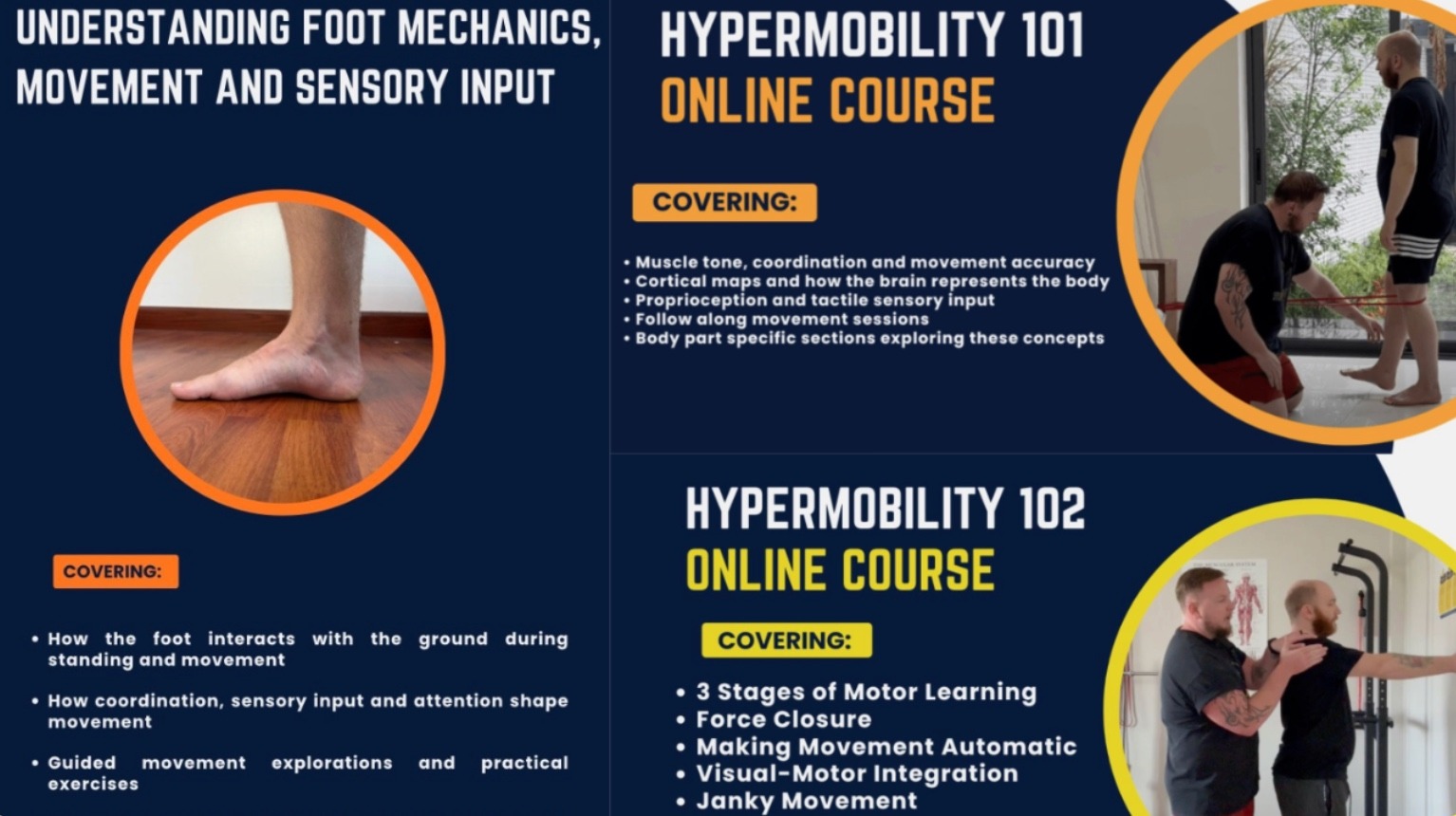
The Hypermobility Fundamentals Bundle is a structured education and movement pathway that starts at the bottom and builds upwards, grounded in motor learning and sensory motor science. Designed for people with hypermobility and persistent pain, it focuses on how strength and stability are organised and learned by the nervous system, beginning with the feet and progressing through sensory input, coordination, and motor learning. The courses are intended to be completed in sequence, with each one establishing the concepts and skills needed for the next.
— The Fibro Guy Team —