

- Hypermobile hip exercises we use, and why clamshells aren’t one of them - 17 October 2026
- Is Fibromyalgia a Disability in the UK, and Can You Claim PIP? - 14 October 2026
- Fibromyalgia and Central Sensitisation, What Is It in Plain English? - 8 October 2026
There’s a grief that sits underneath chronic pain that most clinicians don’t name, most partners don’t fully see, and most people living with it don’t have a word for. It’s not depression, exactly. It’s not bereavement. It doesn’t follow the five stages. It doesn’t end.
If you’ve come here from the main guide looking for the piece about the emotional layer of all this, then you probably already know what we’re talking about. The grief that flares again every time your body fails you in a new way. The creeping sense that the person you were before your diagnosis has become a stranger. The way your relationship with your own sexuality has shifted, quietly and without anyone asking how you feel about it.
This post covers the psychological and identity layer that sits underneath chronic pain and intimacy. Specifically: what the research actually says about chronic sorrow, identity loss, changes to how you see yourself as a sexual person, the depression and pain connection, and the medication side effects your prescriber probably hasn’t mentioned. It also covers what the therapy evidence actually looks like, without pretending there’s a simple fix.
We’re not going to tell you that you’ve got this. We are going to tell you that the things you’re feeling are real, well documented, and a lot more studied than the average GP appointment would suggest.
The grief that doesn’t fit the grief models
The grief framework most people know, the one with the five stages, was built around bereavement. It was designed for a loss with an endpoint: someone dies, and over time, you adjust. The implicit promise is that grief resolves. You move through it.
Chronic illness doesn’t work like that. The losses it generates don’t have endpoints. Your body doesn’t stay stable long enough to grieve one thing before something else shifts. Every flare brings another round of it, every comparison with who you were before, every thing you can’t do that you used to be able to, starts the whole process again.
There’s a concept in the clinical literature called biographical disruption [1], developed to describe what happens when chronic illness fundamentally disturbs the structures of a person’s everyday life. Not just the practical structures, though those get disrupted too. The ontological ones. The sense of who you are, what your body does, what you can expect from the future. Chronic illness doesn’t just inconvenience the self, it interrupts the whole story you’ve been living.
Alongside that, there’s the concept of loss of self [2]. People living with serious chronic illness describe something beyond role disruption. They describe feeling that the person they used to be has gone. That illness has made them into someone they don’t recognise. The line “I’m just a shadow of who I used to be” isn’t self-pity, it’s a fairly accurate description of a documented process. Long COVID research found exactly this: persistent symptoms caused people to lose the biographical resources they needed to maintain a coherent sense of who they were, and that this became a continuous, demanding piece of work rather than a stage they passed through [3].
When it comes to intimacy and sexuality specifically, this matters. Your sense of yourself as a sexual person is part of that biographical self. Its disruption isn’t a symptom management problem. It’s an identity level loss, and it deserves to be named as one.
Chronic sorrow and why it keeps coming back
Chronic sorrow was first described in 1962, which means it’s been a recognised concept for over sixty years. It was originally observed in parents of disabled children, and later developed into a formal theory that applies across populations living with progressive or ongoing illness and disability [4].
The key thing that distinguishes chronic sorrow from ordinary grief is that the losses driving it are what the theory calls nonfinite. They don’t resolve. They recur. Every time your symptoms worsen, every time you miss something that mattered, every time you look at your body and see what pain has done to it, the grief fires again. You’re not back at square one exactly, but you’re not finished with it either.
The theory also makes a distinction that’s clinically important: chronic sorrow is different from depression. It’s directly linked to specific, recurring losses. It doesn’t respond to antidepressants the way depression does. And it’s a normal response to an abnormal set of circumstances. The grief is proportionate. The circumstances are the problem, not the emotional response to them.
The reason it often goes unrecognised is that it lacks the social scaffolding we give to bereavement. There’s no funeral, no condolence cards, no culturally understood period of mourning. Chronic sorrow is what the literature calls disenfranchised: the wider world doesn’t see it as grief, so it doesn’t acknowledge it as grief, so the person experiencing it is left grieving without the language or the permission to do so.
One r/cfs community member put it this way: “After a decade of battling this relentless illness, I feel as though it has robbed me of my vitality.” That’s not catastrophising. That’s chronic sorrow, accurately named.
The body that has stopped feeling like yours
Body image in chronic illness is a bit of a separate thread from the grief and identity disruption, though they’re tangled together in practice. Chronic pain and hypermobility related changes, the visible and invisible ones, affect how people see themselves physically, and that has a direct effect on sexuality.
The qualitative literature on fibromyalgia and sexuality found that disrupted body image and altered identity as a sexual being were consistent themes across multiple studies [5]. People describe body changes from medications, from inability to exercise, from the visible effects of conditions they’d spent years trying to hide. Weight shifts. Skin changes. The way a body looks when it’s been in pain for a long time.
When it comes to body monitoring during sexual activity, there’s a specific mechanism worth knowing about: spectatoring. Instead of being present during sex, people find themselves watching their own performance from outside, monitoring whether their body is behaving correctly, waiting for something to go wrong. It’s the opposite of what allows desire and arousal to build. It maintains a kind of vigilance that the nervous system interprets as threat, which then makes the whole thing harder.
This isn’t a personality quirk. It’s a predictable response to having a body that has, repeatedly and unpredictably, caused pain or embarrassment in intimate contexts. The nervous system has learned to watch. Unlearning that takes time and, often, specific work. (The therapy section below covers what that work looks like.)
One person in the Long COVID community wrote: “If you’re dealing with this too, you’re not broken. Your body is exhausted.” That distinction matters. Not broken. Exhausted. The body hasn’t betrayed you by being malfunctioning. It’s responding to genuinely difficult circumstances.
The sexual self before, and the one you’re rebuilding
There’s a concept in psychology called sexual self-schema, which is basically the cognitive representation of yourself as a sexual being, a set of beliefs you hold about your own sexuality, your attractiveness, your function, what you’re like as a partner. It’s usually reasonably stable. Chronic illness tends to alter it.
Ready to work through this with structure and support?
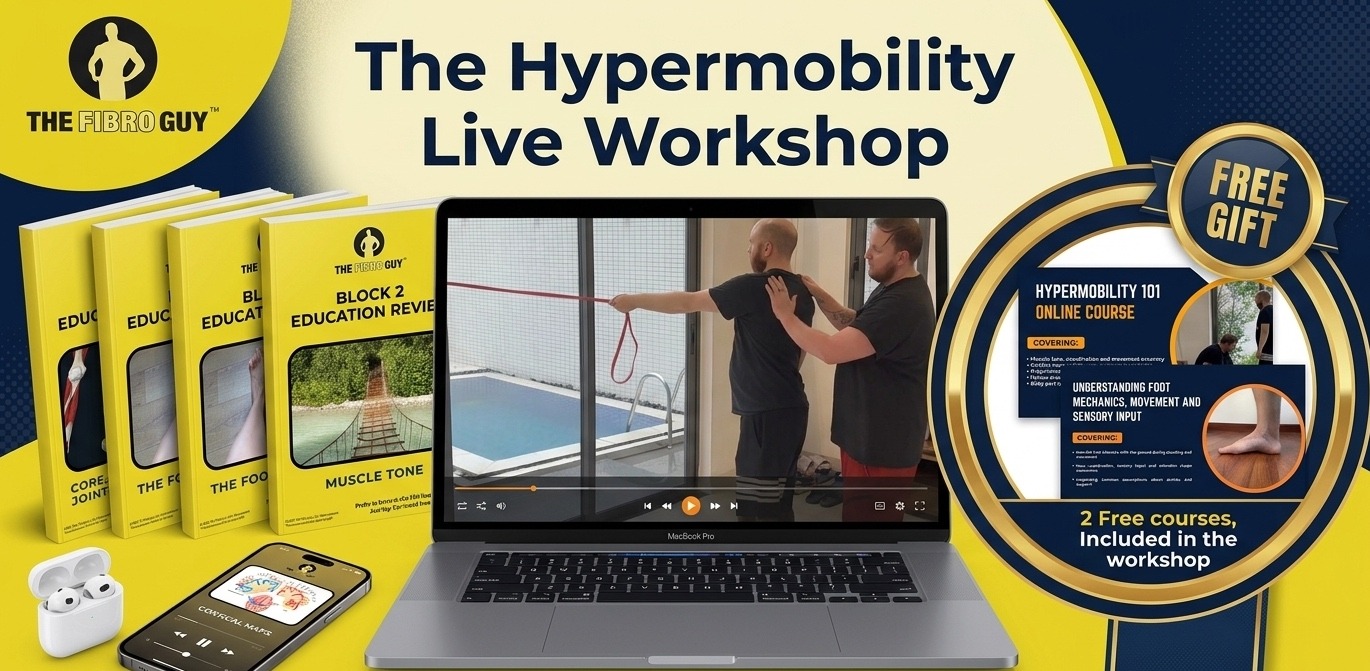
The Hypermobility Live Workshop is four weeks of breaking down the frameworks we use in our studios, with live Q&A so you can ask about your specific situation. Two free courses are included.
Research in cancer and chronic illness populations consistently shows that illness and its treatment change sexual self-schema [6]. The particular effects include: reduced identification as a sexual person, more body monitoring during sex, avoidance of sexual situations, less initiation. These aren’t simply emotional reactions to pain. They reflect a fundamental change in self-concept.
Sexual shame functions as both a cause and a maintaining mechanism here [6]. When the way you see yourself as a sexual being has been disrupted by illness, shame can settle into the gaps and make things worse. The belief that you’re no longer desirable, that sex is too complicated to be worth trying, that a partner would be better off with someone whose body works differently. These beliefs feel like self-assessment. They’re often, at root, a set of internalisations about what a body is supposed to do.
The part that takes the most work to sit with is this: the sexual self you had before your diagnosis isn’t coming back exactly as it was. That’s a real loss. It’s worth grieving. The one you’re rebuilding, which may be slower, more deliberate, more negotiated, more honest about what works and what doesn’t, is a different thing. Not lesser, necessarily. But different, and it takes time to get there.
When the depression is doing the work (and when the pain is)
Depression and chronic pain co-occur at rates that should be in the mainstream conversation far more than they are. A 2025 systematic review and meta-analysis pooling 376 studies and over 347,000 people with chronic pain found clinically significant depression symptoms in about 39 percent and anxiety symptoms in about 40 percent, with fibromyalgia samples hitting 54 percent for depression and 55 percent for anxiety [7]. These aren’t separate problems sitting next to each other. They share neurological pathways, they amplify each other, and they both independently affect sexual desire and function.
Depression reduces libido through a few mechanisms. Reduced dopamine signalling affects reward and motivation, so the things that used to feel good don’t produce the same pull. Anhedonia, the clinical term for reduced capacity for pleasure, affects everything that depends on being able to anticipate enjoyment. Fatigue does the rest.
The clinical picture that emerges from the research is a bit more complicated than “depression kills the sex drive.” One study tracking sexual satisfaction in 134 people with chronic pain found that pain severity, antidepressant use, marital status, and perceived partner support were the unique predictors of sexual satisfaction, with depression and anxiety showing high prevalence but not emerging as independent drivers in the full model [8]. Pain severity remained an independent predictor. So did antidepressant use. Which brings us to the next section.
What this means in practice is that treating the depression, while clearly important, may not fully address sexual function if pain is severe and medications are contributing. All three threads need to be on the table at the same time. They rarely are.
The medication conversation nobody starts: SSRIs, SNRIs, and your libido
This is the section that most prescribing appointments don’t cover.
SSRIs and SNRIs are among the most commonly prescribed medications in chronic pain. They’re used for depression, for anxiety, and in the case of SNRIs like duloxetine, directly for pain in conditions like fibromyalgia. They work for a lot of people on both fronts. They also cause sexual dysfunction in a significant proportion of people who take them, and that number is large enough that it shouldn’t be treated as a footnote.
The largest meta-analysis on this, looking at studies that purposely measured sexual functioning, found treatment-emergent sexual dysfunction ranging from around one in four to four in five people depending on the agent. Sertraline, venlafaxine, citalopram, paroxetine, and fluoxetine sat at the top end; bupropion, mirtazapine, agomelatine, moclobemide, and nefazodone showed no significant difference from placebo [9]. The specific effects include delayed or absent orgasm, reduced libido, genital numbness, and reduced arousal. These are dose dependent and vary between drugs. The Barr cohort in chronic pain found that antidepressant use was an independent predictor of lower sexual satisfaction, remaining significant even after accounting for pain severity and relationship factors [8].
There’s also a concern raised in the literature that serotonin enhancing drugs may dampen the noradrenergic and dopaminergic activity associated with romantic attraction and bonding, potentially affecting relationship quality beyond just libido [10]. This is less established than the orgasm and arousal effects, but it’s worth being aware of.
When it comes to switching agents, there’s real evidence that not all antidepressants carry the same sexual burden. Bupropion, which works through a different mechanism (noradrenergic and dopaminergic rather than serotonergic), sits at placebo levels in the meta-analytic data, well below the SSRI and SNRI range [9]. Adding it as an augmentation strategy or switching to it where clinically appropriate is something that can be discussed with a prescriber.
The reason we’re covering this in detail is simple: in chronic pain populations, where sexual function is already compromised by pain, by fatigue, by the psychological effects we’ve described above, adding medication effects on top without ever naming them is a significant clinical gap. It’s not that antidepressants shouldn’t be used. It’s that the conversation should happen. If it hasn’t, start it.
Opioid induced hypogonadism: the bit your GP didn’t mention
Long term opioid use is associated with something called opioid induced hypogonadism, which is the suppression of the hormonal axis that controls testosterone production in men and oestrogen in women. A 2020 systematic review and meta-analysis put the pooled prevalence of opioid induced hypogonadism at around 63 percent in men receiving long term opioids, with reduced cortisol and oestrogen also documented as part of the wider endocrine picture [11]. The downstream effects are predictable: reduced sexual desire, reduced arousal, function problems. In a cross sectional pilot of 750 chronic non cancer pain patients on long term opioids, around one in three reported sexual dysfunction, with men more affected than women and morphine equivalent dose correlated with severity [12].
The evidence on how common this is puts full agonist opioids (methadone in particular, alongside morphine, oxycodone, and fentanyl) as significantly more problematic than buprenorphine. In a comparative study of men on methadone or buprenorphine maintenance treatment, 65 percent of methadone patients had total testosterone below 12 nmol/L compared with 28 percent of buprenorphine patients, and methadone treated men had significantly lower total testosterone than buprenorphine treated men or age matched reference groups [13]. Buprenorphine, as a partial mu agonist, appears to suppress the hypothalamic pituitary gonadal axis less than full agonists do.
Opioid induced hypogonadism is common, frequently underreported by people taking the medication, and inadequately screened for by clinicians [11]. This is in the published literature. It’s not a fringe claim. It’s a documented side effect of long term opioid therapy that doesn’t get the same clinical attention as, say, constipation.
If you’re on long term opioids and you’ve noticed a shift in sexual desire or function, it’s worth asking your GP about hormone levels. Not because it will necessarily lead to a simple fix, but because knowing whether it’s a contributing factor changes the picture significantly. Untreated, hormonal suppression from opioids also affects bone density, mood, and cardiovascular risk, so it’s not just a sexual function issue.
Internalised ableism, and why “I should be doing better” isn’t true
There’s a pattern that shows up constantly in the chronic pain community, and it sounds something like: “no one would want me like this”, or “I’m not a real partner anymore”, or “my body is too much of a problem to be desirable”. These feel like personal assessments. They’re not, really.
Internalised ableism is the process by which people with disabilities or chronic illness absorb society’s devaluing of bodies that don’t function in expected ways, and apply it to themselves [14]. The wider culture consistently implies that health and physical capacity are prerequisites for attractiveness, desirability, and full participation in intimate relationships. People living with pain hear that message in a hundred different ways. Over time, it tends to get internalised.
In sexual contexts, this translates into some specific patterns: the belief that you’re not a desirable sexual partner; shame about requesting accommodations during sex; avoiding intimacy rather than having to explain your limitations; accepting sexual pain as inevitable when it may actually be treatable. The belief “no one would want me like this” isn’t a neutral self-observation. It’s a societal construct applied to one person’s body.
The research on internalised ableism in young disabled people identified peer connection, access to spaces where disability is ordinary, and family support as protective factors [14]. The online communities, the r/ehlersdanlos and r/cfs and r/fibromyalgia threads, are doing some of that work by making disability and chronic pain visible among people working through the same things. That’s not nothing. The queer chronic illness communities in particular seem to have a higher baseline tolerance for accommodating different bodies and different needs, which some people find more navigable than straight dating contexts.
The “I should be doing better” voice is worth examining. Better by whose standard? Compared to whom? A body that is managing a complex, often poorly understood condition, and still seeking connection and intimacy, is not failing. The framing is the problem.
The therapy that helps: ACT, CBT, mindfulness, EMDR
A brief disclaimer before this section: therapy helps. It doesn’t cure. It doesn’t resolve the grief, it doesn’t fix the medication side effects, it doesn’t change the biology of pain. What the evidence based therapies below do, and do reasonably well, is change the relationship you have with difficult thoughts and feelings, reduce the amplification that happens when pain and avoidance and psychological inflexibility layer on top of each other, and improve function and quality of life even when the underlying condition persists.
That’s not nothing. It’s also not a cure, and any approach that sells it as one should be treated with scepticism.
Cognitive Behavioural Therapy (CBT)
CBT has the most established evidence base for psychological intervention in both chronic pain and pain related sexual difficulties. When it comes to vulvodynia specifically, a randomised trial of CBT against supportive psychotherapy found that CBT produced significantly greater improvement in pain during physician examination and in sexual function from pre to post treatment, with effects well maintained at one year and significantly higher treatment satisfaction reported in the CBT arm [15]. For general chronic pain populations, internet and mobile delivered CBT shows moderate effects across depression, anxiety, general psychological distress, and physical distress, with stronger benefits documented in chronic pain than in several other chronic disease categories [16].
The relevant CBT targets for this topic are: catastrophising about pain and what it means for your identity, the avoidance cycle that develops around sexual activity, and the distorted beliefs about yourself as a partner or sexual person that have developed alongside illness. These are workable problems. Not quick, but workable.
Acceptance and Commitment Therapy (ACT)
ACT has strong and growing evidence across chronic pain populations. A 2023 three level meta-analysis of randomised trials found that, compared to control conditions, ACT improved pain acceptance with a large effect size and produced moderate improvements in pain related functioning, anxiety, and depression in people with chronic pain [17]. For fibromyalgia specifically, a 2024 systematic review and meta-analysis found ACT improved pain interference, depression, anxiety, and pain catastrophising, though effect sizes were generally modest and the evidence base remains limited in size [18].
For the broader question of whether ACT outperforms traditional CBT, a randomised controlled trial in primary care chronic pain found that both ACT and CBT produced improvements in pain interference, depression, and pain related anxiety, with no statistically significant differences between conditions on outcomes; ACT completers did report significantly higher treatment satisfaction than CBT completers [19]. The core mechanism ACT targets is psychological flexibility: the ability to hold difficult thoughts and feelings without them dictating behaviour. When it comes to the grief and identity disruption described in this post, ACT doesn’t try to replace the grief with positive thinking. It helps people act in ways consistent with their values even while carrying the grief. That’s a more honest and often more useful target than “feeling better”.
Mindfulness Based interventions
Mindfulness based approaches have a support role in the chronic pain literature. Mindfulness components within internet delivered CBT for chronic disease have been linked to reductions in physical distress in meta-analytic work [16], and mindfulness shows up as an active ingredient across several of the broader pain therapy reviews. The evidence base is less well developed than CBT or ACT for specific sexual function outcomes, but mindfulness does appear useful as an adjunct, particularly for the body monitoring and spectatoring patterns described earlier. Learning to be present in a body that has previously been a source of pain and unpredictability is a significant ask, and structured mindfulness practice is one of the more evidence supported routes to it.
One thing to say about the “have you tried mindfulness” clinic experience: being told to meditate when you’re in the middle of trying to manage the psychological impact of a serious chronic condition, without any other support, without any acknowledgement that the grief itself is real, is a particular kind of frustrating. Mindfulness as part of a broader, properly supported programme is a different proposition to “have you thought about an app?”
EMDR
Eye Movement Desensitisation and Reprocessing has established evidence in trauma populations and is being explored in chronic pain and pain related sexual distress. The specific evidence base for chronic pain and sexuality isn’t yet developed in the way CBT and ACT are. Where there’s a significant history of painful or distressing sexual experiences (and for many people with pelvic pain or vulvodynia, there is), EMDR may have a role. It’s worth asking about if trauma is part of the picture. Worth being honest about the limits of the current evidence too: it’s not where CBT and ACT are yet for this specific population, and we shouldn’t oversell it.
For anyone with hypermobility or EDS and anxiety, the existing post on hypermobility and anxiety goes into more depth on why the nervous system in hypermobility is primed for threat detection, which is directly relevant to the sexual avoidance and body monitoring patterns described above. That piece is worth reading alongside this one. And for anyone working through pain medication decisions, the post on pain medication for hypermobility and EDS covers the full range of analgesic options.
What the community has worked out about staying intact
The online communities have done some of the work that clinical spaces haven’t. People with fibromyalgia, hEDS, ME/CFS, long COVID, and a range of other conditions have been pooling what they know about working through intimacy with chronic illness, without anyone asking them to, often without any professional support at all.
A few things stand out from the lived experience research.
One: the grief is named and seen in these spaces in a way it often isn’t in clinics. “If you’re dealing with this too, you’re not broken. Your body is exhausted.” That line is from the long COVID community. The r/cfs communities have similar ones. The recognition that what’s been lost is genuinely worth grieving, and that you don’t have to perform gratitude for the remaining function, is something people tend to find significant.
Two: the redefinition of what counts as intimacy is doing real practical work. Not as a consolation prize for what’s been lost, but as an actual expansion of what people notice and value. “It doesn’t have to be penetrative, oral, or anything strictly defined. It doesn’t need to end in orgasm every time.” This comes from the r/ChronicIllness thread. It’s not a therapy technique, it’s just people telling each other what actually helped.
Three: “all of these experiences are really shaping us into exceptional partners who truly understand what matters.” That’s from a queer person with ME/CFS. It’s not a silver lining framing, not exactly. It’s a recognition that living this closely with limitation, grief, and renegotiation teaches something about what connection actually requires. That’s worth holding.
The menopause and hormonal changes post, Menopause, Perimenopause and Hypermobility, also covers some of the hormonal underpinning of sexual function changes that overlap with what’s described here, particularly around oestrogen, libido, and how hypermobility interacts with perimenopause. If hormonal changes are part of your picture, that post is relevant.
The fear of movement post, Fear of Movement in Hypermobility and EDS, covers the kinesiophobia mechanisms that directly parallel what happens when people start avoiding sexual activity out of fear of pain. The psychological pattern is essentially the same, and some of the same principles apply.
This post is part of a series. The other posts in the Chronic Pain, Relationships and Intimacy hub cover:
- Pelvic floor pain and pain during sex
- Disclosure and dating with chronic illness
- Couples communication and chronic pain
Chronic sorrow doesn’t resolve. The identity disruption that comes with chronic illness doesn’t tidy up into a neat arc. The medication side effects are real, underreported, and worth raising. The therapy options have genuine evidence behind them and genuine limits. None of this is the full story you wanted when you got sick. But it is the actual story, and these are the things that help, and that has to be enough to start with.
References
- Bury, M. (1982). Chronic illness as biographical disruption. Sociology of Health and Illness, 4(2), 167-182. doi: 10.1111/1467-9566.ep11339939
- Charmaz, K. (1983). Loss of self: a fundamental form of suffering in the chronically ill. Sociology of Health and Illness, 5(2), 168-195. doi: 10.1111/1467-9566.ep10491512
- Fang, C., Baz, S.A., Sheard, L., and Carpentieri, J.D. (2024). ‘I am just a shadow of who I used to be’: Exploring existential loss of identity among people living with chronic conditions of Long COVID. Sociology of Health and Illness, 46(1), 59-77. doi: 10.1111/1467-9566.13690
- Eakes, G.G., Burke, M.L., and Hainsworth, M.A. (1998). Middle-range theory of chronic sorrow. Journal of Nursing Scholarship, 30(2), 179-184. doi: 10.1111/j.1547-5069.1998.tb01276.x
- Granero-Molina, J., Jiménez-Lasserrotte, M.M., Dobarrio-Sanz, I., Correa-Casado, M., Ramos-Rodríguez, C., and Romero-Alcalá, P. (2023). Sexuality in women with fibromyalgia syndrome: a metasynthesis of qualitative studies. Healthcare, 11(20), 2762. doi: 10.3390/healthcare11202762
- Graziani, C., and Chivers, M.L. (2024). Sexual shame and women’s sexual functioning. Sexes, 5(4), 739-757. doi: 10.3390/sexes5040047
- Aaron, R.V., Ravyts, S.G., Carnahan, N.D., Bhattiprolu, K., Harte, N., McCaulley, C.C., Vitalicia, L., Rogers, A.B., Wegener, S.T., and Dudeney, J. (2025). Prevalence of depression and anxiety among adults with chronic pain: a systematic review and meta-analysis. JAMA Network Open, 8(3), e250268. doi: 10.1001/jamanetworkopen.2025.0268
- Barr, A., Moore, K., Flegge, L.G., Atsaphanthong, E., Kirby, K.E., and Craner, J.R. (2024). Predictors of sexual satisfaction among patients with chronic pain. Frontiers in Pain Research, 5, 1375546. doi: 10.3389/fpain.2024.1375546
- Serretti, A., and Chiesa, A. (2009). Treatment-emergent sexual dysfunction related to antidepressants: a meta-analysis. Journal of Clinical Psychopharmacology, 29(3), 259-266. doi: 10.1097/JCP.0b013e3181a5233f
- Fisher, H.E., and Thomson, J.A. (2007). Lust, romance, attachment: do the side effects of serotonin enhancing antidepressants jeopardize romantic love, marriage, and fertility? In S.M. Platek and T.K. Shackelford (eds), Evolutionary Cognitive Neuroscience. MIT Press.
- de Vries, F., Bruin, M., Lobatto, D.J., Dekkers, O.M., Schoones, J.W., van Furth, W.R., Pereira, A.M., Karavitaki, N., Biermasz, N.R., and Zamanipoor Najafabadi, A.H. (2020). Opioids and their endocrine effects: a systematic review and meta-analysis. Journal of Clinical Endocrinology and Metabolism, 105(4), 1020-1029. doi: 10.1210/clinem/dgz022
- Ajo, R., Segura, A., Inda, M.M., Planelles, B., Martínez, L., Ferrández, G., Sánchez, A., Margarit, C., and Peiró, A.M. (2016). Opioids increase sexual dysfunction in patients with non-cancer pain. Journal of Sexual Medicine, 13(9), 1377-1386. doi: 10.1016/j.jsxm.2016.07.003
- Hallinan, R., Byrne, A., Agho, K., McMahon, C.G., Tynan, P., and Attia, J. (2009). Hypogonadism in men receiving methadone and buprenorphine maintenance treatment. International Journal of Andrology, 32(2), 131-139. doi: 10.1111/j.1365-2605.2007.00824.x
- Jóhannsdóttir, Á., Egilson, S.Þ., and Haraldsdóttir, F. (2022). Implications of internalised ableism for the health and wellbeing of disabled young people. Sociology of Health and Illness, 44(2), 360-376. doi: 10.1111/1467-9566.13425
- Masheb, R.M., Kerns, R.D., Lozano, C., Minkin, M.J., and Richman, S. (2009). A randomized clinical trial for women with vulvodynia: cognitive-behavioral therapy vs. supportive psychotherapy. Pain, 141(1-2), 31-40. doi: 10.1016/j.pain.2008.09.031
- Tao, T.J., Lim, T.K., Yeung, E.T.F., Liu, H., Shris, P.B., Ma, L.K.Y., Lee, T.M.C., and Hou, W.K. (2023). Internet-based and mobile-based cognitive behavioral therapy for chronic diseases: a systematic review and meta-analysis. npj Digital Medicine, 6(1), 80. doi: 10.1038/s41746-023-00809-8
- Lai, L., Liu, Y., McCracken, L.M., Li, Y., and Ren, Z. (2023). The efficacy of acceptance and commitment therapy for chronic pain: a three-level meta-analysis and a trial sequential analysis of randomized controlled trials. Behaviour Research and Therapy, 165, 104308. doi: 10.1016/j.brat.2023.104308
- Eastwood, F., and Godfrey, E. (2024). The efficacy, acceptability and safety of acceptance and commitment therapy for fibromyalgia: a systematic review and meta-analysis. British Journal of Pain, 18(3), 243-256. doi: 10.1177/20494637231221451
- Wetherell, J.L., Afari, N., Rutledge, T., Sorrell, J.T., Stoddard, J.A., Petkus, A.J., Solomon, B.C., Lehman, D.H., Liu, L., Lang, A.J., and Atkinson, H.J. (2011). A randomized, controlled trial of acceptance and commitment therapy and cognitive-behavioral therapy for chronic pain. Pain, 152(9), 2098-2107. doi: 10.1016/j.pain.2011.05.016
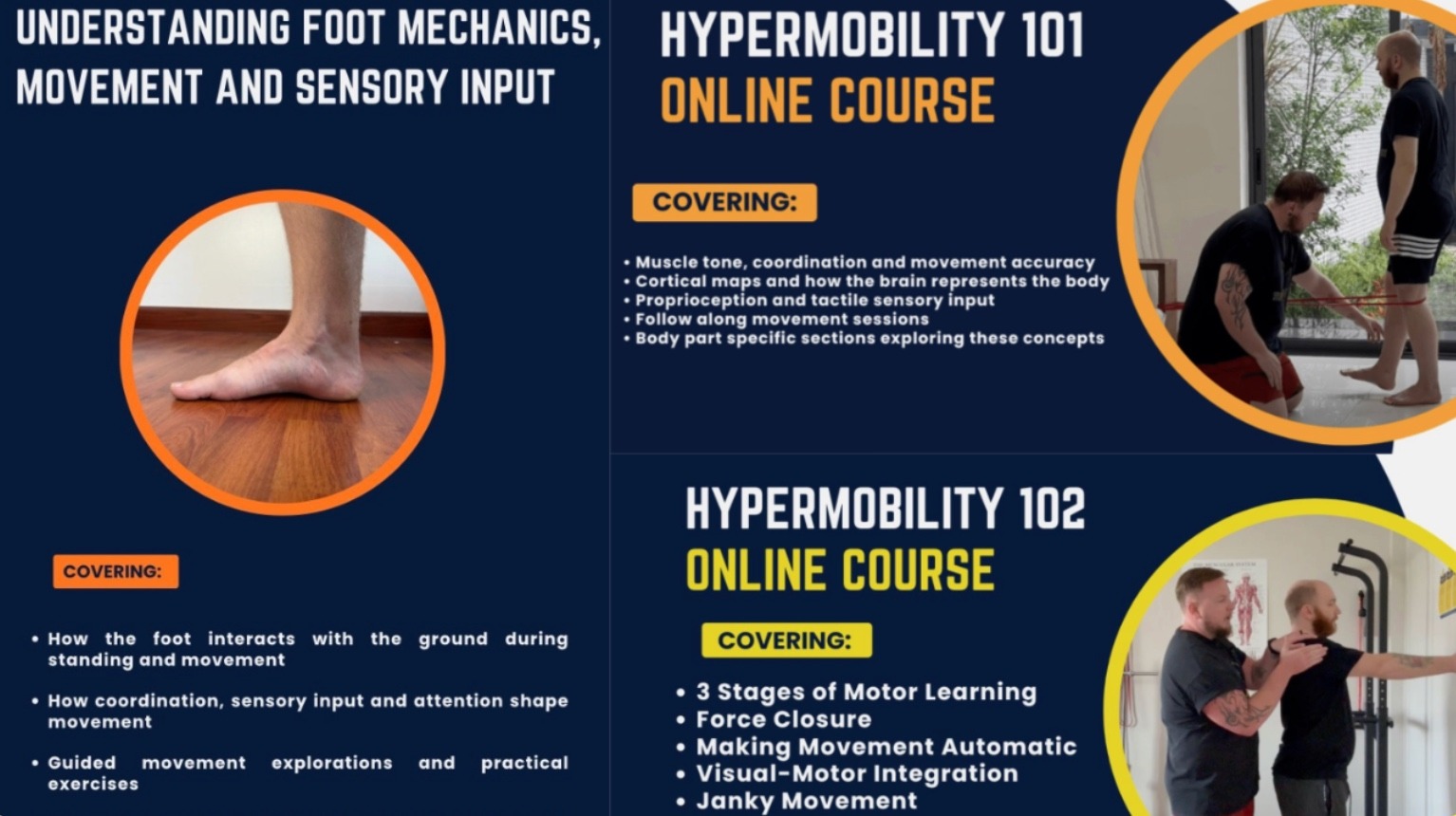
The Hypermobility Fundamentals Bundle
The Hypermobility Fundamentals Bundle is a structured education and movement pathway that starts at the bottom and builds upwards, grounded in motor learning and sensory motor science. Designed for people with hypermobility and persistent pain, it focuses on how strength and stability are organised and learned by the nervous system, beginning with the feet and progressing through sensory input, coordination, and motor learning. The courses are intended to be completed in sequence, with each one establishing the concepts and skills needed for the next.
— The Fibro Guy Team —