

If you have hypermobility, you’ve probably been told two things that don’t seem to fit together.
The first is that you have “low muscle tone”. Floppy. Loose. Not enough. The second you’ve worked out for yourself, because your shoulders creep up your ears, your jaw clenches at three in the morning, and your back aches at the end of a day where you didn’t even do anything. Your muscles feel constantly switched on. Tight. Tense. Overworked.
So which is it? Floppy or tight?
The honest answer is both. At the same time. And once you understand how muscle tone actually works, that stops being a contradiction and starts being the most important clinical insight you’ll get this year, because it changes what you’re meant to be doing in the gym, in your rehab programme, and in your daily life.
This post is about why both things are true, why traditional “just get stronger” advice keeps missing for so many of those with hypermobility, and what the research actually shows works instead. It’s not short. The good ones rarely are. But by the end of it, when it comes to making sense of why your body feels the way it does, you should have a mental model that holds up: a clear picture of what your nervous system is doing, why it’s doing it, and what to ask of it instead.
What this post does not cover: it’s not a programme. It’s not a list of exercises. We’ll get into how the principles translate into training in a separate post, and the specifics live inside our courses and workshops. Today is the why. Once the why clicks, the what makes a lot more sense.
So if you’re ready to actually understand why your body feels the way it does, let’s go.
What People Mean By “Tone”
When someone says “muscle tone” in a clinical setting, they tend to lump everything into one fuzzy idea. In reality tone has a couple of distinct components, and the one that’s usually causing problems for those with hypermobility is not the one you’ve been told about.
In standard clinical physiology, tone is usually broken into two parts. Passive tone, which comes from the tissue itself. And active tone, which is the ongoing nervous system activity that keeps your muscles ready to do something. Some authors then add a third, more functional category, which captures something the first two don’t quite cover on their own. We’ll call that one readiness tone, borrowing from the Soviet neurophysiologist Nikolai Bernstein, who across his mid twentieth century work described tone not as simple stiffness but as a state of readiness for movement. That framing has held up surprisingly well.
Right. Three flavours of tone. Let’s pull each one apart.
Passive Tone: The Tissue Itself
Passive tone is the resting tension in your muscles and connective tissue when you’re not actively doing anything. Lie down completely relaxed and what’s left is passive tone. It comes from the physical properties of the tissue. Stiffness, elasticity, how much resistance the tissue gives when you stretch it.
Think of it as the tautness of an elastic band sitting on the table. The band hasn’t pulled itself tight. Its just got tension built into the material.
In hypermobility, passive tone is often genuinely lower. The connective tissue is more compliant. It stretches further before it pushes back. Joints can move through bigger ranges, end feel is mushier, and there’s less mechanical restraint at the extremes of movement. Some of those with hypermobility describe the resting state as feeling “looser” or less supported, and what they’re describing is, more or less, lower passive tone.
This is the bit clinicians usually mean when they say someone has “low tone”. And as a description of one slice of the picture, it’s fair enough. The problem is when “low tone” gets used as a complete explanation, because it isn’t. It’s a third of the explanation. There’s a lot more going on.
Active Tone: What Your Nervous System Is Doing
Active tone is the ongoing background activity your nervous system generates to keep your body upright, stable, and ready to move. It’s not a property of the tissue. It’s controlled by the brain and spinal cord, and the muscles fire whether you’re paying attention or not.
Now, this is where things get interesting.
In a body without hypermobility, the connective tissue gives the joint a fair amount of mechanical restraint. The brain knows it doesn’t need to ask the muscles to do all the holding. So active tone sits at a moderate level, ready to respond, but not on red alert.
In hypermobility, that mechanical restraint is reduced. The connective tissue isn’t pushing back as much. The brain notices. And the brain isn’t daft, it doesn’t shrug and let the joint flop around. It compensates. It turns up the muscle activity to create the stability the connective tissue isn’t providing on its own.
So in many of those with hypermobility, active tone is actually higher than you’d expect in certain tasks and postures. Not lower. Higher.
That’s exactly what shows up in the research. Greenwood and colleagues in 2011 ran a small pilot comparing pain free hypermobile people with nonhypermobile controls during simple postural tasks like quiet standing and one leg standing [1]. They were looking at electromyography, the signal you can record from the surface of a muscle that tells you how active it is. What they found was interesting. The hypermobile group used different muscle activation patterns, and they showed significantly more co contraction between the rectus femoris and semitendinosus, a knee flexor extensor pair, during quiet standing than the control group. Co contraction is when the muscles on both sides of a joint switch on at the same time, gripping the joint between them. The picture wasn’t simply more bracing everywhere, the control group actually showed higher erector spinae activity in the hardest task, and the hypermobile group had more semitendinosus activity overall. The specific finding was a knee co contraction pattern, not a global gripping strategy.
That’s a small study. Eight people in each group. Pilot data. Nobody’s pretending it settles the question on its own. But the direction of the finding fits exactly what you’d predict from the mechanics. If the connective tissue isn’t holding the joint, the muscles will.
Junge and colleagues in 2015 found a similar story in children. They tested 25 ten to fifteen year olds with generalised joint hypermobility against 29 children without, all doing a single leg hop landing test [2]. Before landing, the hypermobile children had 39% higher co contraction between the vastus lateralis and the lateral gastrocnemius than the non hypermobile children. They also had 33% lower semitendinosus (hamstring) activity and 32% higher medial gastrocnemius (calf) activity, suggesting they’d shifted their landing strategy onto a different set of muscles. Landing distance was the same. But the way the nervous system was organising the landing was different. The authors framed the main finding as a gastrocnemius medialis dominated strategy before landing, plausibly driven by reduced semitendinosus activity, and they flagged the reduced semitendinosus pre and post activation as a potential ACL injury risk factor. More gripping with the calf, less of the usual hamstring deceleration.
So the active tone story isn’t theoretical. It’s been measured, in adults and in kids, in different tasks, by different research groups, and the pattern is consistent. The hypermobile nervous system braces.
That extra neural drive, that constant low grade gripping, is what feels like tightness, guarding, tension. The shoulders that creep up your ears. The jaw that clenches at night. The lower back that aches by mid afternoon. That’s not your muscles being short. That’s your brain holding on, because it’s not confident the joints will hold themselves.
It’s a logical response. But it has a cost. Fatigue, discomfort, and the very specific frustration of being tight in a body that’s supposed to be flexible. When it comes to lived experience, this is the bit those with hypermobility describe most often, and the bit conventional advice tends to skip past entirely, because it doesn’t fit the simple low tone narrative.
Readiness Tone: The One That Actually Matters
Right, so we’ve got passive tone, which is genuinely a bit lower in hypermobility. And active tone, which often runs higher because the nervous system is compensating. Both real, both measurable, both partial.
The third one is the one I really want you to get. It isn’t a standard textbook category alongside passive and active. It’s a functional concept. Bernstein’s idea of tone as readiness for movement.
Readiness tone is your ability to quickly generate the right amount of force, in the right muscles, at the right time, and then modulate that force as conditions change. It’s not about how tense you are at rest. It’s not even about how hard you can push in a single max effort. It’s about how efficiently your nervous system can switch muscles on and off in response to what’s happening.
Can you catch yourself when you stumble? Can you grade your grip so you hold a cup without crushing it or dropping it? Can you maintain a steady contraction for the length of time the task requires, without everything in the room having to switch on at once?
In hypermobility, this is what’s genuinely impaired. Not the amount of muscle you have. Not even, in many cases, how strong you are in raw force terms. But how well your nervous system can recruit muscles selectively, with the right timing, and sustain that control under varied conditions.
And that distinction is the bit that changes everything. Because it shifts the conversation from “you need bigger muscles” to “you need better coordination”. Different problem, different solution.
The Weakness That Isn’t About Muscle Size
Here’s where the picture gets more interesting, and where a lot of conventional advice falls down.
A lot of those with hypermobility notice genuine weakness. Things that should feel easy take more effort. Grip gives out sooner than expected. Legs fatigue quickly. Holding a posture for any length of time turns into a project. It can feel, very strongly, like the muscles just aren’t working properly.
The instinct, both for the person and often for their clinician, is to say: build more muscle. The problem is a lack of muscle mass. Lift heavier things, the muscles will grow, the problem will go away.
But the research tells a more nuanced story.
Rombaut and colleagues in 2012 ran a careful study comparing forty three women with the hypermobility type of Ehlers-Danlos syndrome to 43 sex and age matched healthy controls [3]. They measured muscle strength using isokinetic dynamometry, which is about as objective as muscle testing gets. They measured muscle endurance, posture maintenance time, the chair rise test, all the standard functional measures. And they measured muscle mass using DXA scans.
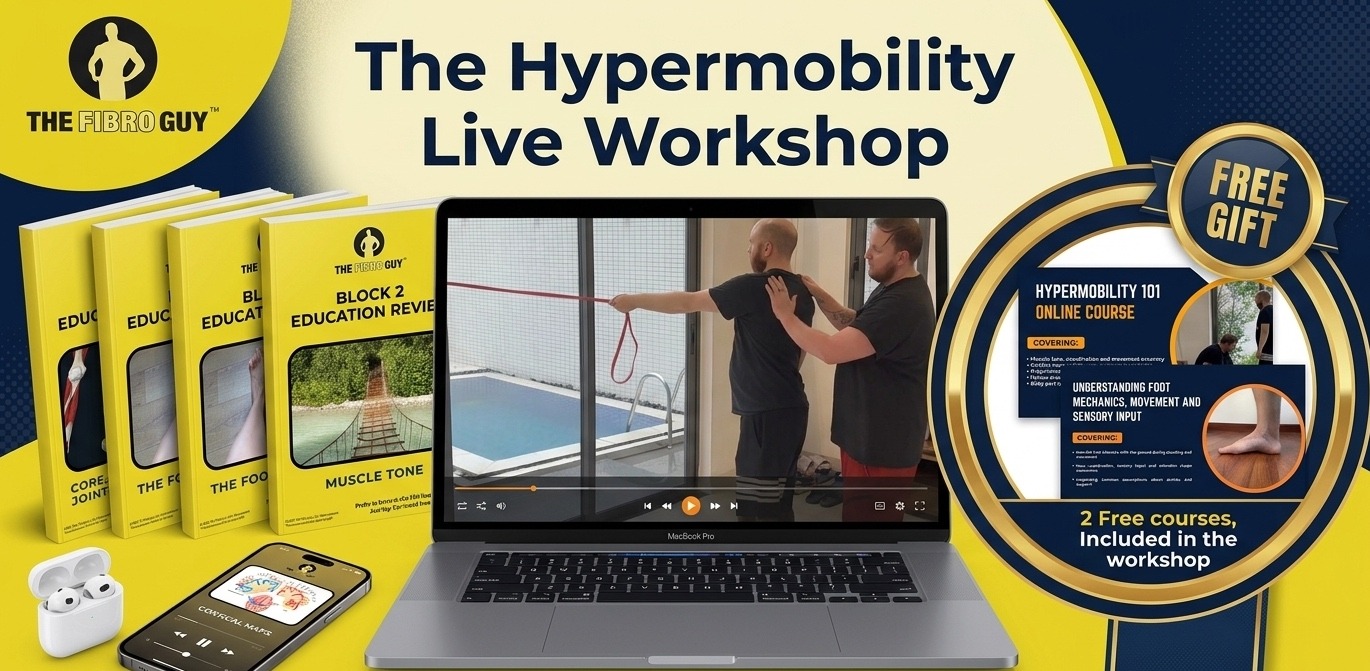
Ready to work through this with structure and support?
The Hypermobility Live Workshop is four weeks of breaking down the frameworks we use in our studios, with live Q&A so you can ask about your specific situation. Two free courses are included.
What they found was striking. The hEDS group had substantially reduced muscle strength. Knee extensor and flexor strength and endurance were significantly lower, with differences ranging from 30 to 49% compared to the controls. That’s a big effect.
But here’s the bit that matters: lower extremity muscle mass was similar between the two groups. The muscles themselves weren’t visibly smaller on the scan. The authors concluded the weakness was likely due to muscle dysfunction rather than reduced muscle mass.
That finding got further support from Coussens and colleagues in 2021 [4], who followed thirty women with hEDS / HSD and seventeen controls over an eight year period. Maximal muscle strength and strength endurance were significantly lower in the hEDS / HSD group at both the baseline and the follow up assessment compared to controls. The muscle imaging picture across the literature isn’t fully settled, and different research groups using different imaging techniques have reported slightly different findings on muscle size in hEDS specifically.
But the consistent finding across multiple studies is that muscle size on its own doesn’t explain the size of the force deficit. The muscles are there. They’re roughly the size they should be. They’re just not producing the force you’d expect for that size.
That points you towards a muscle dysfunction problem, not a muscle volume problem. The mechanism most likely sits at the interface between the muscle and the connective tissue around it, the extracellular matrix that transmits force from the muscle fibres out through the tendon and surrounding fascia. In hEDS that matrix is built from altered collagen, so the force a muscle generates may not transmit cleanly through the surrounding tissue into the joint. Neural coordination almost certainly plays a part too, the timing and selectivity of recruitment matters, but the primary mechanism Rombaut’s group flagged was force transmission through the connective tissue, not pure neural recruitment. A 2022 study of muscle density and mass in hEDS and HSD versus controls didn’t find significant group differences, so the picture is still being built out, the strength gap is real but the explanation for it is more layered than a simple wiring problem.
Scheper and colleagues in 2017 sharpened this further [5]. They studied 24 EDS-HT patients and 24 controls, looking at the relationship between muscle strength, proprioception, and activity limitations. They found that muscle strength was associated with activity limitations, as you’d expect. But proprioception confounded that association for some of the activity measures, the 30 second chair rise test and the Health Assessment Questionnaire, though not for the 6 minute walk test. In plain English: for some of the things hEDS patients struggle with day to day, the relationship between how much force you can produce and how much real life activity you can manage gets distorted by how good your sense of where the joint is. The sensory side of the equation matters as much as the strength side for those tasks. The authors concluded that controlling strength on the basis of proprioceptive input may matter more than just building strength on its own.
The implication is something the conventional advice rarely admits. If the problem were purely about muscle size, then yes, the answer would be to grow the muscles. But it isn’t purely that. The nervous system can’t use force it can’t aim. And aim depends on knowing where you are.
That’s why, for a lot of those with hypermobility, the “just get stronger” approach feels like pushing against a wall. You’re loading more onto a system that hasn’t yet learned to coordinate what it already has. You can have the strongest quads in the room and still feel your knee buckle, because the buckling isn’t about quad force, it’s about the timing and selectivity of how the brain uses the quad.
Why Movement Can Feel Genuinely Effortful
Stop me if you’ve heard this one. Walking should be automatic. Standing should be automatic. Reaching for a cup should not require a planning meeting between your shoulder, your elbow, and your wrist. And yet, for a lot of those with hypermobility, it kind of does.
That experience is real. And it makes sense neurologically.
When joint position sense is slightly less accurate, the brain has to pay more attention to movement. Instead of running mostly on automatic, you find yourself consciously thinking about how you’re moving. That takes energy. It increases effort. And it’s tiring in a specific way that’s hard to explain to someone whose body just gets on with it.
Some of those with hypermobility describe it as feeling like they have to “control” their body more than other people do. That description is mechanically accurate. If the maps are slightly fuzzy, the system compensates with extra muscle activity and increased attention. Over the course of a day, that compounds. By the evening you feel wrecked, even though, on paper, you didn’t do all that much.
This is also why standard exercise advice can feel disproportionately hard. A non hypermobile person doing a set of squats burns through one budget, the muscular budget. A hypermobile person doing the same set burns through two budgets, the muscular one and the attentional control one. Same exercise, different cognitive load.
When it comes to working out why you feel so tired all the time, this is one of the bits that doesn’t usually get mentioned. It’s not laziness. It’s not a tolerance problem. It’s the actual physiological cost of a nervous system that’s been working harder than the textbook movement curriculum assumes.
What Doesn’t Work, And Why
Right, so if all of that is true, what does the rehab world actually offer?
The most common piece of advice those with hypermobility get is some version of “you just need to get stronger”. On the surface, it makes sense. You feel weak, your joints feel unstable, surely the answer is more strength. And nobody is saying strength training is bad. It absolutely has a place.
But applied as the whole answer, it misses the actual problem. The issue, as we’ve covered, isn’t that the muscles are too small or too weak in a raw force sense. The issue is neural. The brain isn’t using the muscles it has in a coordinated, efficient way.
Random stretching is the other go to recommendation, and that one is more problematic. The tension you’re feeling isn’t primarily coming from short, tight muscles. It’s coming from neural compensation. The nervous system is gripping because it doesn’t trust the joint. Stretching that tension away is, more or less, removing the guardrails on a wobbly bridge. The stiffness is doing a job. Take it away without giving the system a better strategy and the brain will either rebuild the bracing within a few days, or it will cope without it and the joint pays the price.
That’s not me saying stretching is always wrong. Targeted, considered work for specific tissues that genuinely need length can have a place. But when it comes to the whole body, daily, “I just need to stretch this out” approach that a lot of those with hypermobility get told to do, that approach is rarely solving anything because it’s treating a symptom (the gripping) without changing the reason for the symptom (the brain not trusting the joint). We’ve written a longer piece on this if you want the full version: stretching and hypermobility / EDS, a beginner’s guide.
Isolated strength training, then. Can it grow muscle? Yes. Nobody’s disputing that. But growing the muscle doesn’t necessarily fix how the brain uses it. You can build a thicker quadriceps and still have a knee that gives way, because thickness isn’t the variable that controls the giveaway. Coordination, timing, and sensory feedback are.
This is exactly what Scheper’s group found. Muscle strength was associated with activity, but for tasks like the chair rise test and the daily living questionnaire, proprioception confounded the association. If the sensory side is unreliable, all the strength in the world won’t fully solve the problem on its own.
There’s also the inconvenient truth that traditional strength programmes were developed on populations whose nervous systems do trust their joints. The exercises assume the brain will recruit the right muscles in the right order at the right time. In hypermobility, that assumption is not always safe. Without the underlying coordination work, a strength programme can end up reinforcing the bracing pattern. You’re getting stronger at gripping, not stronger at moving.
What Actually Does Help
Now, the good news. There is a growing body of evidence on what actually moves the needle, and the pattern is quite consistent. It points towards training the nervous system, not just the muscles.
Proprioceptive training is the most consistently supported intervention across the wider movement science literature. Winter, Huang, Sertic and Konczak in 2022 published a major systematic review covering 70 studies of proprioceptive training across many populations [6]. The headline numbers are striking. On average, proprioceptive training led to a 46% improvement in proprioceptive function and a 45% improvement in motor performance. The two went hand in hand. The training that worked best involved active movement tasks where the brain had to pay attention to where the joints were, not passive stretching, not just lifting heavy.
That review wasn’t specific to hypermobility, and that’s a fair caveat. It looked at clinical and healthy populations across a lot of different conditions. But the principle holds, and it lines up with everything we see in our work with those with hypermobility. When the nervous system gets clearer information about where the joint is, the way it controls that joint changes.
Sensorimotor training shows the same logic in action. Moutzouri and colleagues in 2019 ran a controlled clinical trial in 52 patients undergoing total knee replacement, comparing early home based sensorimotor training against standard functional exercise [7]. The sensorimotor group ended up with significantly better quadriceps peak force, better quadriceps activation, and bigger rectus femoris cross sectional area than the control group. That last bit is the interesting one. Their muscles were bigger. The sensory training, the coordination training, the work on giving the brain clearer information, ended up driving more strength and more growth than the strength focused control. The sensory side wasn’t a nice to have. It was the lever.
Now, that study was on knee replacement patients, not hEDS, so the population is different. But the mechanistic point is the same: improving how the brain organises movement can produce improvements in the muscles themselves, on top of all the other benefits.
Closer to home, Celletti and colleagues in 2021 specifically tested a neurocognitive rehabilitation approach in 18 hEDS patients with chronic low back pain [8]. Instead of a standard strengthening programme, they focused on training the brain’s ability to organise movement. After three months, the group showed significant improvements in pain (numerical rating scale and McGill total score), fatigue, fear of movement, and pain associated disability. It’s a small, non randomised study, and the authors are appropriately cautious about it, but the direction is consistent with everything else we’re seeing. Train the nervous system, function improves.
van Meulenbroek and colleagues in 2020 took it a step wider [9]. They followed 14 hypermobile adolescents through a multidisciplinary rehab programme that combined physical training with exposure based work on pain related fear. Functional disability dropped by 67%. Motor performance, muscle strength, perceived harmfulness of movement, and pain intensity all improved significantly. Again, small numbers, no control group, and they say so. But the principle is the same: addressing the nervous system’s response to the body, not just hammering the muscles harder, gets results.
Pull all of this together and the message is reasonably clear. It’s not that strength doesn’t matter, it does. But strength without sensory accuracy, without the brain being able to coordinate and control the movement properly, is fuel for the same chaotic engine. You need to fix the engine first. Or, more precisely, you need to upgrade the engine’s wiring while you also build its fuel reserves. The two go together. They’re not in competition.
Building Genuine Readiness Tone: The Three Ingredients
So what does training for readiness tone actually look like in practice? Across the research, three ingredients show up repeatedly when people make real progress.
1. Clear sensory input first. Maps before tone.
The brain can’t control what it can’t feel. Before you can build lasting tone, the nervous system needs reliable information about where the joint is and what it’s doing. If the maps are blurry, everything you build on top of them will be unreliable. The brain will keep defaulting to co contraction, because co contraction is what you do when you can’t tell where things are.
This is why the cortical maps work and the tactile cue work that runs through the early stages of our courses isn’t warm up busywork. It’s laying the sensory foundation that everything else depends on. We’ve covered this in more depth on the blog if you want a longer read: KT tape for hypermobility and Ehlers Danlos syndrome is a good entry point on tactile cueing, and internal tibial rotation exercises for hypermobility walks through what map first training looks like at the knee.
2. Graded, meaningful movement practice.
Not “do 3 sets of 10 and we’ll see you next week”. The nervous system learns from repeated, controlled, varied movement practice where sensory feedback actually matters. And the nature of that practice matters more than most people realise.
Here’s where Bernstein’s framework becomes useful again. He observed that when the brain is learning a new movement, it first “freezes” excess degrees of freedom. It locks everything down with co contraction. Everything switches on at once. That’s the rigid early stage of skill acquisition, and it’s exactly what a hypermobile body looks like trying to learn a new movement: stiff, gripped, joints all locked, breath held.
Then, as control improves, the brain “frees” those degrees of freedom. It allows the joints to move more independently. It shifts from gripping to grading. From clenching to flowing.
That progression from rigid to fluid is what building readiness tone actually looks like. It is not about bracing harder. It’s about the nervous system becoming confident enough to relax its grip.
Variable practice matters too. Same exercise, different speed. Different load. Different surface. Different context. Your nervous system doesn’t live its life on a perfectly stable gym floor doing perfectly identical reps. It needs practice handling variety. Doing the same thing the same way every time produces good performance in that exact scenario and not a lot of transfer to anything else.
We’ve also got a longer piece specifically on hypermobility core exercises that actually work, and a piece on hypermobility knee instability exercises, if you want to see what graded, sensory rich practice actually looks like at specific joints.
3. Time and consistency, not intensity.
This is neural adaptation, not muscle hypertrophy. The timescale is different. You’re not tearing muscle fibres and waiting for them to rebuild bigger. You’re training neural pathways to become more efficient. That takes consistent, repeated practice over weeks and months, not heroic one off efforts.
Some of the proprioceptive training research shows improvements within a single session, which is encouraging. But meaningful, lasting changes to how the nervous system controls movement need sustained practice. Think less like building a wall, more like wearing a path through a field. Each time you walk it, the path gets a little clearer. Stop for too long and the grass starts growing back.
So consistency beats intensity. Regular, moderate practice where you’re paying attention to what you feel will outperform occasional brutal sessions where you’re grinding through reps with the form falling apart. Always. There’s no version of hypermobility rehab where smashing yourself once a week beats a sensible thirty minutes most days.
The Wobbly Bridge
Let’s bring all of that back to a single image, because it makes the whole picture click.
Picture a wobbly bridge. The surface underneath you is unpredictable. You don’t know which step is going to give. So what do you do? You grip. You brace. Your shoulders pull up. Your jaw clenches. Your back tenses. You step gingerly, with everything switched on, just in case.
That’s co contraction. That’s the bracing strategy your hypermobile nervous system has been running, possibly for years, because the joints underneath have been giving it unreliable information.
The instinct, for most people and most rehab programmes, is to try to grip harder. Get stronger. Brace more. Lift heavier weights. Do more planks. The logic being that if you’re already gripping, more grip will make the bridge feel safer.
But that’s just more co contraction. And co contraction is exhausting. It’s the reason you feel wrecked after seemingly nothing. It’s the reason your muscles ache without you having been to the gym. Gripping harder on a wobbly bridge does not make the bridge less wobbly. It just tires you out faster.
The goal isn’t to grip harder. The goal is to make the bridge less wobbly.
And that is what well designed training does. When the brain has clearer maps, better sensory input, and more practice controlling movement under varied conditions, the bridge feels steadier. Not because the laxity has gone away, it hasn’t. The connective tissue is what it is. But the nervous system has better information and better strategies for dealing with it. The signals that used to be unreliable are now sharper. The reactions that used to need conscious thought start happening automatically again.
When the bridge feels steadier, the nervous system doesn’t need to brace as hard. The co contraction can start to reduce, not because you forced it to relax, but because it no longer needs to compensate as aggressively. And that is when you start to feel genuinely stable, rather than just exhausted from holding on.
That’s what building readiness tone actually means. Not more tension. Better control. The same body, run by a calmer nervous system that finally trusts the joints it’s been bracing against for years.
Maps and Tone: How They Connect
There’s one more bit worth pulling out, because it explains the order of operations in a good rehab programme and why so many of those with hypermobility get nowhere with bog standard gym work.
Map clarity is how precisely you can connect to and control your joints. It’s the resolution of your control. Can your brain tell the difference between “tighten everything around the knee” and “activate this specific portion of the quad at this specific moment”? That’s map precision. It depends on the quality of sensory information getting to the brain.
Tone, particularly readiness tone, is how long you can sustain that precise control before the system fatigues, starts compensating, or reverts back to old bracing habits. Maps determine the precision. Tone determines the endurance of the precision.
And the order matters. You need the map clarity first. There’s no point trying to build endurance of control if the control itself is vague. It’s like practicing a piano piece when you can’t feel which keys you’re pressing. You’ll get faster at hitting wrong notes. You won’t get better at playing the song.
This is why the first phase of any sensible hypermobility rehab is sensory work. Tactile cues. Slow, deliberate movement under attention. Map sharpening before load. Once the maps are clearer, the nervous system has decent information to base its decisions on. It can start to relax some of the excessive guarding. It can begin to trust the joints a bit more. From there, you can build genuine, sustainable tone, the kind that comes from confident, well organised neural control rather than fear driven bracing.
For a longer take on what fearful, guarded movement actually looks like and why it’s so common in hypermobility, the fear of movement in hypermobility and EDS post is worth a read. And if you want to see what the underlying chronic pain mechanisms look like in plain English, what causes chronic pain in fibromyalgia and hypermobility covers a lot of the ground.
What This Means For The Way You Train
Pull all of it together and a few things follow.
First, when it comes to measuring progress, stop using weight on the bar or reps on the clock as your only metric. Those things are real, but they’re outputs of a system, not the system itself. Watch instead for the texture of how movement feels. Less effortful. Less attention required. Less aching the day after for no obvious reason. Joints that feel like they belong to you rather than something you’re chaperoning around.
Second, expect the early stages to feel boring. Map work is, on the surface, deeply unsexy. It looks like nothing. You’re pressing into a surface, you’re feeling the floor under your foot, you’re noticing where your knee tracks. There’s no Instagram clip in it. But that work is what makes the strength work later actually pay off. Skip it and you’re back to gripping the bridge.
Third, drop the assumption that more is better. Hypermobility responds to graded, frequent, varied practice with attention. Not to occasional savage sessions. The body has been doing its best with the information it had, for years. Give it better information, give it consistent practice, give it a bit of time, and the whole way it organises itself starts to shift.
Fourth, give up on the “you just need to be stronger” framing. Strength is necessary and not sufficient. Necessary, because nobody is rehabbing complex bodies on tea and biscuits. Not sufficient, because force without coordination just gives you more fuel for the same chaotic engine.
Fifth, and this is the bit nobody tells you: the goal isn’t to stop being hypermobile. You won’t. The goal is for your nervous system to get better at managing the body it has. As that happens, the bracing reduces. The fatigue eases. The tension that’s been baked into your neck and shoulders for years starts to back off. Not because you forced it to, but because the system stopped needing it.
That’s what efficient stability looks like. Not rigidity. Not bracing. A calmer, more confident nervous system that trusts its own joints a little more each week.
For practical day to day applications across specific joints, we’ve got a few related pieces that fit nicely with this one: hypermobile flat feet, hypermobility rib subluxation, TMJ exercises for hypermobile jaws, and the broader hypermobility and exercise: part 1 that walks through the principles in a slightly different angle.
What Actually Settles In Time
Be honest about what we know and what we don’t. The research on muscle tone in hypermobility is growing, but it’s nowhere near settled. Sample sizes in the hEDS specific work are often small. Different research groups use slightly different definitions and measures. Mechanisms aren’t fully understood. Individual experiences vary enormously.
But the consistent finding across the studies that exist is that many of the functional difficulties those with hypermobility experience, the fatigue, the apparent weakness, the constant tension, the effort, are not purely about muscle or connective tissue, they involve how the nervous system organises movement, and that, when it comes to where you can actually intervene, is the bit that gives you most leverage, because nervous systems are built to learn whereas tissues are not.
If you’ve been told your muscles are “too weak” or you have “low tone” and felt like that didn’t quite capture the full picture, you were right. The picture is more nuanced. “More nuanced” also means “more options for improvement”, though, which is the encouraging bit.
You’re working with a nervous system that has been doing its best with the information it had. Now you can give it better information, better options, and a structured path to build the kind of control that lasts. Your muscles aren’t the problem. The way your nervous system is using them is the opportunity.
Where To Go Next
If this post helped pieces click into place, the work that follows is in the studios and the courses. The core programmes we run are built around exactly the principles in this post. Map clarity first, then graded coordination work, then load. We’ve got a deeper hypermobility cluster on the blog if you want more reading first: is hypermobility linked to autism, does EDS get worse as you age, hypermobility and anxiety, and Ehlers-Danlos syndrome symptoms all link in different directions from here.
A separate post is coming on motor learning, which picks up where this one finishes and gets into how exactly the nervous system rewires itself when you give it the right kind of practice. That’s the bit that turns understanding into results.
For now, the takeaway. Your muscles are not the problem. The way your nervous system is using them is the opportunity. And that’s exactly what we’re here to work on.
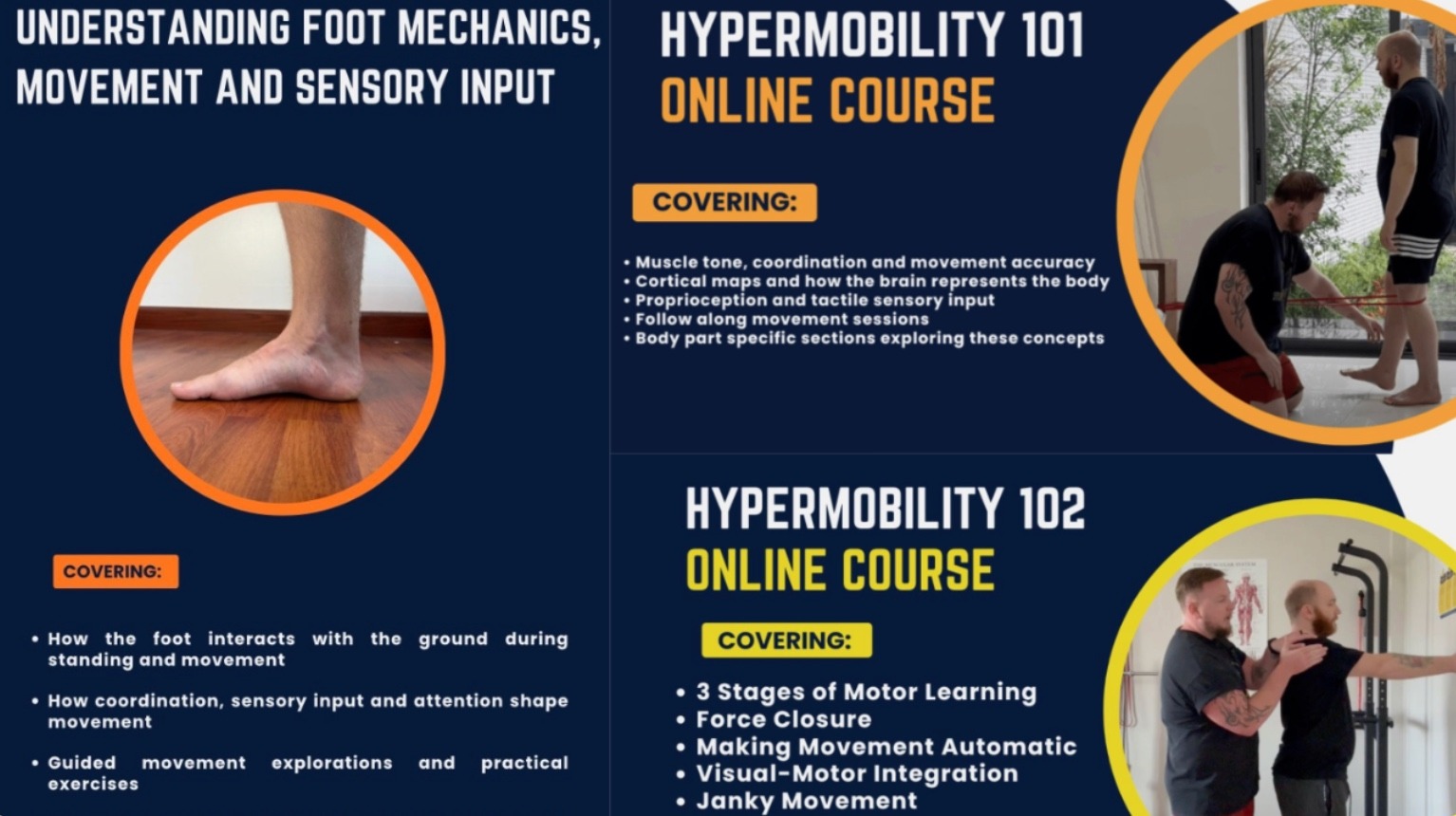
The Hypermobility Fundamentals Bundle
The Hypermobility Fundamentals Bundle is a structured education and movement pathway that starts at the bottom and builds upwards, grounded in motor learning and sensory motor science. Designed for people with hypermobility and persistent pain, it focuses on how strength and stability are organised and learned by the nervous system, beginning with the feet and progressing through sensory input, coordination, and motor learning. The courses are intended to be completed in sequence, with each one establishing the concepts and skills needed for the next.
— The Fibro Guy Team —